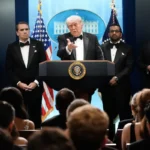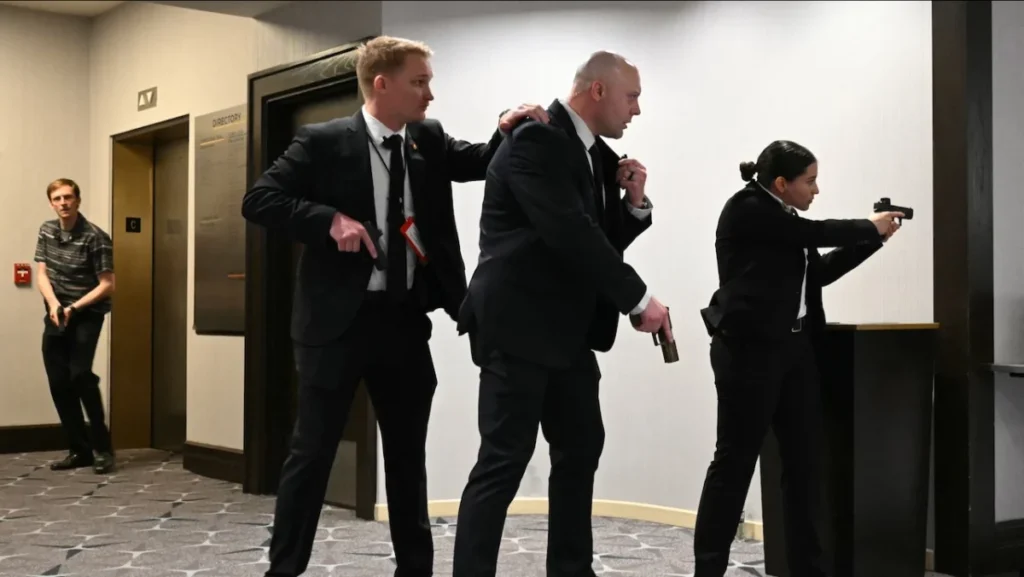

President Donald Trump and key members of his administration were swiftly evacuated from the White House Correspondents’ Dinner on the evening of April 26, 2026, following a critical security incident at the Washington Hilton hotel. The dramatic events unfolded after a member of the U.S. Secret Service engaged an active shooter in the lobby of the upscale hotel, a venue synonymous with Washington D.C.’s most prestigious annual gatherings. Reports from CNN, among other outlets, confirmed the engagement, with the assailant reportedly killed on site. President Trump was confirmed safe, a testament to the immediate and decisive action by his protective detail during what could have been a far more tragic situation. The incident plunged the normally celebratory and high-profile event into chaos, underscoring the ever-present security challenges faced by high-ranking officials and the elite forces tasked with their protection.
Unfolding Crisis at a High-Profile Event
The White House Correspondents’ Dinner, an annual gathering that brings together the President, top government officials, journalists, and celebrities, was in full swing when the tranquility of the evening was shattered. Eyewitnesses inside the main ballroom, where thousands were gathered, reported hearing muffled but distinct loud noises originating from the hotel’s lobby area. Initial confusion quickly gave way to alarm as Secret Service agents, already positioned strategically throughout the venue, moved with pre-planned precision. President Trump, who had been attending the event, was immediately secured and escorted out of the ballroom and then the hotel, as standard operating procedure dictates for any credible threat to the Commander-in-Chief. The swiftness of the evacuation, captured in a widely circulated video clip, highlighted the readiness of the presidential security detail.
Chronology of a Crisis
The evening began with the usual pomp and circumstance characteristic of the WHCD. Attendees had started arriving in the late afternoon, passing through multiple layers of security checkpoints established by the Secret Service and local law enforcement. The President and First Lady typically make their entrance later, after which the dinner, awards presentations, and the President’s traditional comedic address commence.
- Approx. 7:00 PM EDT: Attendees are largely seated in the Washington Hilton ballroom. President Trump and his entourage are present.
- Approx. 7:45 PM EDT: Reports of "loud noises" or gunfire emanate from the hotel lobby, distant from the main ballroom but close enough to trigger immediate security protocols.
- 7:46 PM EDT onwards: Secret Service agents, having identified the source of the threat, engage the shooter in the lobby. Simultaneously, the presidential protective detail initiates an immediate evacuation of President Trump and senior administration officials from the ballroom.
- Within minutes: The shooter is neutralized, confirmed killed by Secret Service. The immediate threat is contained.
- Shortly thereafter: President Trump is confirmed safe and transported to a secure location. The Washington Hilton is placed on immediate lockdown, and a thorough sweep of the premises begins.
The rapid response of the Secret Service was crucial. Their training for such scenarios, which emphasizes immediate neutralization of threats and extraction of the protectee, was demonstrably effective. The incident, while terrifying, showcased the agency’s preparedness for active shooter situations in complex environments.
The Significance of the White House Correspondents’ Dinner
The White House Correspondents’ Dinner is more than just a social event; it’s a symbolic cornerstone of American democracy, representing the often-complex relationship between the presidency and the free press. Hosted by the White House Correspondents’ Association (WHCA), it traditionally serves as an evening of both levity and seriousness, where the President often delivers a humorous speech, followed by a comedic host, and awards are given for excellence in journalism. Its history dates back to 1921, and it has grown to become one of Washington’s most anticipated annual gatherings, attracting thousands of influential figures.
The choice of the Washington Hilton as the venue for decades is also significant. Located in the heart of D.C., the hotel is accustomed to hosting high-profile events and has established security protocols. However, the open nature of its lobby, while grand, can present unique challenges for security details when an unexpected threat emerges from outside the primary secured perimeter of the main event space. The event’s high visibility and the presence of so many key figures make it an attractive, albeit heavily guarded, target for those seeking to make a political statement or cause disruption.
Secret Service Protocols and Rapid Response
The U.S. Secret Service, an agency primarily known for protecting the President and other high-ranking officials, is trained to an elite standard for situations precisely like the one that unfolded. Their operational philosophy is built on prevention, detection, and rapid response. At events such as the WHCD, security is meticulously planned months in advance, involving multiple agencies, including the Secret Service, local metropolitan police departments, and sometimes the FBI.
Layers of security are typically in place:
- Outer Perimeter: Controlled access points around the venue.
- Inner Perimeter: Screening checkpoints for all attendees, often involving metal detectors and bag searches.
- Close Protection Detail: Agents physically surrounding the President and key officials, trained for immediate extraction.
- Tactical Response Teams: Heavily armed agents strategically positioned to respond to active threats.
The engagement with the shooter in the lobby highlights the critical role of these tactical response teams and the close protection detail. The ability to identify, engage, and neutralize a threat within seconds, while simultaneously initiating a seamless evacuation, is a core competency that averted a potential catastrophe. The speed with which the shooter was reportedly killed suggests a direct and overwhelming response from trained agents.
Statements and Official Reactions
In the immediate aftermath, official statements began to emerge, aiming to reassure the public and detail the ongoing investigation.
- White House Press Secretary: A statement was quickly issued confirming President Trump’s safety and commending the "extraordinary bravery and professionalism" of the Secret Service. "The President is safe and secure," the statement read. "We are immensely grateful to the Secret Service agents who put their lives on the line to protect him and everyone at the Correspondents’ Dinner tonight."
- U.S. Secret Service: The agency released a preliminary statement acknowledging the incident. "A Secret Service agent engaged an individual identified as an active shooter in the lobby of the Washington Hilton. The individual was neutralized. All Secret Service protectees are safe. An investigation is underway in conjunction with local law enforcement." They refrained from offering further details immediately, citing the ongoing nature of the investigation.
- White House Correspondents’ Association (WHCA): The WHCA President issued a statement expressing profound relief for the safety of all attendees and deep gratitude to law enforcement. "Tonight’s events were a stark reminder of the risks faced by public servants and the vital role of the Secret Service. Our thoughts are with everyone affected, and we extend our deepest thanks to the courageous men and women who protected us all." The association also indicated it would cooperate fully with all investigations.
- Metropolitan Police Department (MPD): D.C. police confirmed their involvement in securing the scene and assisting the Secret Service. "MPD officers responded to the Washington Hilton following reports of an active shooter. The situation was brought under control by federal agents. Our department is assisting in securing the area and in the subsequent investigation."
These initial reactions underscored a unified message of gratitude for the security forces and a commitment to understanding the full scope of the incident.
Broader Impact and Implications
The incident at the White House Correspondents’ Dinner carries significant implications, both for presidential security and the nature of high-profile public events in a volatile security landscape.
- Enhanced Security Reviews: This event will undoubtedly trigger an immediate and comprehensive review of security protocols for all major public gatherings involving the President and other senior officials. Questions will be raised about how the shooter gained access to the hotel lobby, the layers of security outside the main event space, and potential vulnerabilities. This could lead to even more stringent measures, potentially impacting the accessibility and format of future events.
- Political Discourse: The attack, occurring at an event meant to foster dialogue between the press and the presidency, will likely become a point of discussion in the political arena. It may fuel debates on gun control, domestic extremism, and the constant threats faced by public figures. Depending on the shooter’s motive, once revealed, the incident could be framed within broader political narratives.
- Public Perception of Safety: For the general public, an attack at such a high-profile event can erode confidence in the safety of large gatherings, even those with heavy security. It serves as a stark reminder that no venue, however secured, is entirely immune to determined threats.
- Investigation Focus: The immediate priority for investigators will be to identify the shooter, determine their motives, and ascertain if they acted alone or as part of a larger plot. Forensic analysis of the scene, review of surveillance footage, and interviews with witnesses will be critical in piecing together the full narrative. The Secret Service, likely in conjunction with the FBI, will lead this exhaustive inquiry.
- Future of the WHCD: While the dinner is a tradition, such a severe security breach could prompt discussions about its future format, location, or even its continued existence in its current form. The symbolism of the event, meant to celebrate the First Amendment and foster a spirit of camaraderie, could be overshadowed by security concerns.
The incident at the Washington Hilton on April 26, 2026, serves as a sobering reminder of the persistent threats faced by leaders and the unyielding vigilance required by those sworn to protect them. While the immediate danger was neutralized and the President secured, the ramifications of this dramatic event will resonate throughout Washington D.C. and beyond, prompting critical reassessments of security in an increasingly unpredictable world.