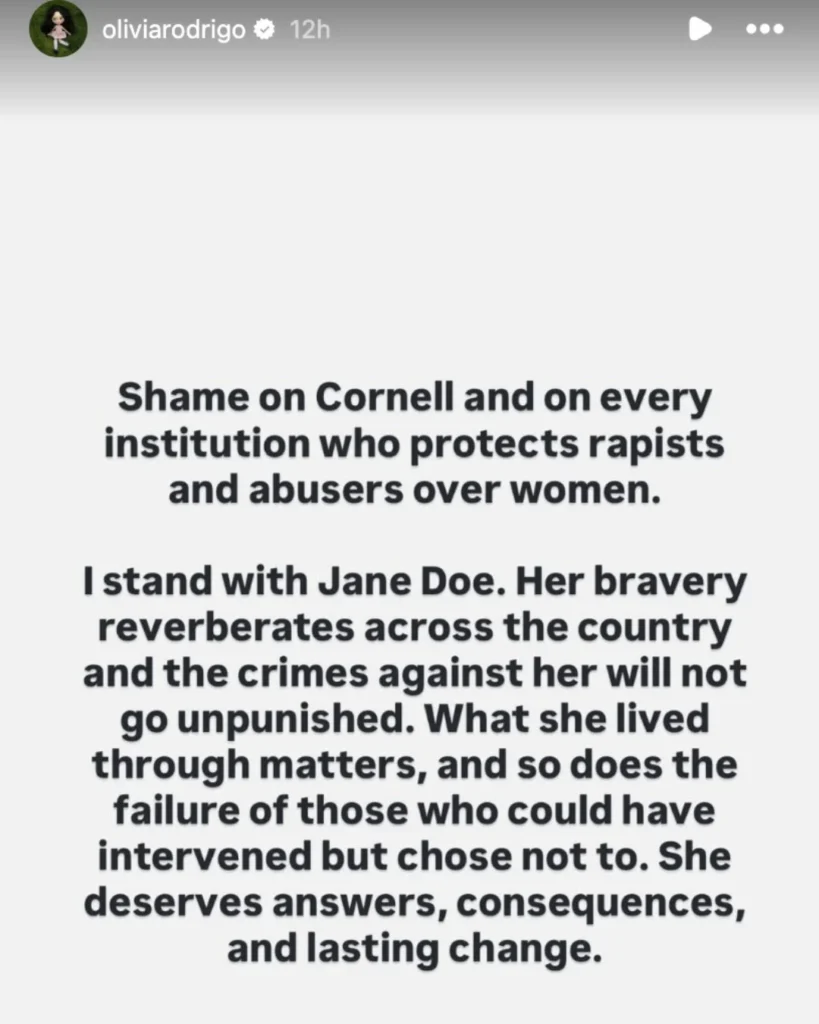

Pop superstar Olivia Rodrigo has publicly condemned Cornell University in response to a high-profile sexual assault lawsuit involving members of the school’s Chi Phi fraternity. In a forceful statement shared via her Instagram story on October 4, the Grammy-winning artist expressed her solidarity with the plaintiff, a woman identified in legal filings as “Jane Doe,” and leveled sharp criticism at the institution’s handling of sexual misconduct allegations.
The controversy centers on a civil lawsuit filed in September 2026, which alleges that the plaintiff was subjected to drugging and sexual assault by multiple members of the Chi Phi fraternity in October 2024. The gravity of these allegations has prompted an independent criminal investigation led by the office of New York Attorney General Letitia James, marking a significant escalation in the scrutiny surrounding the university’s administrative response to gender-based violence.
A Call for Institutional Accountability
In her public remarks, Rodrigo did not mince words regarding the responsibilities of academic institutions. “Shame on Cornell and on every institution who protects rapists and abusers over women,” Rodrigo wrote. “I stand with Jane Doe. Her bravery reverberates across the country and the crimes against her will not go unpunished. What she lived through matters, and so does the failure of those who could have intervened but chose not to. She deserves answers, consequences, and lasting change.”
Rodrigo’s intervention serves as a high-profile amplification of the victim’s narrative, drawing national attention to the specific legal challenges faced by survivors when navigating university disciplinary systems. By framing the issue as an institutional failure rather than an isolated criminal act, Rodrigo has reignited a broader conversation about the systemic protections often afforded to Greek life organizations on college campuses.
Chronology of the Case and Ongoing Investigations
The legal proceedings began in September 2026, when the plaintiff filed her civil suit against Cornell University and specific members of the Chi Phi fraternity. The allegations describe a harrowing sequence of events occurring in October 2024, during which the plaintiff claims to have been incapacitated by substances before being sexually assaulted.
Following the filing, the case gained rapid momentum due to the severity of the claims and the involvement of the New York Attorney General’s office. The criminal investigation, which runs parallel to the civil lawsuit, seeks to determine whether university officials had prior knowledge of misconduct patterns within the fraternity and whether those officials failed to act in accordance with Title IX mandates or state laws.
Historically, Cornell, like many Ivy League institutions, has faced intense pressure to reform its policies regarding campus safety and sexual violence. The inclusion of the Attorney General’s office suggests that the state government is treating this as a test case for institutional accountability. For the plaintiff, the legal path forward involves overcoming significant procedural hurdles, including potential motions to dismiss from the university and the complex evidentiary requirements necessary to prove negligence in a university setting.
A Growing Chorus of Public Outcry
Rodrigo is not the only prominent figure in the music industry to weigh in on the situation. Her statement follows a similarly impassioned post from Halestorm frontwoman Lzzy Hale. While Hale did not explicitly name Cornell University in her social media commentary, her remarks were widely interpreted as a direct response to the same case.
“If you are the kind of man who thinks it’s ok to reduce another human being to nothing more than something you can stick your d*ck into… there is something severely wrong with you,” Hale wrote. The convergence of voices from different corners of the music industry—ranging from pop icons like Rodrigo to hard rock staples like Hale—underscores a shift in how celebrity influence is being leveraged to advocate for victim advocacy and institutional reform.

The Landscape of Gender-Based Violence on Campus
Data regarding sexual assault on college campuses remains a sobering indicator of the scale of the problem. According to the Association of American Universities (AAU) campus climate surveys, a significant percentage of female undergraduates experience some form of nonconsensual sexual contact during their time at university. Critics argue that fraternity culture, in particular, frequently facilitates environments where alcohol consumption and lack of oversight lead to increased risks for sexual assault.
Legal experts note that cases involving universities often turn on the concept of "deliberate indifference." If a university is found to have had knowledge of a hostile environment and failed to take reasonable steps to prevent further harm, the institution can be held liable. The current case against Cornell may serve as a bellwether for future litigation, as it tests the boundaries of university responsibility for the actions of private student organizations operating on and off campus grounds.
Rodrigo’s Track Record of Advocacy
This intervention aligns with Rodrigo’s established history of political and social activism. Beyond her musical output, she has consistently used her platform to engage with issues of reproductive rights and gender equality. Notably, her "Daisy Chain Fields" festival, an all-women lineup event, successfully raised $20 million to support organizations focused on reproductive health and the mitigation of gender-based violence.
By integrating her advocacy into her public persona, Rodrigo has fostered a fanbase that expects a high degree of social consciousness from their favorite artists. Her current tour, "The Unraveled Tour," provides a massive stage to keep these issues in the public consciousness, with upcoming performances scheduled in cities across the United States through February 2027.
Institutional Implications and Future Outlook
As the investigation proceeds, Cornell University faces a pivotal moment. The school’s administration is currently balancing the need to cooperate with state authorities while defending its internal policies in civil court. The outcome of this case will likely have lasting implications for how universities manage risk, interact with fraternity systems, and support survivors of sexual assault.
For the legal team representing the plaintiff, the goal is to establish a clear link between the university’s oversight mechanisms and the events of October 2024. For the administration, the challenge lies in restoring public trust and addressing the systemic issues that allowed the alleged abuse to occur.
The involvement of high-profile figures like Rodrigo ensures that the case will remain in the public eye, preventing the university from potentially settling the matter quietly behind closed doors. In an era where institutional transparency is increasingly demanded by the public, the "Jane Doe" case represents a significant point of friction between traditional university autonomy and the modern expectation of accountability.
As the legal timeline progresses, observers are watching to see if other institutions take proactive measures to reassess their own safety protocols. The "Jane Doe" lawsuit is more than just a local legal dispute; it is a manifestation of a national cultural shift that rejects the historical patterns of silence surrounding sexual violence in elite academic environments.
Whether the result of the Attorney General’s investigation or the civil lawsuit will lead to meaningful policy changes remains to be seen. However, the intensity of the reaction from artists, students, and the general public confirms that the status quo is under unprecedented pressure. For now, the spotlight remains on the courtroom in New York, where the pursuit of justice for the survivor continues to be the primary concern of all involved parties.