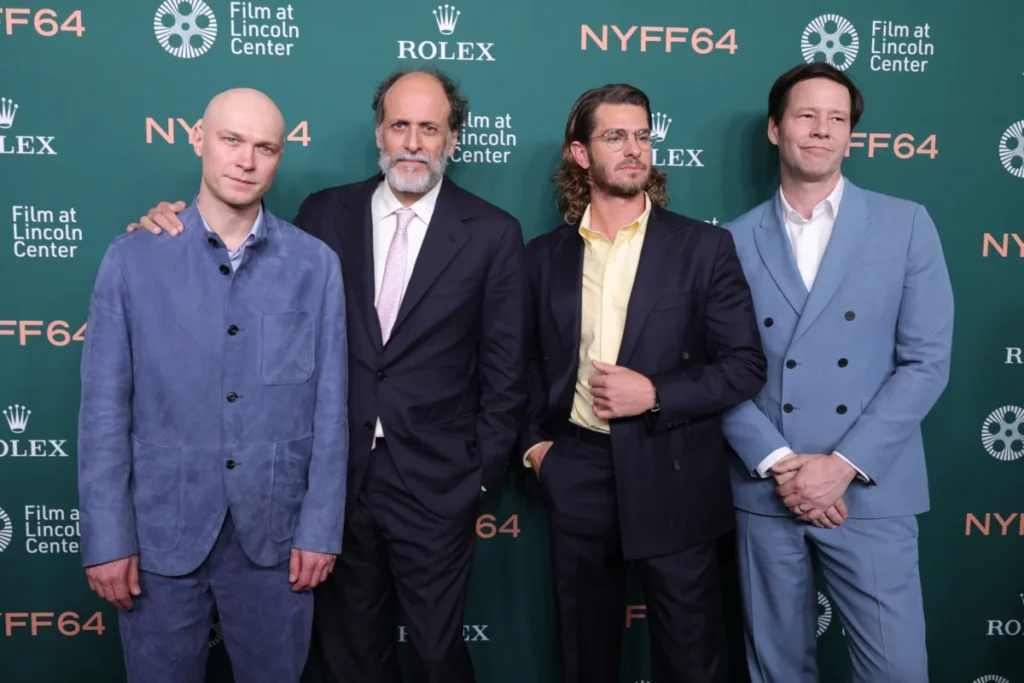

The intersection of advanced computation, multi-billion-dollar corporate maneuvers, and modern cinematic storytelling converged at the 64th New York Film Festival on Monday evening with the world premiere of Artificial. Directed by Luca Guadagnino, the feature-length drama offers a relentless, highly critical examination of the modern artificial intelligence industry, tracing its trajectory from academic laboratories in the early 2000s to the high-stakes boardroom battles of Silicon Valley. Originally backed by Amazon MGM Studios—before being dropped following the parent company’s $50 billion investment in OpenAI—the film has found a home under the distribution aegis of independent studio Neon. Scheduled for a nationwide theatrical release this Christmas, Artificial arrives as a cultural lightning rod, capturing the anxieties of a society rapidly yielding its data, autonomy, and safety infrastructure to the imperatives of rapid technological acceleration.
From Academic Roots to Commercial Ambitions
The narrative structure of Artificial operates as a chronological dissection of the large language model boom, anchoring its emotional core in the relationship between foundational computer science and hyper-capitalist expansion. The film opens in 2003 at the University of Toronto, where Ilya Sutskever—portrayed with quiet, disarming sincerity by Yura Borisov—arrives as a socially unpolished, idealistic immigrant seeking guidance from Geoffrey Hinton, widely recognized as a godfather of modern AI. Hinton, who would later share the Nobel Prize in Physics, is depicted as a well-intentioned academic whose theoretical breakthroughs unwittingly laid the groundwork for commercial exploitation.
As the narrative progresses, Sutskever follows Hinton’s professional lineage into the Bay Area. The turning point arrives in 2014 at a technology conference, where a thirty-year-old Sam Altman—portrayed by Andrew Garfield as a mercurial, deeply charismatic, and ultimately duplicitous figure—pursues Sutskever to join a nascent OpenAI as its chief science officer. What begins as a theoretical quest to develop artificial general intelligence (AGI) to benefit humanity slowly metastasizes into a race for capital accumulation and global market dominance.
The inclusion of pivotal historical figures—including Elon Musk, Greg Brockman, Dario Amodei, and Mira Murati—maps out the internal ideological fractures that plagued OpenAI during its formative years. The film details the friction between researchers who prioritized safety protocols and executives who favored rapid commercialization, culminating in the historic events of late 2022 with the public launch of ChatGPT, and the dramatic boardroom coup of November 2023.
A Star-Studded Cast Embodies Silicon Valley Royalty
Guadagnino’s film benefits from a formidable ensemble cast tasked with portraying some of the most influential and polarizing figures in contemporary technology. Rather than relying on simple hagiography or straightforward demonization, the performances aim for a complex psychological portrait of modern power dynamics.
Andrew Garfield’s portrayal of Sam Altman has already drawn significant critical attention and preemptive pushback from its subject. Garfield approaches the role not as a traditional caricature, but as an interrogation of the systemic reliance modern society places on charismatic tech leaders. In a recent interview with Vanity Fair, Altman dismissed the film’s accuracy based on promotional materials, illustrating the friction between Hollywood’s interpretation of Silicon Valley culture and the lived reality of its executives.
Yura Borisov delivers a tragic performance as Ilya Sutskever, charting the character’s agonizing realization that his scientific ideals were co-opted to build a corporate war chest. Supporting performances further enrich the canvas: Mark Rylance brings gravitas to the role of Geoffrey Hinton, serving as the moral conscience of the scientific community; Monica Barbaro navigates the enigma of Mira Murati, balancing complicity with whistleblower tendencies; and Ike Barinholtz portrays Elon Musk as an erratic, arrogant, yet initially non-threatening presence whose modern political radicalization looms retroactively over the performance.
Corporate Friction and Distribution Turmoil
The production history of Artificial is nearly as compelling as its narrative content. Amazon MGM Studios initially financed the project, only to sever ties following parent company Amazon’s landmark $50 billion investment in OpenAI. This conflict of interest underscored the pervasive influence of big tech capital within Hollywood, raising fundamental questions about the ability of major studios to finance art that directly critiques their institutional partners.
Luca Guadagnino noted during his New York Film Festival Q&A that while artificial intelligence is fundamentally rooted in mathematics and computational infrastructure, it remains a product of human interactions and systemic power imbalances. Screenwriter Simon Rich, known for his work on Saturday Night Live and with Pixar, drew inspiration for the screenplay from early conversations with a childhood friend who entered the tech industry. Rich described the project as a last-ditch effort to alert the public to the unchecked velocity of AI deployment.
Following its separation from Amazon, the film was swiftly acquired by Neon, the boutique studio responsible for the distribution of critical darlings like Anora. The studio now faces the challenge of positioning an explicitly anti-capitalist critique of Silicon Valley for an awards season audience, while navigating a rapidly shifting geopolitical and technological landscape.
Implications and the Contemporary Safety Debate
Artificial enters the cultural zeitgeist at a moment of unprecedented regulatory and ethical scrutiny surrounding artificial intelligence. The film concludes with postscripts addressing the contemporary landscape of late 2026, highlighting the exodus of safety researchers and whistleblowers—such as Jacob Coxon—who have publicly rebuked companies like OpenAI and Anthropic for prioritizing speed over institutional safeguards.
The timing of the film’s premiere coincided precisely with real-world public appearances by industry dissidents on major media programs, amplifying the sense that Artificial is less a historical period piece than an urgent, real-time warning. Programming chief Dennis Lim noted during the festival introduction that society has entered a threshold period requiring immediate critical evaluation of how technological hegemony was established.
As the industry braces for the widespread theatrical release of Artificial this December, the film serves as a definitive cultural artifact of the 2020s. By interrogating the convergence of advanced science and obscene wealth, Guadagnino and his collaborators have delivered a provocative cinematic trial of an industry that continues to reshape human autonomy, labor markets, and global infrastructure with minimal democratic oversight.