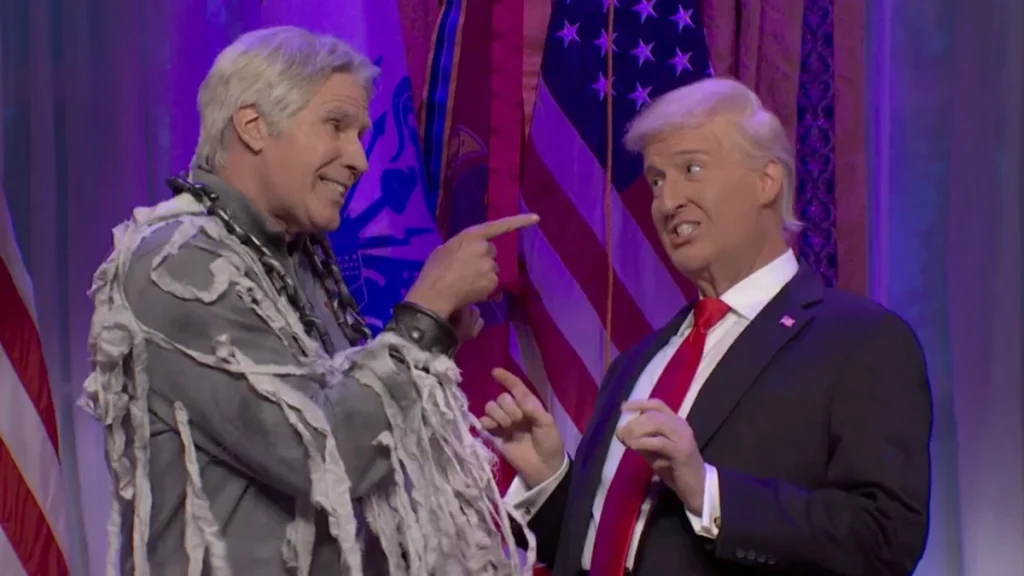

The Season 51 finale of Saturday Night Live, broadcast on May 17, 2026, delivered a cold open that immediately captured national attention, featuring a surprise appearance by former cast member Will Ferrell reprising his role as the spectral form of convicted sex offender Jeffrey Epstein. The segment depicted Epstein’s ghost visiting former President Donald Trump, portrayed by James Austin Johnson, following a fictional "whirlwind trip to China" that left the president asleep in the Oval Office. This highly anticipated comedic reunion served as a poignant, if dark, capstone to another season of political satire, leveraging both SNL’s deep bench of talent and its long-standing tradition of provocative commentary.
The Cold Open: A Spectral Visit to the Oval Office
The sketch commenced with James Austin Johnson’s Donald Trump character, known for his distinctive vocal and physical impersonation, dozing off at his desk, presumably exhausted from a strenuous international diplomatic mission. The serene quiet of the Oval Office was abruptly interrupted by the ethereal manifestation of Will Ferrell as Jeffrey Epstein. Ferrell, instantly recognizable in his portrayal, greeted Trump with a familiar, yet unsettling, intimacy. "Don’t worry, Donald, it’s me, your best friend, Jeffrey Epstein," Ferrell’s character declared, setting the tone for the macabre humor that followed.
The interaction quickly delved into a darkly comedic exploration of their alleged past connections and the enduring public fascination with Epstein’s controversial life and death. A notable moment of the sketch involved Epstein playfully, yet pointedly, declining Trump’s attempt at a high-five, stating, "You know what? This time I’m gonna leave you hanging." This line, subtle in its delivery, carried layers of implication, referencing Epstein’s mysterious death by suicide while in federal custody and the myriad conspiracy theories surrounding it, many of which involve powerful individuals attempting to distance themselves from him.
As the sketch progressed, Epstein’s spectral visit transitioned from a mere reunion into a satirical premonition. The ghost claimed to offer Trump insights into his political future six months hence, specifically referencing the standing of figures like Kristi Noem, Pete Hegseth, and Kash Patel. These individuals, all prominent in conservative media and politics, and often associated with the Trump movement, were used as touchstones for the sketch’s broader political commentary, hinting at their continued relevance or potential shifts in their influence within the conservative ecosystem.
The sketch culminated in Epstein’s chillingly delivered punchline: "But Donnie, just remember: no matter how many wars you start or how bad you tank the economy as a distraction, people will always associate you with me. And that, my dear close friend… that is a beautiful thing." This statement underscored the indelible stain of Epstein’s legacy on anyone publicly linked to him, a stark reminder of the reputational damage inherent in such associations. The scene concluded with the unlikely duo joining in a duet of Bill Withers’ classic "Just the Two of Us," a darkly ironic choice that amplified the unsettling camaraderie depicted.
A Legacy of Political Satire: SNL and Presidential Impersonations
Saturday Night Live has long served as a cultural barometer for American politics, its cold opens often setting the national conversation for the week. Since its inception in 1975, the show has consistently utilized political satire to lampoon presidents, presidential candidates, and major political figures. From Chevy Chase’s Gerald Ford to Dana Carvey’s George H.W. Bush, Darrell Hammond’s Bill Clinton, Will Ferrell’s George W. Bush, and Tina Fey’s Sarah Palin, SNL has carved a niche as both an entertainer and a political commentator.
The show’s relationship with Donald Trump, both as a celebrity and a political figure, has been particularly significant. Trump hosted SNL twice prior to his presidency, in 2004 and 2015, the latter during his initial presidential campaign. His actual presidency, however, ushered in an unprecedented era for SNL’s political humor. Alec Baldwin’s Emmy-winning portrayal of Trump became a defining feature of the show during his first term, drawing both immense viewership and considerable criticism, including from Trump himself. Following Baldwin’s departure, James Austin Johnson stepped into the role, earning praise for his uncanny vocal mimicry and nuanced physical comedy, which offered a fresh take on the former president. Johnson’s Trump, often depicted as rambling and self-absorbed, provided a consistent comedic anchor for the show’s political commentary in the post-Trump presidency era.
The decision to feature Will Ferrell as the ghost of Jeffrey Epstein tapped into SNL’s history of bringing back beloved former cast members for high-profile sketches. Ferrell, a legendary figure from the show’s late 1990s and early 2000s golden era, has a long history of iconic characters and memorable political impersonations, including George W. Bush. His return for the Season 51 finale added significant star power and cultural weight to an already charged political satire.
The Shadow of Jeffrey Epstein: A Figure of Dark Fascination
Jeffrey Epstein, a financier convicted of sex trafficking minors, died by suicide in a federal jail in August 2019 while awaiting trial on new charges. His death sparked widespread conspiracy theories and public outrage, largely fueled by the extensive network of powerful and influential individuals he had associated with, including politicians, celebrities, and business magnates. The lack of clear answers surrounding his death, coupled with the horrific nature of his crimes and the alleged complicity of his associates, cemented Epstein as a figure synonymous with elite corruption and moral decay.
For SNL to introduce Epstein as a character, even a spectral one, is a bold move that ventures into deeply sensitive and controversial territory. The comedic device of Epstein’s ghost serves as a potent metaphor for the inescapable nature of his legacy and the continued public scrutiny of those who associated with him. The line "people will always associate you with me" directly addresses the ongoing challenge for public figures, including Trump, to fully extricate themselves from the public perception of their past connections to Epstein. This satirical choice underscores how Epstein remains a cultural touchstone for discussions about accountability, privilege, and justice.
Future Predictions: Kristi Noem, Pete Hegseth, and Kash Patel
The sketch’s specific references to Kristi Noem, Pete Hegseth, and Kash Patel as indicators of Trump’s political future six months out added another layer of topicality and satirical depth.
- Kristi Noem: As the current Governor of South Dakota, Noem has been a prominent conservative voice and a staunch ally of Donald Trump. Her name has frequently been floated as a potential running mate for Trump or a future presidential candidate herself. Her recent controversies, including revelations from her memoir, have kept her in the national spotlight. The sketch’s mention of her suggests an ongoing relevance in the Republican Party’s internal dynamics.
- Pete Hegseth: A co-host on Fox News’ Fox & Friends, Hegseth is a vocal supporter of Trump and a prominent figure in conservative media. His consistent defense of Trump and his alignment with the former president’s political agenda make him a recognizable figure to the SNL audience as someone whose standing might indeed be tied to Trump’s political fortunes.
- Kash Patel: A former Trump administration official, Patel served in various roles, including as chief of staff to the acting United States Secretary of Defense. He gained prominence for his role in investigations related to the 2016 election and is a frequent commentator on conservative media, often promoting narratives favorable to Trump. His inclusion in the sketch highlights his continued presence within the Trump orbit and the broader conservative movement.
By name-checking these specific individuals, SNL subtly comments on the enduring influence of the Trump faction within the Republican Party and the conservative media landscape. The implications of Epstein’s predictions about their "standing" could range from continued ascent to potential setbacks, leaving the exact satirical meaning open to audience interpretation but firmly rooting the sketch in contemporary political realities.
Broader Impact and Ethical Considerations of Satire
The cold open of Saturday Night Live‘s Season 51 finale, featuring Will Ferrell as Jeffrey Epstein’s ghost, sparked immediate and widespread discussion across social media platforms and news outlets. The segment’s use of such a controversial figure inevitably reignited debates about the boundaries of satire and the ethics of comedic portrayal, especially when it touches upon heinous crimes and their victims.
Historically, SNL has often walked a tightrope, pushing the envelope of taste and decency in its pursuit of humor and political commentary. While some viewers applauded the sketch for its biting critique of power and the lingering questions surrounding Epstein’s connections, others expressed discomfort, arguing that the humor risked trivializing the severe nature of Epstein’s crimes and the suffering of his victims. Critics often contend that when satire employs figures like Epstein, it must do so with extreme care to avoid inadvertently normalizing or softening the gravity of their actions.
Conversely, proponents of the sketch would argue that satire’s role is precisely to confront uncomfortable truths, to shine a light on societal anxieties, and to hold powerful figures accountable, even through the lens of dark humor. The sketch, in this view, was not about making light of Epstein’s crimes but about satirizing the persistent shadow he casts over the elite, and the inability of some figures to escape association with him. The "Just the Two of Us" duet, in particular, served as a stark, unsettling commentary on the alleged symbiotic relationships within certain powerful circles.
The immediate online reaction to the sketch, evidenced by the viral spread of clips and discussion threads, confirmed SNL’s continued relevance as a cultural touchstone. Viewership data for the Season 51 finale would likely indicate a spike during the cold open, a testament to the drawing power of high-stakes political satire and the return of a beloved cast member. The sketch successfully generated conversation, fulfilling one of satire’s primary functions: to provoke thought and discussion, even if that discussion includes debate over its own appropriateness.
In conclusion, the Saturday Night Live Season 51 finale’s cold open was more than just a comedic sketch; it was a potent piece of cultural commentary. By intertwining the figures of Donald Trump and Jeffrey Epstein through the unexpected return of Will Ferrell, SNL delivered a memorable and provocative segment that spoke to enduring political narratives, the complexities of public association, and the indelible nature of certain controversial legacies. It underscored the show’s ongoing commitment to pushing boundaries and its unique position in the landscape of American political discourse.