
For millennia, the human impulse to map the known universe has found its most profound expression in the globe—a three-dimensional representation that offers the viewer the perspective of a deity, encompassing the entirety of the world or the heavens in a single, evocative glance. These spherical objects have transcended their original roles as utilitarian tools for tactical planning, maritime navigation, and mercantile trade to become some of the most coveted items in the realms of interior design and fine art collecting. From the ancient halls of Roman sculpture to the modernist retreats of Palm Springs and the high-fashion ateliers of Paris, the globe remains a singular symbol of intellectual curiosity, worldliness, and aesthetic refinement.
The Genesis of the Sphere: Ancient Origins and Celestial Beginnings
While the modern observer often associates globes primarily with the mapping of continents and oceans, the earliest iterations were focused upward toward the stars. The oldest known representation of a globe is found in a Roman sculpture dating back to the second century: the Farnese Atlas. This marble masterpiece depicts the Titan Atlas holding a celestial globe upon his shoulders, intricately carved with the constellations known to the Greco-Roman world. During this era, celestial globes were essential instruments for astronomers and astrologers, used to track the movement of stars and planets long before the terrestrial world had been fully explored or documented.
The transition from celestial to terrestrial mapping was a slow evolution dictated by the limits of human exploration. It was not until the late 15th century, a period defined by the Age of Discovery, that the earth began to take a spherical shape in the workshops of European cartographers. In the 1490s, coinciding with Christopher Columbus’s first expedition to the Americas, Germany became the birthplace of the oldest surviving terrestrial globe. Created by Martin Behaim in Nuremberg in 1492, the Erdapfel (literally "Earth Apple") represents the state of geographical knowledge just before the "New World" was integrated into European consciousness.
The construction of these early globes was a feat of meticulous craftsmanship. Master cartographers would paint delicate illustrations of continents—often based on speculative accounts and ancient maps—onto paper. These paper strips, known as "gores," were then painstakingly applied to a wood core wrapped in linen. The final product was typically housed in an iron or brass stand, often featuring a meridian ring to allow for rotation and measurement. During this period, globes were almost exclusively the province of royalty and the highest echelons of the clergy, frequently displayed in pairs: one terrestrial to represent the dominion of man, and one celestial to represent the dominion of God.

The Golden Age of Cartography and the Merchant Class
By the 16th and 17th centuries, the production of globes shifted from the Mediterranean and Germany to the Low Countries and later to England. The Dutch Golden Age saw the rise of legendary cartographic houses, such as those of Willem Blaeu and Jodocus Hondius. This era marked a significant shift in the social utility of the globe. As global trade routes expanded, the globe trickled down from royal courts to the studies of wealthy merchants and the captains of the great East India companies.
For these individuals, the globe was both a practical necessity and a status symbol. It was used to plot the trajectories of spice-laden ships and to visualize the vast distances of the colonial enterprise. By the 1800s, the globe had undergone a further democratization, becoming a staple of the "landed gentleman’s" library in Victorian Britain. No longer just a tool for sailors, it became an educational icon, signifying that the owner was a person of letters, aware of the geopolitical shifts of the British Empire and the scientific advancements of the Industrial Revolution.
A Multifaceted Object: Geography, Furniture, and Symbolism
The enduring appeal of the globe lies in its unique ability to exist in multiple categories simultaneously. George Glazer, a prominent New York-based gallery owner and specialist in antique globes, emphasizes this multifunctionality as the core of the object’s allure. "It’s a piece of furniture, it’s geography and astronomy, it’s a symbol, it’s a decorative arts object," Glazer notes. This intersection of science and art ensures that globes remain relevant even in an age where digital mapping has rendered physical cartography obsolete for practical navigation.
From a design perspective, globes offer a rare sculptural quality. Unlike flat maps, which require wall space and framing, a globe occupies three-dimensional space, inviting interaction. The tactile experience of spinning the sphere allows a viewer to travel across oceans and borders in seconds, fostering a sense of "poetic exploration," as described by contemporary French designer Julien Sebban.
The Globe in Modernist and High-Society Design
The 20th century saw the globe reimagined through the lens of modernism and celebrity culture. In the mid-century desert modernism of Palm Springs, architect Albert Frey utilized the globe as a minimalist statement piece. In his renowned Frey House II, an illuminated globe served as one of the few decorative flourishes in a home defined by its integration with the rugged California landscape. In this context, the globe suggested a global perspective that transcended the isolation of the desert.

The globe has also been a fixture in the homes of cultural icons, often carrying with it a sense of history and provenance. A famous example is the Victorian globe that belonged to the legendary ballet dancer Rudolf Nureyev. In the September 1985 issue of Architectural Digest, Nureyev was photographed lounging in his Paris apartment alongside the ornate piece. The image left a lasting impression on the design world, specifically on AD100 designer Stephen Sills. When the globe eventually went to auction at Christie’s following Nureyev’s death, Sills acquired it for his own home in Bedford, New York, illustrating how these objects often carry the legacy of their previous owners.
In the contemporary era, luxury brands continue to innovate within the medium. Hermès, for instance, has produced celestial globes crafted from printed leather, blending the house’s heritage in leatherwork with the ancient tradition of star mapping. These modern iterations prove that the globe remains a canvas for luxury and artistic expression.
The Hidden World: The Evolution of the "Secret Bar" Globe
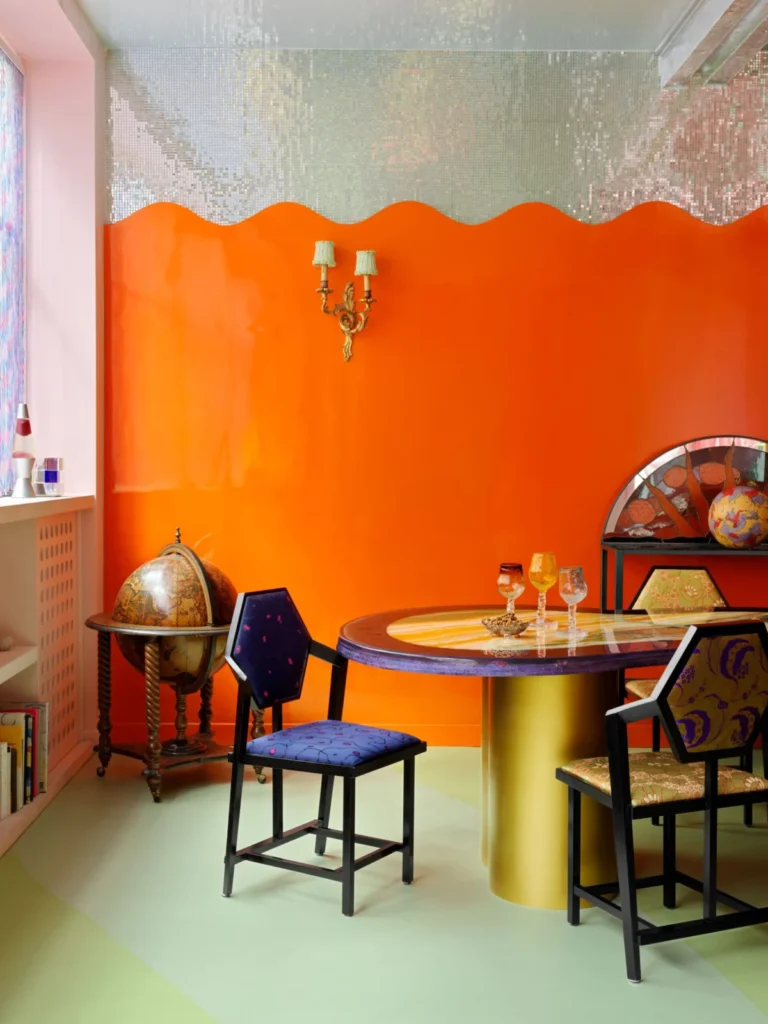
One of the most popular iterations of the decorative globe in the 20th century was the "bar globe." Often found in mid-century dens and offices, these pieces feature a hinged northern hemisphere that opens to reveal a hidden compartment for spirits and glassware. While sometimes dismissed as kitsch by purists, these objects hold a deep nostalgic value for many.
Designer Julien Sebban of the Paris-based firm Uchronia credits a globe inherited from his grandparents—which concealed a secret bar—as a source of childhood fascination. For Sebban, the piece was more than a novelty; it was a "portal to exploration." This sentiment highlights the psychological impact of the globe: it is an object that promises discovery, whether through geographical knowledge or the simple surprise of a hidden interior.
Market Trends and the Value of Antique Cartography
The market for antique globes remains robust, driven by collectors who value both the historical accuracy (or inaccuracy) of the maps and the aesthetic quality of the stands. According to auction data from houses like Sotheby’s and Christie’s, 17th- and 18th-century globes in good condition can fetch anywhere from tens of thousands to hundreds of thousands of dollars.

Collectors typically look for several key factors when assessing a globe’s value:
- Cartographer and Maker: Pieces by renowned makers like Blaeu, Senex, or Newton command a premium.
- Condition of the Gores: Because globes are made of paper, they are susceptible to "foxing" (brown spotting), yellowing of the varnish, and peeling. Well-preserved surfaces are rare.
- The Stand: The quality of the furniture—whether it is carved mahogany, inlaid fruitwood, or cast iron—is often as important as the map itself.
- Historical Anomalies: Globes that depict "California as an island" or other corrected geographical errors are particularly prized for their historical narrative.
Implications: The Physical Globe in a Digital World
In an era dominated by GPS and satellite imagery, the continued relevance of the physical globe might seem paradoxical. However, its value has shifted from the functional to the philosophical. A digital map is a tool for "zooming in" on a specific destination; a physical globe is a tool for "zooming out" to appreciate the totality of the human environment.
The globe serves as a reminder of the era of exploration, a time when the world felt vast and mysterious. It represents a bridge between the scientific rigor of the Enlightenment and the decorative traditions of the Renaissance. As interior designers continue to seek objects that provide "soul" and "history" to a space, the globe stands as a timeless choice—an object that contains the entire world within the palm of one’s hand, offering a sense of perspective that no screen can replicate. Whether as a scholarly reference in a library or a secret bar in a modern living room, the globe remains an enduring testament to the human desire to understand, map, and ultimately possess the world we inhabit.