
In an otherwise quiescent late-spring television landscape, Apple TV+’s Widow’s Bay unexpectedly captivated audiences and critics alike, rapidly ascending from a promising premiere to a certified hit for the streaming giant. The inventive horror-comedy series, which debuted in April, garnered widespread critical acclaim and generated robust audience word-of-mouth, culminating in its much-discussed season one finale this Wednesday. This groundswell of popularity translated into an early second-season renewal even before its inaugural run concluded, positioning Widow’s Bay as a formidable contender in the upcoming Emmy Awards race – a contention, however, that is intricately complicated by the Television Academy’s stringent eligibility rules.
Navigating Emmy Eligibility: The May 31st Conundrum
The path to Emmy glory for Widow’s Bay is marked by a unique chronological challenge. The series premiered within the Television Academy’s designated eligibility window, allowing a sufficient number of episodes to air for the show to qualify for the overall ballot, particularly in the highly competitive comedy series categories and their associated fields. However, the dramatic season finale, along with the eighth and ninth installments of the 10-episode season, narrowly missed the Academy’s strict May 31st cutoff date. Consequently, these critical concluding episodes are not eligible for consideration in the current awards cycle and will instead "roll over," becoming eligible for various categories in the subsequent Emmy year.
This specific timing means that when Emmy nominations are unveiled next month, the absence of Widow’s Bay‘s finale in categories such as Outstanding Writing for a Comedy Series, Outstanding Directing for a Comedy Series, or various below-the-line technical awards should not be misconstrued as a snub. Rather, it is a direct consequence of the Television Academy diligently upholding its established rules. The Academy’s guidelines are designed to ensure fairness and a clear demarcation for judging content released within specific timeframes. While the majority of the season can be evaluated, the climactic moments and their associated craft contributions from the final three episodes are effectively held in abeyance. This administrative nuance highlights the often-complex interplay between production schedules, release strategies, and the rigid timelines of major awards bodies.
Strategic Release: A Masterclass in Awards Timing
Despite, or perhaps because of, these eligibility peculiarities, the timing of Widow’s Bay‘s release has proven to be an unexpected strategic boon for its awards prospects. The series found itself enjoying a significant advantage: none of its direct competitors are currently on the air. Esteemed returning players, such as FX’s The Bear and the fictional series Nobody Wants This, have not aired new episodes since 2025, leaving a clear runway for Widow’s Bay to dominate the cultural conversation. This lack of concurrent competition has allowed the show to capture the undivided attention of both critics and the viewing public, fostering an environment where its unique blend of scares and laughs could truly resonate.
This sustained buzz has created a "fever pitch" of excitement, reaching its zenith precisely when it matters most for awards success. The show’s innovative approach to genre storytelling, blending genuinely unsettling horror elements with sharp comedic timing and poignant character development, has been lauded by critics. Publications like Rotten Tomatoes reported a staggering 94% critical approval rating, with Metacritic echoing this sentiment with high aggregate scores, solidifying its status as a critical darling. Audience engagement has been equally fervent, with social media platforms abuzz with discussions, fan theories, and praise for its originality. Hiro Murai, who serves as a director and executive producer on the series, recently reflected on this phenomenon, stating, "I’m getting texts from high school friends I haven’t talked to in 20 years," underscoring the show’s broad cultural penetration. Star Matthew Rhys, recognizing the intensity of the hype, humorously remarked on the potential pressure for future seasons: "Now we’re at the point where you go, ‘This is too much. Now we’re set up to fail in season two!’" This self-aware acknowledgment, however, only further amplifies the show’s current momentum.
The "Bear" Precedent and Voter Psychology
The situation faced by Widow’s Bay is not entirely without precedent, particularly concerning the psychology of awards voters. A notable parallel can be drawn with The Bear. That acclaimed series technically secured the top comedy-series Emmy for its first season. However, when Academy members cast their final ballots, they had recently binged and absorbed the widely praised second season. This meant their voting decisions were likely influenced by the fresher, more immediate impact of the newer episodes, even though those episodes were not formally eligible for the specific season being voted on. Conversely, The Bear‘s second season, despite its critical adoration, then faced a similar fate, losing out in its own Emmy cycle, potentially because voters had the "divisive third season" fresh in their minds, as noted by industry observers.
This phenomenon underscores a crucial aspect of awards campaigning: while strict eligibility dates govern which specific episodes can be judged, the broader perception and immediate recall of a series can profoundly sway voters. For Widow’s Bay, this means that even though the finale is technically ineligible, its impactful conclusion, which left a lasting impression, remains vivid in the minds of Academy members as they cast their ballots for the earlier, eligible episodes. This strategic, albeit perhaps unintended, scheduling ensures that Widow’s Bay remains front-of-mind, benefiting from recency bias in a landscape devoid of fresh competition. The critical and popular success of the entire season, capped by a memorable finale, provides a compelling narrative that transcends the technicalities of episode eligibility, effectively packaging the show as a must-see television event deserving of top honors.
A Star is Re-Recognized: K. Callan’s Breakout Finale
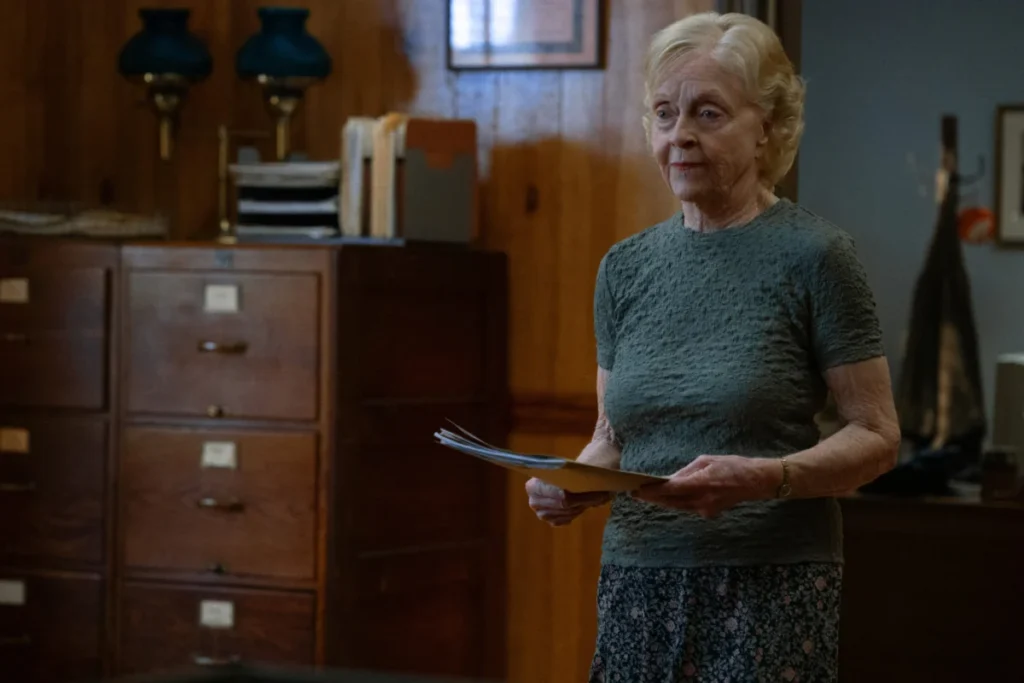
Among the many standout elements of Widow’s Bay‘s acclaimed first season, the performance of veteran actress K. Callan in the finale provides a particularly compelling case study for awards consideration. For much of the season, Callan’s character, Ruth, the steadfast secretary to the conflicted mayor Tom Loftis (played by Matthew Rhys), largely operated in the background, offering dry comedic relief and a grounding presence. However, the season one finale delivered a bracing showcase for her talents, transforming her role into a pivotal emotional and narrative linchpin.

The episode plunges Mayor Loftis into a moral quandary reminiscent of the classic "trolley problem." He discovers that Ruth is the sole living descendant of the Warren bloodline, believed to be the source of a curse plaguing their beleaguered island town. Loftis is forced to grapple with an agonizing decision: sacrifice Ruth for the perceived good of the community and potentially lift the curse, or seek an alternative path, enduring the town’s suffering. Creator Katie Dippold masterfully crafts a tense, emotionally charged two-hander scene between Rhys and Callan, where Ruth is suddenly illuminated in an entirely new light, her quiet resilience and humanity brought to the forefront just as she faces a cruel, existential threat. "I wanted Loftis to be in a situation where he’s really questioned: ‘What are you willing to do to end this?’" Dippold explained. "Or is the answer to just endure it, to love each other and endure it together?" Ultimately, Loftis proves his willingness to make the ultimate sacrifice, though Ruth, through a twist of fate, survives the ordeal. Callan’s portrayal during this intense sequence is lauded for its moving sincerity, grounded realism, and subtle comedic timing, allowing her to go toe-to-toe with Rhys’s critically acclaimed performance.
Dippold and Murai on Crafting the Climax
The profound impact of K. Callan’s performance in the Widow’s Bay finale was, by the creators’ own admission, a delightful surprise. Director and executive producer Hiro Murai, who helmed both the pilot and the finale episodes, revealed the serendipitous nature of her casting and the subsequent development of her character’s pivotal role. "If I’m being totally honest, we cast K before the finale was written, off of taped sides for the first few episodes where she had a couple lines and acts as a comedic sidekick," Murai recounted. "I could tell that she was a good actor, but it was more about timing and just making those scenes work."
The true extent of Callan’s dramatic range became apparent during the production of the finale. "By the time the finale came, we didn’t know what she was going to do with a seven-page scene with Matthew on a couch," Murai continued, describing the pivotal confrontation between Loftis and Ruth. "And it was kind of mindblowing just to watch her go toe to toe with him. She was asking a lot of questions and busting Matthew’s balls, and it was kind of an incredible thing. Katie and I looked at each other like, ‘Thank God we picked K. This would not have worked at all with somebody else.’" This testament from the creative team underscores the organic evolution of the character and the immense talent Callan brought to the role, elevating a seemingly minor character to one of the season’s most memorable. Her ability to imbue Ruth with such depth and vulnerability, especially in a scene of such emotional weight, proved to be an unexpected lynchpin for the finale’s success.
A Legacy of Performance: K. Callan’s Enduring Career
From an awards perspective, K. Callan’s performance is bolstered by a compelling campaign narrative that resonates deeply within the industry: a celebrated veteran actress, with a career spanning over six decades, finally receiving a late-career, high-profile showcase. Callan’s extensive filmography is a testament to her enduring presence in television history. Her career began in the 1960s, and she became a ubiquitous character actress throughout the 1970s and beyond, appearing in an astonishing array of classic shows. In 1977 alone, she graced episodes of beloved sitcoms like One Day at a Time, All in the Family, and Rhoda, showcasing her versatility across different comedic styles. Over the decades, her resume has grown to include appearances in countless iconic series, making her a familiar and respected face to generations of viewers and industry professionals.
This rich history provides a powerful narrative for her Emmy campaign in the Comedy Supporting Actress category. Many Academy voters will undoubtedly recognize her name and face, having grown up watching her work or having worked alongside her throughout their careers. The opportunity to honor a performer with such a long and distinguished career, particularly for a role that unexpectedly provided such a profound dramatic platform, offers a unique appeal. Even with the finale technically ineligible for this awards cycle, the collective memory and goodwill towards Callan, combined with the undeniable impact of her performance, could very well sway voters. Her work in Widow’s Bay is seen not just as a strong individual performance but as a culmination of a lifetime dedicated to her craft, a poignant and powerful narrative that could prove irresistible to those casting ballots.
Broader Implications for Apple TV+ and the Genre
The unexpected triumph of Widow’s Bay carries significant implications not only for the series itself but also for Apple TV+ and the burgeoning horror-comedy genre. For Apple TV+, the show represents a significant win in its ongoing quest to establish itself as a formidable player in the streaming wars. While Apple has invested heavily in prestige dramas and star-studded features, Widow’s Bay‘s success demonstrates the streamer’s ability to cultivate original, genre-bending content that resonates widely with audiences and critics. Its swift renewal and Emmy buzz validate Apple’s commitment to diverse storytelling and its strategy of allowing creators like Katie Dippold and Hiro Murai the creative freedom to explore unique narrative territories. This success could pave the way for more genre experimentation on the platform, attracting new subscribers and further solidifying its reputation for quality programming.
Furthermore, Widow’s Bay‘s critical and commercial reception reinforces the growing popularity and artistic legitimacy of the horror-comedy genre. Once considered niche or cult, shows like Widow’s Bay (and films like Get Out or Ready or Not) prove that a delicate balance of scares and laughter can yield incredibly compelling and thought-provoking narratives. The series’ ability to explore complex themes—such as community responsibility, moral dilemmas, and the burden of legacy—through the lens of inventive genre storytelling highlights the genre’s capacity for depth beyond mere entertainment. This success may encourage other networks and streamers to greenlight more projects that defy easy categorization, pushing the boundaries of traditional television formats and fostering a richer, more diverse content landscape.
Looking Ahead: Season Two and Future Award Cycles
As the current Emmy voting period concludes, with ballots due on Monday, the industry watches with keen interest to see how the unique circumstances surrounding Widow’s Bay will play out. While the finale’s ineligibility for specific craft awards this year is a technicality, the overall impact of the season, amplified by the concluding episodes, is undeniably fresh in voters’ minds. The strong word-of-mouth, critical acclaim, and the compelling narrative surrounding K. Callan’s performance create a potent combination for awards success.
The renewal for a second season offers Widow’s Bay the opportunity to build on its initial momentum, further exploring the intricacies of its cursed island community and the complex characters that inhabit it. For the episodes that "rolled over" from season one, they will have another chance at Emmy recognition in the subsequent awards cycle, potentially extending the show’s presence in the awards conversation for years to come. Ultimately, the question of whether voters will allow the impact of the technically ineligible finale to influence their decisions for the eligible episodes remains at their discretion, a testament to the human element inherent in the awards process. The industry, and indeed fans, will be staying tuned not just for the upcoming Emmy nominations, but for the continuing saga of Widow’s Bay and its evolving legacy in the television landscape.