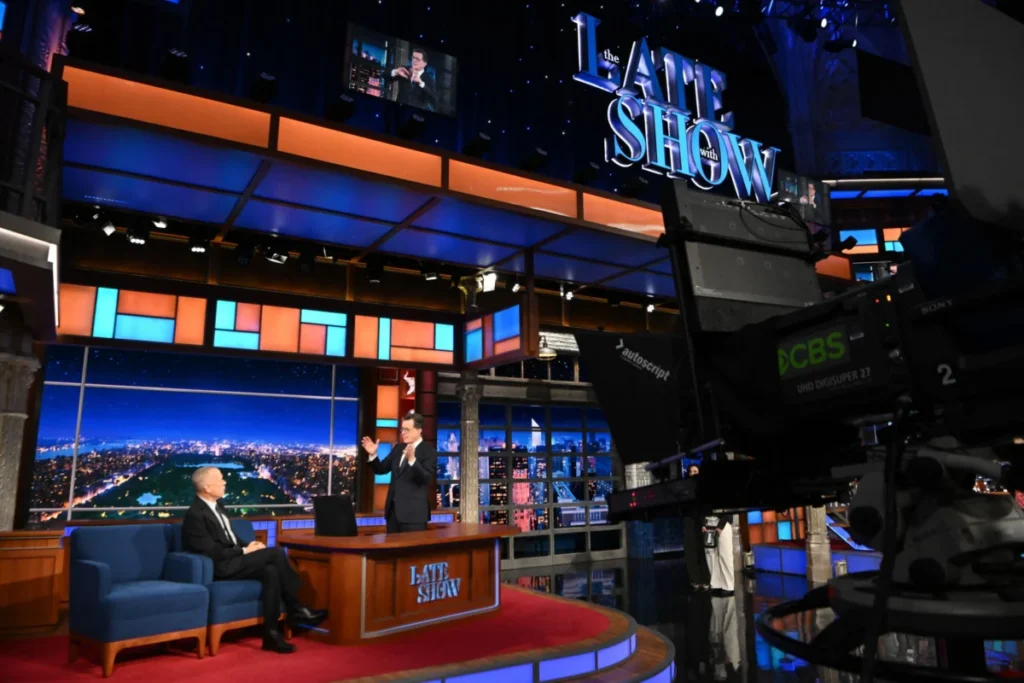

The announcement that The Late Show with Stephen Colbert will conclude its historic run on May 21, 2026, marks the end of a pivotal chapter in American broadcasting and refocuses public attention on the architectural and cultural sanctuary that is the Ed Sullivan Theater. Following a 33-year tenure as the home of CBS’s flagship late-night franchise—first under David Letterman and subsequently under Stephen Colbert—the theater stands as one of the most storied venues in the history of global entertainment. As the network prepares for the show’s final broadcast, the future of the landmarked Broadway structure remains a subject of intense speculation within the media industry and the New York City real estate market.
Since Stephen Colbert assumed the hosting duties in 2015, the Ed Sullivan Theater has undergone a physical and spiritual restoration that bridged the gap between modern television production and early 20th-century Gothic grandeur. The transition from the David Letterman era to the Colbert era was defined by a massive renovation project that stripped away decades of acoustic paneling and dropped ceilings to reveal the theater’s original architectural bones. As the production nears its conclusion, the details of this historic space offer a roadmap of the evolution of American media, from the vaudeville stage to the digital age.

The Architectural Genesis of Hammerstein’s Monument
The Ed Sullivan Theater was not originally intended for the cameras of a broadcasting network. Completed in 1927, the building was the brainchild of Arthur Hammerstein, a prominent theatrical producer who sought to create a lasting monument to his father, the legendary opera impresario Oscar Hammerstein I. Designed by architect Herbert J. Krapp, the venue opened its doors as Hammerstein’s Theater. Krapp, who was responsible for many of Broadway’s most iconic houses, infused the space with a distinct Gothic Revival style, featuring intricate plasterwork, pointed arches, and a grand vaulted ceiling.
The theater’s early years reflected the volatile nature of Manhattan’s entertainment district during the Great Depression. By 1934, the venue had transitioned from a traditional Broadway playhouse into a casino and later a music hall. Its survival was secured in 1936 when the Columbia Broadcasting System (CBS) leased the space for use as a radio playhouse. This move signaled the beginning of a nearly century-long relationship between the building and the network. In 1949, as television began to eclipse radio as the primary medium for American domestic life, CBS converted the space into a television studio, designated as CBS Studio 50.
The Ed Sullivan Era and the Birth of Modern Variety
The theater gained its current name in 1967, honoring Ed Sullivan, the host of the variety program that defined Sunday night television for a generation. The Ed Sullivan Show, which aired from 1948 to 1971, utilized the theater to host some of the most significant cultural moments of the 20th century. It was on this stage that 72.8 million viewers watched The Beatles make their American debut in February 1964, an event that fundamentally altered the trajectory of the music industry.

The physical demands of The Ed Sullivan Show led to several unique architectural modifications that remain part of the building’s lore. One of the most notable features is the "elephant columns." During the 1950s, Sullivan frequently booked acts from the Ringling Brothers and Barnum & Bailey Circus. To accommodate the immense weight of live elephants on the stage, CBS engineers were forced to install additional structural support columns beneath the floorboards. Today, these columns are preserved and commemorated with a mural and a plaque, serving as a reminder of the era when variety television required the logistical precision of a traveling circus.
The 1993 Revitalization and the Letterman Transition
Following the conclusion of The Ed Sullivan Show in 1971, the theater experienced a period of mixed use, including television specials and a brief return to live theatrical performances. Its modern identity was forged in 1993 when CBS purchased the building for approximately $4 million to serve as the home for David Letterman’s new program, The Late Show.
Letterman’s move from NBC to CBS was a seismic event in the "Late Night Wars," and the Ed Sullivan Theater was central to the network’s strategy. The interior was heavily modified to create a "set-within-a-set" feel, with modern lighting rigs and a sleek, urban aesthetic that masked much of the original Gothic detail. Letterman’s 22-year tenure at the theater solidified the venue as the epicenter of late-night comedy in New York City, drawing thousands of tourists to the corner of Broadway and 53rd Street daily.

The 2015 Restoration: Revealing the Hidden Dome
When Stephen Colbert was named as Letterman’s successor in 2015, production designer Jim Fenhagen was tasked with reimagining the space. Colbert expressed a desire to honor the theater’s history rather than hide it. During the renovation process, workers discovered that many of the original 1927 features—long thought to have been destroyed or removed—were simply covered up.
The most dramatic discovery was the theater’s central dome. For decades, the dome had been obscured by soundproofing material and technical equipment. Upon its rediscovery, Colbert insisted on a full restoration. The process involved specialized craftsmen using toothbrushes to clean decades of dust from the intricate plasterwork and stained glass. During the cleaning, workers found artifacts from the 1940s and 50s, including discarded tools, old cigars, and even vintage traffic tickets that had been tucked away in the rafters for over half a century. The restored dome, now illuminated by modern LED technology, serves as the centerpiece of the current set, blending the building’s 1920s origins with 21st-century production values.
Symbolic Design: Satire and Personal Mementos
The current set of The Late Show with Stephen Colbert is meticulously designed to reflect the host’s personality and his background in political satire. Lighting designer Michael Scricca implemented a system of "Mondrian panels"—square light fixtures that can be instantly reconfigured to change the mood of the room. The color palettes are intentional: orange and blue for standard interviews, and a patriotic red, white, and blue for political segments.

Scricca has noted that the lighting design includes "hidden" elements that serve as an homage to Colbert’s previous work on The Colbert Report. One specific area of the library set features lighting that subtly forms the pattern of an American flag, a nod to Colbert’s request that the set feel like a "clandestine" display of patriotism.
The library itself is a repository of Colbert’s personal history. It houses a collection of science fiction and fantasy literature, reflecting the host’s well-known obsession with the works of J.R.R. Tolkien. Key artifacts include:
- Andúril: A prop sword from The Lord of the Rings, gifted to Colbert by actor Viggo Mortensen.
- Captain America’s Shield: A gift from Marvel Studios that was a staple of his previous set.
- The Freedom March Pennant: A historical artifact from the 1963 March on Washington, which Colbert’s mother attended while pregnant with him.
- The South Carolina Marker: On the stage floor, the traditional "mark" where the host stands for his monologue is shaped like the state of South Carolina, featuring the crescent moon and palmetto tree from the state flag. Colbert has stated that this marker serves as a grounding tool, reminding him to "stay himself" during the broadcast.
Chronology of the Ed Sullivan Theater
- 1927: Opened as Hammerstein’s Theater; designed by Herbert J. Krapp.
- 1931: The theater struggles during the Depression; Arthur Hammerstein files for bankruptcy.
- 1934: Converted into a casino and music hall.
- 1936: Leased by CBS for radio broadcasts.
- 1949: Converted into a television studio (CBS Studio 50).
- 1948–1971: Home of The Ed Sullivan Show.
- 1964: The Beatles perform, drawing record-breaking viewership.
- 1967: Building officially renamed the Ed Sullivan Theater.
- 1993: CBS purchases the building for The Late Show with David Letterman.
- 2015: Stephen Colbert takes over; major architectural restoration occurs.
- 2025: CBS announces the show will conclude in May 2026.
Economic Implications and the Future of Late Night
The conclusion of The Late Show with Stephen Colbert in 2026 comes at a time of significant transition for the television industry. Late-night talk shows, once the undisputed profit centers of broadcast networks, have faced declining linear viewership as audiences migrate to streaming platforms and social media clips. The high overhead costs associated with maintaining a historic Broadway theater and a large-scale production staff have led many networks to reconsider the traditional late-night format.

CBS has not yet announced its plans for the Ed Sullivan Theater post-2026. Given the building’s landmark status, any future use will be subject to strict preservation guidelines. Industry analysts suggest several possibilities: the network may lease the space for another production, convert it back into a traditional Broadway house, or utilize it for a new, lower-budget digital-first program.
The departure of Colbert also raises questions about the economic health of the surrounding Theater District. The Late Show has been a reliable engine for local tourism for over three decades, providing consistent foot traffic for nearby restaurants and hotels. The loss of a daily television taping with a live audience of hundreds will undoubtedly be felt by the small businesses in the 53rd Street corridor.
Conclusion: A Landmark in Transition
As the countdown to May 21, 2026, begins, the Ed Sullivan Theater stands as a testament to the enduring power of New York City’s cultural institutions. From its beginnings as a tribute to an opera legend to its role as the stage for the British Invasion and modern political satire, the building has remained a constant in a rapidly changing media landscape. While Stephen Colbert’s departure marks the end of a specific era of late-night television, the theater itself—with its hidden domes, elephant columns, and Gothic arches—remains an architectural survivor, ready for its next act in the history of American entertainment.