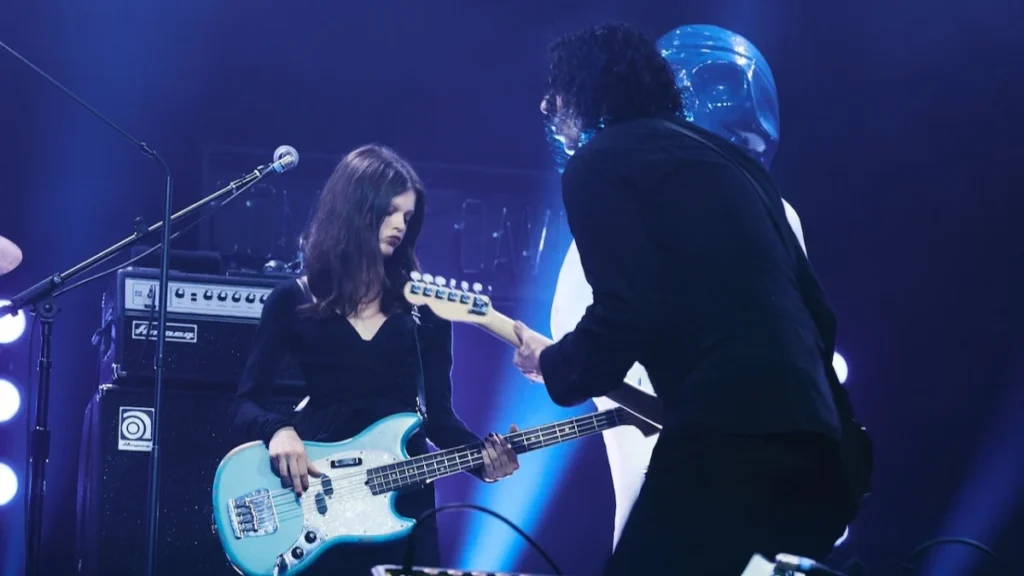

The iconic musician Jack White recently shared a significant moment on stage with his daughter, Scarlett White, at a sold-out performance at the Brooklyn Paramount on Saturday, July X, 2026. The 19-year-old Scarlett, who is establishing herself as an aspiring artist, musician, and model based in New York City, joined her father on bass guitar for a powerful rendition of three distinct tracks: "Cannon," "John the Revelator," and "Black Math." This unexpected collaboration marked a poignant highlight in White’s ongoing North American tour, which supports his recently released solo album, Frozen Charlotte.
A Memorable Brooklyn Paramount Performance
The atmosphere within the historic Brooklyn Paramount was charged with anticipation as Jack White, known for his electrifying and often improvisational live shows, commanded the stage. Midway through his expansive set, a palpable shift occurred as Scarlett White, a striking figure in her own right, stepped into the spotlight, strapping on a bass guitar. Her appearance was met with an enthusiastic roar from the capacity crowd, many of whom were aware of her previous, more sporadic collaborations with her acclaimed father. The chosen songs for their joint performance showcased a breadth of White’s catalog, from the raw blues energy of "Cannon," often associated with his earlier, more stripped-down aesthetic, to the darker, more intricate textures of "John the Revelator" and the aggressive, garage-rock drive of "Black Math," a track from The White Stripes’ seminal album Elephant. Scarlett’s bass lines provided a solid, rhythmic foundation, demonstrating a confident command of her instrument that seamlessly integrated with her father’s dynamic guitar work and the rest of his touring band. Her contribution was not merely symbolic; it was an integral part of the sonic tapestry, adding a fresh layer to these familiar compositions and offering fans a unique, one-off live experience. The visual spectacle of father and daughter performing together, sharing a profound musical connection, resonated deeply with attendees, underscoring the enduring power of artistic legacy and familial bonds within the often-unpredictable world of rock and roll. The Brooklyn Paramount, a venue steeped in entertainment history since its opening in 1928 and recently reopened after extensive renovation, provided a fitting backdrop for this memorable intergenerational musical exchange, blending a sense of tradition with contemporary relevance.
Scarlett White’s Growing Presence in Music
Scarlett White’s appearance in Brooklyn is not her first foray into the professional music scene alongside her father, nor is it her only artistic endeavor. At 19, she is actively cultivating a multifaceted career in New York City, extending beyond music into art and modeling. Her journey into the public eye as a musician has been gradual yet consistent, suggesting a thoughtful approach to entering the industry. Prior to her Brooklyn Paramount performance, Scarlett had previously shared the stage with Jack White during a show at New York’s Irving Plaza in February 2025. During that engagement, she contributed to a performance of "Archbishop Harold Holmes," a track that further highlighted her burgeoning musical capabilities in a live setting. Beyond the concert stage, Scarlett also made significant contributions to her father’s 2024 album, No Name. While specific details regarding the two tracks she appeared on remain somewhat under wraps, her involvement indicated a growing trust and creative partnership within the studio environment. This studio experience provided an invaluable opportunity for Scarlett to hone her craft and gain professional recording experience under the guidance of one of contemporary music’s most respected figures. Her contributions to No Name were noted by critics as adding subtle yet impactful layers to the album’s soundscape, suggesting an innate musicality that transcends her relatively young age. Her development as a bassist, in particular, has garnered attention, positioning her as a promising talent to watch.
Jack White himself has openly acknowledged his daughter’s talent and individuality. In a previous interview with CONSEQUENCE magazine, he described Scarlett as a "great" bassist, a commendation that carries considerable weight coming from an artist known for his discerning musical sensibilities. However, White also emphasized his desire for Scarlett to carve out her own distinct musical path, free from the shadow of his immense legacy. "She likes doing her own thing, and I like her doing her own thing," White stated, articulating a philosophy that prioritizes creative autonomy. "So once in a while we might touch base here and there, but, I like her doing her own thing, and I think that’s where she feels comfortable, too." This statement reflects a thoughtful approach to parenting within the arts, fostering independence while providing a supportive foundation. It underscores a respect for her individual artistic vision, allowing her the space to explore her identity as a musician without overt pressure to conform to or replicate her father’s groundbreaking career. This measured encouragement is crucial for young artists, particularly those with famous parents, as it allows them to develop their unique voice and artistic direction organically, fostering genuine creativity rather than manufactured stardom.
The "Frozen Charlotte" Tour Kicks Off with a Bang
The Brooklyn Paramount concert served as a key stop early in Jack White’s extensive North American tour, which officially commenced earlier in July 2026. The tour is a dedicated effort to support his recently released solo album, Frozen Charlotte, which has been met with critical anticipation and fan excitement. Frozen Charlotte represents the latest chapter in White’s prolific solo career, following a consistent stream of innovative and genre-bending releases. The album, lauded for its intricate songwriting and signature sonic textures, continues White’s exploration of blues, rock, and experimental soundscapes, often infused with his distinctive lyrical narrative. Initial reviews of Frozen Charlotte have highlighted its raw energy and introspective themes, positioning it as another strong entry in his diverse discography.
The Brooklyn Paramount setlist was a carefully curated blend of new material from Frozen Charlotte and beloved classics spanning his entire career, including his seminal work with The White Stripes. Songs like "Raising the Grain," "There’s Nobody There," and "Nobody Knows" from the new album were prominently featured, allowing audiences to experience the fresh tracks in a live, dynamic setting. These new compositions showcased White’s evolving artistry and demonstrated the continued vitality of his creative output. Interspersed with the new material were electrifying performances of fan favorites that have become anthems for generations of rock enthusiasts. The crowd erupted for classics such as "Fell in Love With a Girl" and "Hotel Yorba," both instantly recognizable from The White Stripes’ catalog, embodying the raw, minimalist power that defined their sound. Other highlights included "I Cut Like a Buffalo" from The Dead Weather, showcasing his diverse collaborative projects, and "The Hardest Button to Button" and "Icky Thump," further solidifying his legacy with The White Stripes. The set culminated, as expected, with the iconic riff of "Seven Nation Army," a track that has transcended its original rock context to become a global sports anthem and a universally recognized symbol of rock and roll power. The inclusion of these enduring hits alongside the new material ensured a comprehensive and satisfying experience for attendees, bridging the gap between White’s storied past and his vibrant present. The tour’s kick-off, particularly with the added element of Scarlett’s collaboration, set a high bar for the remainder of the dates, promising an unforgettable series of performances for fans across North America.
A Timeline of Collaboration: From Studio to Stage
The musical partnership between Jack White and his daughter, Scarlett, has evolved organically over the past few years, marking a clear chronology of her increasing involvement in his artistic endeavors. This progression highlights a deliberate and thoughtful integration rather than an abrupt introduction, allowing Scarlett to gain experience and confidence at each step.
-
2024: Studio Debut on No Name
- The first public indication of Scarlett White’s musical contributions came with the release of Jack White’s 2024 solo album, No Name. While the exact tracks remain largely unpublicized, her involvement as a contributor to two songs on the album provided her with her initial professional recording experience. This studio work offered a crucial foundation, allowing her to understand the intricacies of music production and the demands of studio musicianship in a controlled environment. It also signaled Jack White’s trust in her musical abilities and his willingness to integrate her into his creative process beyond a familial context. No Name itself was well-received, and Scarlett’s contributions, however subtle, were part of a critically acclaimed project.
-
February 2025: First Live Stage Appearance at Irving Plaza
- Building on her studio experience, Scarlett made her live stage debut with her father in February 2025 at New York City’s intimate Irving Plaza. This performance was a significant milestone, transitioning from the recording booth to the dynamic, immediate environment of a live concert. During this show, she joined Jack White on bass for a rendition of "Archbishop Harold Holmes." This appearance allowed her to experience the energy of a live audience and the demands of performing in real-time, further solidifying her comfort and proficiency as a live musician. The smaller, more personal venue of Irving Plaza likely provided a less intimidating entry point into live performance compared to larger arenas.
-
July 2026: Expanded Role at Brooklyn Paramount
- The most recent collaboration at Brooklyn Paramount in July 2026 represents a substantial expansion of Scarlett’s role. Performing three songs – "Cannon," "John the Revelator," and "Black Math" – signifies a greater commitment and more extensive presence on stage. The choice of tracks, particularly well-known and often high-energy songs from her father’s repertoire, indicates a growing confidence in her abilities and a deeper integration into the live band’s dynamic. This performance at a larger, more prominent venue like the Brooklyn Paramount also exposed her to a significantly larger audience, marking a notable step forward in her public musical profile. Each step in this timeline demonstrates a carefully orchestrated and progressive unveiling of Scarlett White’s talents, allowing her to mature as a musician within a supportive yet challenging environment.
The Dynamics of Musical Kinship: Mentorship and Independence
The collaboration between Jack White and his daughter, Scarlett, illuminates a fascinating dynamic within the music industry: the delicate balance between familial mentorship and the imperative for an artist to forge an independent identity. For children of highly successful musicians, the path into the industry is often fraught with both unparalleled opportunities and significant challenges. On one hand, they benefit from direct access to industry knowledge, professional networks, and the invaluable experience of learning from a master. On the other, they face the immense pressure of living up to a famous surname and the constant comparison to their celebrated parent.
Jack White’s stated approach to Scarlett’s musical development reflects a profound understanding of these complexities. By describing her as a "great" bassist but simultaneously emphasizing her need to "do her own thing," he articulates a philosophy that champions creative autonomy above all else. This stance is deeply consistent with White’s own career trajectory, which has been defined by a fierce independence, a commitment to artistic integrity, and a relentless pursuit of authentic expression. From his early days in The White Stripes, eschewing traditional rock star tropes, to his diverse solo projects and his advocacy for analog processes and independent labels, White has consistently prioritized artistic freedom. This ethos is now seemingly being passed down to his daughter.
The intermittent nature of their collaborations – studio contributions, a single song at Irving Plaza, and three songs at Brooklyn Paramount – suggests a strategic, measured approach. It allows Scarlett to gain experience in high-profile settings without being fully absorbed into her father’s touring machinery. This method provides exposure and validation while leaving ample room for her to explore her own sound, develop her unique artistic voice, and build a career that stands on its own merits. It is a testament to White’s respect for the creative process and his understanding that true artistry cannot be simply inherited; it must be cultivated through personal exploration and genuine passion. This model of mentorship, one that encourages self-discovery and a distinct identity, is perhaps the most valuable legacy a musician of White’s stature can bestow upon the next generation. It positions Scarlett not merely as "Jack White’s daughter" but as Scarlett White, an artist in her own right, whose talent is recognized and nurtured, yet whose journey remains uniquely her own.
Broader Implications and Future Prospects
The recent collaboration between Jack White and Scarlett White at the Brooklyn Paramount carries several broader implications for both artists and offers intriguing insights into future prospects. For Jack White, these family appearances subtly enrich his already formidable legacy. They add a personal, intergenerational dimension to his performances, showcasing not only his enduring artistic vitality but also his role as a mentor and father. Such moments resonate deeply with audiences, offering a rare glimpse into the personal life of an artist who often maintains a degree of mystique. It humanizes his rock god persona and connects with fans on a more intimate level, demonstrating the continuation of a musical lineage. These collaborations also generate significant media buzz, providing unique angles for coverage of his ongoing tours and new album releases, further solidifying his relevance in a constantly evolving music landscape.
For Scarlett White, the implications are arguably more profound. These high-profile performances serve as an invaluable launchpad for her burgeoning career. Sharing a stage with an artist of Jack White’s caliber instantly grants her credibility and exposes her to a massive, pre-existing fan base. Her appearances are not merely novelties; they are demonstrations of her developing musicianship, affirmed by one of the industry’s most respected figures. This exposure, combined with her contributions to No Name and her stated aspirations as an artist and model, positions her as a multifaceted talent. The carefully managed nature of her involvement, as discussed, suggests a strategic cultivation of her public image and artistic development.
Looking ahead, the future prospects for Scarlett White appear promising. While her father’s guidance emphasizes independence, these joint appearances lay a strong foundation for a potential solo career or involvement in other musical projects. The experience gained from performing in front of thousands, coupled with studio work, equips her with practical skills and professional insights. It is reasonable to anticipate that as she continues to refine her artistic vision, she may embark on her own recording projects, potentially exploring genres or styles distinct from her father’s, aligning with his encouragement for her to "do her own thing." Her background in art and modeling also indicates a broader creative scope, suggesting that her artistic expression may not be confined solely to music. The music industry has a rich history of successful multi-talented artists, and Scarlett White, with her unique background and clear artistic drive, is well-positioned to become a notable figure in her own right. Her journey will be closely watched by fans and industry observers alike, eager to witness how she carves out her unique niche in the creative world.
The Enduring Appeal of Live Music and Surprise Collaborations
The recent performance at the Brooklyn Paramount, highlighted by Scarlett White’s guest appearance, serves as a powerful reminder of the enduring appeal and unique magic of live music, particularly when unexpected collaborations unfold. In an era dominated by digital consumption and curated experiences, the spontaneous and unrepeatable nature of a live concert remains a cornerstone of musical culture. These events offer a shared, communal experience that transcends mere audio playback, creating memories that linger long after the final note fades.
Surprise collaborations, especially those involving family members of renowned artists, amplify this magic exponentially. They inject an element of unpredictability and intimacy into a performance, transforming a standard concert into a singular event. For fans, witnessing such a moment is not just about the music; it’s about being present for a piece of musical history, a fleeting connection that transcends the typical performer-audience dynamic. It fosters a deeper sense of engagement and a feeling of having been part of something truly special and exclusive. These moments are often amplified across social media platforms, with attendees sharing videos, photos, and personal accounts, further extending the reach and impact of the surprise. This organic spread of excitement creates a ripple effect, generating buzz and drawing attention to both the established artist and the emerging talent.
Jack White, known for his dynamic stage presence and his commitment to the raw, visceral power of rock and roll, understands the importance of these live experiences. His career has consistently emphasized the authenticity and energy of live performance, often incorporating elements of improvisation and unexpected turns. By inviting Scarlett to join him, he not only offers her an invaluable platform but also enriches the concert-goer’s experience, reinforcing the idea that live music is a living, breathing entity capable of producing unforgettable moments. This particular collaboration underscores how intergenerational artistic connections, when nurtured with respect for individual paths, can invigorate both established legacies and burgeoning careers, proving that the most compelling narratives in music are often those woven between the lines of family and shared passion.