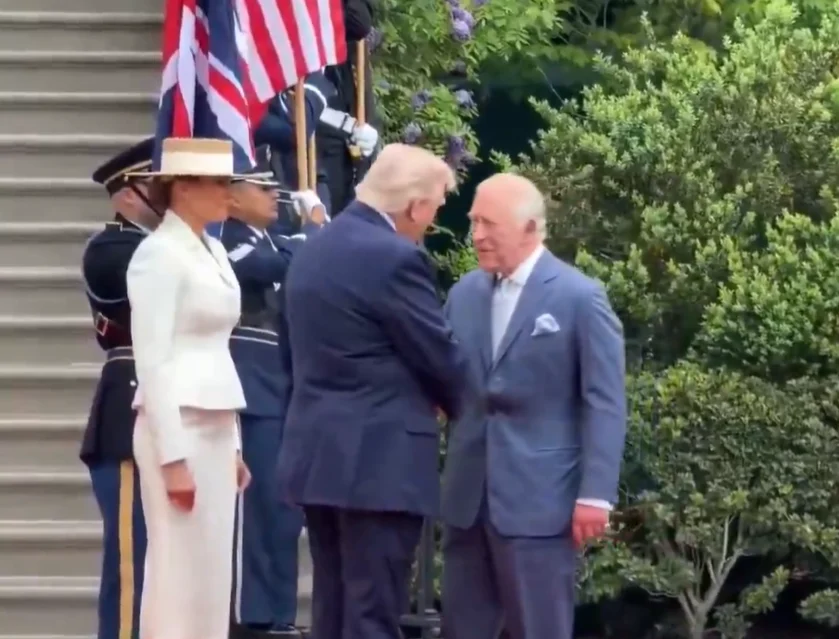

President Donald Trump initiated the official welcome for King Charles III and Queen Camilla at the White House with a surprisingly personal anecdote, revealing that his late mother, Mary Anne MacLeod Trump, had a distinct fondness for the then-young Prince Charles, even humorously suggesting she harbored a "crush" on him. The remarks, delivered during a formal address on the South Lawn, offered a blend of diplomatic pleasantries and nostalgic reminiscence, highlighting the enduring, albeit sometimes unexpected, threads connecting American and British royalty.
The State Visit, a significant diplomatic undertaking, commenced with the grandeur befitting the occasion. The arrival of Their Majesties was met with the solemnity of the national anthems of both the United States and the United Kingdom, followed by a traditional 21-gun salute, a testament to the diplomatic ties and mutual respect between the two nations. This formal ceremony set the stage for a day packed with engagements, underscoring the importance of the monarch’s first State Visit to the US since ascending to the throne.
A Personal Touch in Diplomatic Diplomacy
President Trump’s speech, while ostensibly a formal welcome, took a turn towards personal reflection, drawing parallels between his own family’s admiration for the British Royal Family and the historical relationship between the two countries. He spoke of his mother, a proud Scottish immigrant, and her deep affection for Queen Elizabeth II. "My mother was glued to the television any time the Queen was involved in a ceremony," President Trump recounted, emphasizing the late monarch’s widespread appeal.
It was in this context that he shared the anecdote about King Charles. "I also remember her saying, very clearly… ‘young Charles, he’s so cute’… my mother had a crush on Charles, can you believe it?" The lighthearted confession, met with likely amusement from the assembled guests, served to humanize the often-formal interactions between heads of state and royalty. It also served as a subtle nod to the generational continuity within the British monarchy, as the current King, once a "cute" young prince, now stands as sovereign.
President Trump also paid a heartfelt tribute to Queen Elizabeth II, whom he has consistently lauded in past encounters. Describing her as a "very, very special woman," he noted that she "is very greatly missed on both sides of that mighty Atlantic." He then drew a direct link between the Queen and the enduring alliance, pointing to a tree planted by her at the White House many years prior. "We see today a living symbol of this centuries-old bond… look at it now," he stated, gesturing towards the tree, a tangible reminder of shared history and legacy.
The State Visit: A Day of Pageantry and Diplomacy
The official welcome ceremony was the opening act of a meticulously planned day. Following the South Lawn proceedings, which included King Charles and President Trump, accompanied by the Commander of Troops, inspecting a Guard of Honour, the itinerary branched into distinct engagements. While the King was slated to meet President Trump in the Oval Office for discussions on critical bilateral and global issues, Queen Camilla was to participate in an educational event focused on the historical connections between the UK and the US, alongside First Lady Melania Trump.
This dual-track approach allowed for focused discussions at the highest levels while also engaging in softer diplomacy that highlights shared cultural and historical narratives. The King’s subsequent address to a joint session of Congress was another significant moment, offering him a platform to articulate his vision and the UK’s priorities to American lawmakers.
The day was set to culminate in a glittering State Banquet, a traditional event hosted by the US President to honor visiting heads of state. Such banquets are not merely social gatherings but are crucial opportunities for cultivating relationships, fostering goodwill, and reinforcing the diplomatic and economic partnerships between the host nation and the visiting delegation. The guest list typically includes prominent figures from politics, business, culture, and diplomacy, further amplifying the significance of the occasion.
Background and Context of the State Visit
This State Visit marked a significant moment in US-UK relations, occurring at a time of evolving global dynamics. For King Charles III, it was his first State Visit to the United States as monarch, a symbolic continuation of the special relationship that has long defined the alliance between the two nations. His mother, Queen Elizabeth II, made an unprecedented ten State Visits to the US during her reign, commencing with her visit in 1957. These visits have historically served as powerful affirmations of shared values, democratic principles, and strategic alignment.
The timing of this visit also held particular weight. With the United Kingdom navigating its post-Brexit identity and the United States undergoing its own political transitions, the reaffirmation of the transatlantic bond was seen as particularly important by both sides. Discussions were expected to cover a broad spectrum of issues, including economic cooperation, defense, climate change, and international security challenges.
The choice of the White House as the venue for the official welcome underscored the direct and personal nature of the diplomatic engagement. The State Visit protocol is reserved for the highest level of international diplomacy, signifying the paramount importance the US places on its relationship with the United Kingdom. The intricate planning involved in such visits, from security arrangements to the precise scheduling of events, reflects the immense logistical undertaking required to host a reigning monarch and their consort.
Supporting Data and Historical Parallels
The historical tapestry of US-UK relations is rich with instances of royal visits. Queen Elizabeth II’s first State Visit in 1957, for example, was a landmark event, setting a precedent for future royal engagements. Her subsequent visits, including her address to the United Nations General Assembly and her meetings with multiple US Presidents, further cemented the unique bond.
The economic dimension of the relationship is also substantial. The United Kingdom remains a key trading partner and significant investor in the United States, and vice versa. State Visits often serve to reinforce these economic ties, with discussions potentially leading to new trade agreements or increased investment opportunities. According to the U.S. Bureau of Economic Analysis, UK foreign direct investment in the U.S. was valued at over $600 billion in recent years, while U.S. investment in the UK also stands in the hundreds of billions.
The cultural exchange between the two nations is equally profound, ranging from literature and music to film and television. The presence of Queen Camilla at an educational event focused on UK-US history served to highlight this ongoing cultural dialogue, a less tangible but equally vital component of the bilateral relationship.
Analysis of Implications and Broader Impact
President Trump’s personal anecdote, while seemingly minor, offered a glimpse into the human element that often underpins international diplomacy. By sharing his mother’s fond memories, he subtly alluded to the deep-seated, personal connections that can exist between citizens of both nations and the British Royal Family. This can foster a sense of shared heritage and mutual understanding, even among those not directly involved in political or diplomatic circles.
The State Visit itself, regardless of the specific policy outcomes, serves as a powerful symbol of the enduring strength of the US-UK alliance. In an increasingly complex global landscape, such demonstrations of unity and cooperation are crucial for projecting stability and shared purpose. The King’s address to Congress, in particular, would have provided an opportunity to reiterate shared democratic values and to outline areas of mutual interest and concern on the world stage.
Furthermore, the visit provided a platform for both leaders to address pressing global issues. Discussions on climate change, for instance, would have been particularly pertinent, given the UK’s hosting of COP26 and the US’s renewed commitment to environmental initiatives. Similarly, discussions on international security, including ongoing geopolitical conflicts, would have reinforced the strategic alignment between the two nations.
The media coverage surrounding a State Visit invariably amplifies the importance of the relationship to a global audience. It reinforces the perception of the US and the UK as close allies, capable of working together on a wide range of challenges and opportunities. While the specific details of the private meetings between King Charles and President Trump would likely remain confidential, the public-facing elements of the visit – the ceremonies, the speeches, the banquets – all contribute to a narrative of strong and vital partnership. The seemingly lighthearted mention of a youthful King Charles by President Trump, therefore, served as an accessible entry point into a broader narrative of enduring friendship and shared history between two of the world’s most influential nations.