
HYBE, the South Korean entertainment conglomerate that has redefined the global music landscape, is currently navigating a wave of scrutiny regarding the creative direction of its diverse roster of female artists. The latest wave of discourse emerged following the release of promotional content for ILLIT, the rookie girl group under the subsidiary Belift Lab. Specifically, the group’s "It’s Me" dance challenge has ignited a polarized debate across online communities, with netizens and industry observers pointing to what they describe as striking similarities between ILLIT’s choreography and the performance styles of other HYBE-affiliated groups, including LE SSERAFIM and the global girl group KATSEYE. This development adds another layer to the ongoing conversation regarding the "HYBE style" and the potential homogenization of artistic output within a multi-label system.
The Genesis of the Controversy: ILLIT’s It’s Me Challenge
The controversy gained momentum shortly after ILLIT uploaded a short-form video featuring the choreography for "It’s Me," a track that emphasizes the group’s youthful and energetic concept. Almost immediately, users on platforms such as theqoo and X (formerly Twitter) began circulating side-by-side comparisons of the group’s movements with existing routines from their labelmates.
Observers highlighted specific "point dances"—the catchy, repetitive movements designed for viral social media challenges—that mirrored the high-intensity, "kitsh" aesthetic popularized by LE SSERAFIM. Furthermore, the electronic dance music (EDM) foundation of the track and the sharp, synchronized arm movements drew comparisons to KATSEYE, the group formed through the "Dream Academy" collaboration between HYBE and Geffen Records. Critics argue that while each group is marketed with a distinct narrative, the visual and auditory execution of their content is beginning to overlap, leading to accusations that the company is utilizing a "one-size-fits-all" creative formula.
A Pattern of Parallels: Comparing LE SSERAFIM and KATSEYE
To understand the weight of the current criticism, one must look at the recent releases from the groups in question. LE SSERAFIM, managed by Source Music, recently promoted their track "Celebrate." The song and its accompanying performance are characterized by a "hard-hitting" beat and a choreography style that blends street dance elements with playful, camera-ready poses. This "celebratory" and "kitschy" vibe is exactly what netizens claim has been transposed onto ILLIT’s latest challenge.

Simultaneously, KATSEYE has been establishing its identity through tracks like "Pinky Up," which utilizes a sophisticated EDM-pop soundscape and precise, intricate hand movements. The group’s performance at major international venues, including Coachella-related events, has solidified their image as a high-performance unit with a specific "party tune" energy. The overlap in these aesthetic choices—heavy EDM influence, high-energy syncopation, and "TikTok-ready" hooks—has led to a perception that HYBE’s internal creative teams may be drawing from a centralized pool of inspiration rather than fostering unique identities for each subsidiary.
Chronology of Creative Friction within HYBE
The current backlash does not exist in a vacuum. It follows a tumultuous period for HYBE, marked by public internal conflicts and previous allegations of creative overlap.
- April 2024: The conflict between HYBE and Min Hee-jin, the CEO of ADOR (the label behind NewJeans), becomes public. Min Hee-jin explicitly accused HYBE and Belift Lab of "copying" the NewJeans formula to create ILLIT, citing similarities in styling, choreography, and creative direction.
- May 2024: ILLIT debuts with "Magnetic," which achieves massive commercial success but continues to face scrutiny over its "NewJeans-esque" visual identity.
- June – July 2024: LE SSERAFIM and KATSEYE release new content that leans heavily into EDM and "brat-pop" aesthetics, a trend currently dominating the global music market.
- August 2024: The release of ILLIT’s "It’s Me" challenge serves as the tipping point for the current round of criticisms, as fans observe that the group is now being compared not just to NewJeans, but to nearly every other female act under the HYBE umbrella.
This timeline suggests a growing tension between the efficiency of HYBE’s centralized infrastructure and the creative autonomy of its individual labels.
The Multi-Label System: Innovation or Homogenization?
At the core of this debate is HYBE’s "multi-label" business model. Unlike traditional K-pop agencies where a single creative director often oversees the entire roster, HYBE’s structure is designed to allow subsidiaries like Source Music, Pledis Entertainment, ADOR, and Belift Lab to operate independently. This system was intended to diversify the company’s output and mitigate the risks associated with relying on a single group.
However, the recent controversy suggests a potential "standardization" of content. Industry analysts point out that while the labels are technically independent, they often share the same top-tier performance directors, producers, and marketing strategists. When a specific trend—such as the "Y2K aesthetic" or "EDM-lite" choreography—proves successful for one group, there is an institutional pressure to replicate that success across the portfolio.

Data from social media engagement suggests that this strategy is effective in the short term. "Point dances" that are easy to replicate and visually stimulating tend to garner higher view counts on TikTok and Instagram Reels. For a company like HYBE, which prioritizes global digital reach, the "formulaic" approach to choreography is a calculated business decision.
Market Performance vs. Creative Integrity: Data and Metrics
Despite the negative buzz surrounding the lack of originality, the commercial performance of these groups remains unparalleled. ILLIT’s debut single "Magnetic" became the first K-pop debut song to enter the Billboard Hot 100, a testament to the effectiveness of HYBE’s promotional machinery. Similarly, LE SSERAFIM’s recent comeback saw significant charting success in both South Korea and Japan.
The data reveals a disconnect between "netizen sentiment" and "consumer behavior." While a vocal segment of the online community criticizes the lack of differentiation, the broader global audience continues to consume the content at record-breaking levels. This suggests that for the average listener, the "HYBE style"—characterized by high production value, catchy hooks, and polished visuals—is a mark of quality rather than a lack of creativity.
Public Sentiment and Industry Reactions
The reaction from the Korean public, particularly on forums like theqoo, has been more critical. Comments often reflect a sense of fatigue, with one user noting, "If you put them all in the same outfits, I wouldn’t be able to tell which group is which based on the dance alone." Another commented, "It feels like they are all being produced by the same AI."
Conversely, some industry insiders defend the similarities as a reflection of global music trends rather than internal copying. The "kitschy EDM" sound is currently a dominant force in the Western pop market, influenced by artists like Charli XCX and PinkPantheress. As HYBE seeks to position its groups as global pop stars, it is natural for their creative output to align with international trends.
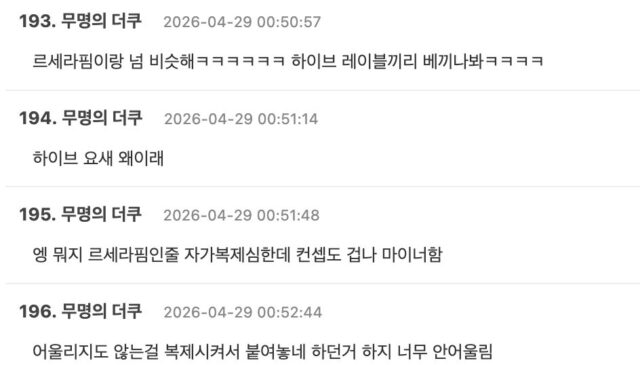
Official responses from HYBE and its subsidiaries have generally avoided addressing specific choreography comparisons. The company typically maintains a stance that each group represents a unique "storyline" and "universe," even if the aesthetic execution shares common DNA.
The Broader Implications for K-Pop’s Global Strategy
The controversy surrounding ILLIT, LE SSERAFIM, and KATSEYE raises fundamental questions about the future of the K-pop industry. As the genre continues to expand globally, the pressure to produce "viral" content is immense. If the world’s largest K-pop company is perceived to be sacrificing artistic individuality for the sake of trend-following, it could lead to a broader stagnation of the genre.
Furthermore, the "creative similarity" debate has potential legal and ethical implications. In an industry where intellectual property is the primary commodity, the line between "inspiration" and "imitation" is razor-thin. If subsidiaries within the same parent company continue to clash over creative similarities, it could undermine the very stability that the multi-label system was designed to provide.
In conclusion, while HYBE continues to dominate the charts and set new records, the mounting criticism regarding the creative overlap of its girl groups suggests a need for a strategic pivot. Ensuring that each group maintains a distinct artistic voice will be crucial for the long-term sustainability of the labels and the continued loyalty of a fanbase that values authenticity as much as entertainment. As ILLIT moves forward with their promotions, the industry will be watching closely to see if HYBE takes steps to differentiate its "super rookies" from the established stars in its galaxy.