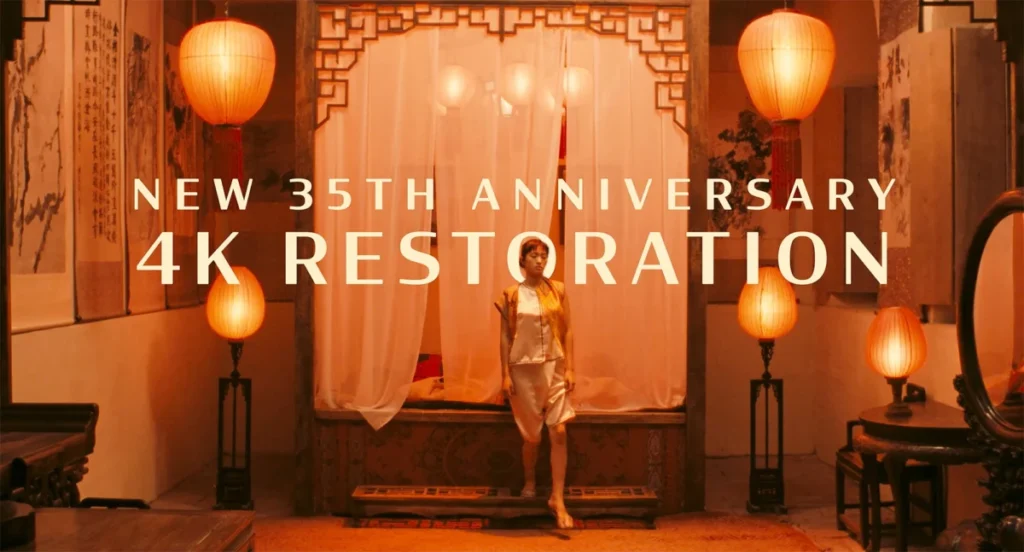

Distributor Film Movement has officially unveiled the brand-new official trailer and release schedule for the upcoming 4K restoration of Zhang Yimou’s critically acclaimed 1991 cinematic masterpiece, Raise the Red Lantern. Originally serving as the fourth feature film in the legendary Chinese director’s illustrious career, the sweeping drama is slated to return to the big screen in select United States theaters beginning November 6, 2026.
Widely regarded as a landmark achievement in international cinema, the film originally captured global attention during its festival run in the autumn of 1991. Following its meticulous 4K restoration process—completed in 2024 by the renowned preservation laboratory L’Immagine Ritrovata—audiences will once again have the opportunity to experience the visually striking, emotionally harrowing tragedy in pristine ultra-high definition. The theatrical rollout is expected to reintroduce the poignant narrative to modern cinephiles while highlighting the enduring technical and thematic brilliance of Fifth Generation Chinese cinema.

Meticulous 4K Restoration Process and Archival Integrity
The newly minted 4K restoration of Raise the Red Lantern was spearheaded by the Udine Far East Film Festival to commemorate its 26th edition. To achieve the highest possible fidelity, the restoration technicians utilized the original image and sound negatives under the direct supervision of director Zhang Yimou.
Maintaining historical color accuracy presented a significant challenge for the preservationists at L’Immagine Ritrovata. To solve this, the restoration team relied upon a vintage positive copy of the film that had been screened at the 1991 Venice Film Festival. This pristine print, preserved meticulously within the Historical Archive of Contemporary Arts at the Venice Biennale, served as the definitive color timing reference. The resulting digital transfer breathes vibrant new life into the film’s signature cinematography, defined by meticulous symmetry, deep shadows, and the hypnotic, recurring glow of crimson lanterns.
Plot, Cast, and Literary Origins
Set in 1920s China during the warlord era, Raise the Red Lantern tells the devastating story of 19-year-old Songlian, portrayed by international icon Gong Li. Following the sudden death of her father and the financial ruin of her family, Songlian is forced to abandon her university studies. To secure her survival, she enters into an arranged marriage as the fourth and newest concubine to the wealthy, aging, and largely unseen Master Chen.

Upon entering the sprawling, fortress-like Chen family compound, Songlian is immediately thrust into a rigid, feudal hierarchy governed by ruthless psychological warfare. The household operates under a strict nightly ritual: red lanterns are illuminated exclusively outside the chambers of whichever wife the master decides to visit. This illuminated favor brings with it status, physical protection, and exclusive household privileges, while the neglected wives are cast into symbolic and literal darkness.
As Songlian navigates this claustrophobic environment, she is forced to interact with her bitter rivals, including characters played by Ma Jingwu, He Saifei, Cao Cuifen, and Jin Shuyuan. Initially determined to remain aloof from the petty cruelties and psychological games of the estate, Songlian gradually succumbs to the toxic pressures of isolation. To protect her precarious standing, she begins engaging in deception and strategic alliances, culminating in dire consequences that ultimately fracture her spirit.
The screenplay was written by Ni Zhen and adapted from Su Tong’s acclaimed 1990 novella, originally published in English under the alternative titles Raise the Red Lantern and Wives and Concubines. The film was produced by an elite team of international producers, including Hou Hsiao-hsien, Chiu Fu-sheng, and Zhang Wenze.

Chronological Milestones and Historical Context
To fully understand the cultural weight of Raise the Red Lantern, film historians often look at its timeline within the broader movement of Chinese filmmaking:
- 1990: Zhang Yimou releases his third feature film, Ju Dou, which also stars Gong Li and becomes the first Chinese-language film to be nominated for an Academy Award for Best International Feature Film.
- Spring 1990: Author Su Tong publishes the novel Wives and Concubines, capturing the attention of the Chinese film community.
- 1991: Principal production concludes, and Raise the Red Lantern is completed.
- September 1991: The film premieres internationally, competing at both the 48th Venice International Film Festival—where Zhang Yimou won the Silver Lion for Best Director—and the Toronto International Film Festival.
- February 1992: Raise the Red Lantern opens in commercial theaters across the United States through specialized distributors, paving the way for mainstream arthouse appreciation of Chinese cinema.
- March 1992: The film receives an Academy Award nomination for Best Foreign Language Film at the 64th Academy Awards, cementing Zhang’s status as a global auteur.
- April 2024: The 4K restoration is finalized at L’Immagine Ritrovata under Zhang’s oversight, debuting later at the 26th Udine Far East Film Festival.
- November 6, 2026: Film Movement schedules the theatrical release of the 4K restoration across select art-house cinemas in the United States.
Broader Impact and Critical Implications
The re-release of Raise the Red Lantern arrives at a time of renewed interest in cinematic heritage and the preservation of classic celluloid. As modern theaters increasingly lean toward franchise blockbusters, specialized distribution outfits like Film Movement play a vital role in keeping repertory cinema alive.
Upon its original release, the film was celebrated not only for its narrative power but also for its profound political allegory. While ostensibly a period piece detailing the oppressive patriarchal structures of pre-revolutionary China, critics widely interpreted the claustrophobic courtyard dynamics as a subtle commentary on totalitarianism, surveillance, and systemic oppression. The courtyard functions as a micro-society where citizens—or in this case, concubines—are pitted against one another to fight for the approval of an invisible, absolute authority.

The visual motif of the red lantern remains one of the most indelible images in film history. By restricting much of the narrative color palette to the monochromatic gray stone of the fortress contrasted sharply with the deep crimson of the lanterns and silks, Zhang created a cinematic language that transcends linguistic barriers.
With the 4K restoration granting audiences unprecedented visual clarity, contemporary viewers will be able to appreciate the intricate framing, shadow work, and acoustic sound design as the director originally intended. Tickets and theater listings for the November 6, 2026 release can be found through Film Movement’s official website, marking a significant cultural event for the fall repertory calendar.