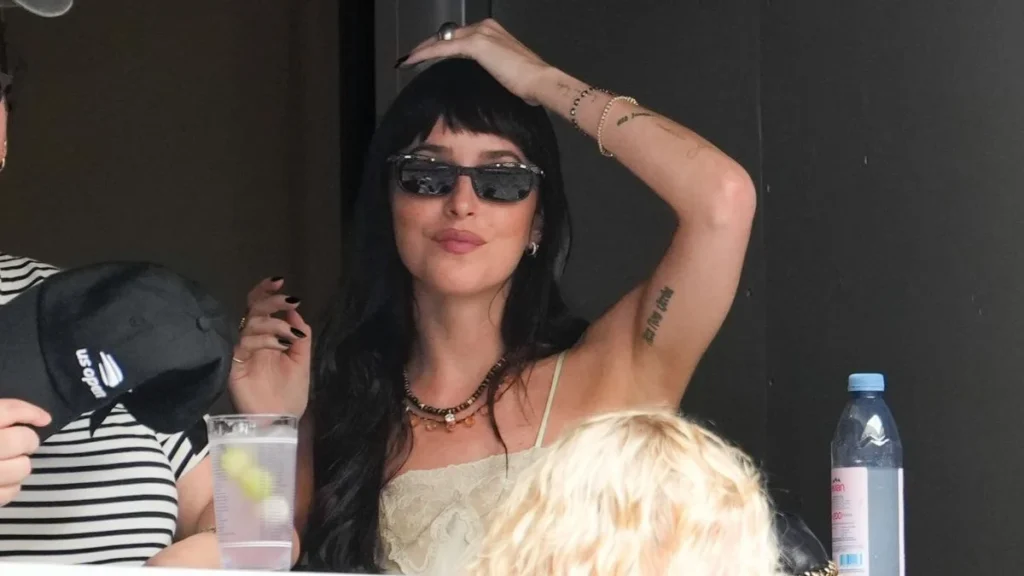

Dakota Johnson has once again cemented her status as an international fashion authority, gracing the cover of Vogue in a striking minimalist ensemble that merges high-fashion architecture with understated elegance. Lying against a backdrop of crisp white sheets, the actor effortlessly delivers a masterclass in modern luxury, wearing a butter-yellow bustier dress designed by the storied luxury fashion house Jil Sander. The visual presentation of the magazine cover underscores a prevailing shift in contemporary style toward refined minimalism—a movement characterized by clean lines, muted color palettes, and a conscious rejection of overt ostentation.
The striking image, captured by acclaimed fashion photographer Larissa Hofmann, showcases Johnson in a strapless, structured corseted bodice that accentuates her waist while gathered satin drapes fluidly down her frame. With the short hemline riding high upon her thighs, the silhouette is both daring and effortless. Reclining softly on one arm—revealing a delicate forearm tattoo—Johnson gazes directly into the camera lens, establishing an intimate, relaxed bedroom aesthetic that strips away the traditional artifice of high-fashion photography in favor of authentic vulnerability.
Anatomy of a Cover Shoot: Behind the Scenes with Vogue’s Creative Team
The creation of the Vogue cover and accompanying editorial spread required a meticulously coordinated effort by some of the industry’s most sought-after creative talents. Fashion editor Tonne Goodman helmed the styling direction, deliberately keeping accessories to an absolute minimum to ensure that the architectural integrity and subtle hue of the Jil Sander dress remained the undisputed focal point of the narrative.
The aesthetic choices extended seamlessly into hair, makeup, and grooming. Hair artist Mark Townsend opted for a style that honors Johnson’s signature look, leaving her dark locks loose and unstructured, anchored by the blunt bangs that have long served as one of her most recognizable physical traits. Makeup artist Georgie Eisdell cultivated a fresh, luminous complexion, accentuating Johnson’s features with soft pink lips and understated, natural eye makeup. Manicurist Emi Kudo completed the understated glamor with a neat, neutral manicure that harmonized with the butter-yellow palette of the wardrobe.
The choice of Jil Sander as the primary fashion vehicle for the cover is deeply symbolic. The brand, historically celebrated for its uncompromising commitment to sleek, high-end minimalism, serves as an extension of Johnson’s personal sartorial philosophy. Rather than leaning toward loud prints or heavy embellishments, Johnson routinely gravitates toward quiet luxury pieces that feel fresh, modern, and timeless. The soft butter-yellow shade of the bustier dress introduces a delicate, romantic warmth, softening the severe geometry of the garment and aligning with seasonal shifts toward pastel and neutral infusions in luxury ready-to-wear collections.
A Cinematic Retrospective: From Commercial Blockbusters to Acclaimed Indies
Beyond the high-fashion imagery, the accompanying Vogue feature offers a comprehensive retrospective of Johnson’s diverse and expanding cinematic portfolio. Over the past decade, Johnson has systematically dismantled the constraints of typecasting, building a filmography that bridges commercial blockbusters with critically acclaimed independent cinema.
Her breakout role as Anastasia Steele in the massively successful Fifty Shades trilogy thrust her into the epicenter of global pop culture between 2015 and 2018. While the franchise brought unprecedented commercial visibility, Johnson leveraged that platform to pivot toward intellectually challenging and character-driven projects. This transition yielded compelling performances in Luca Guadagnino’s psychological horror remake Suspiria (2018), the neo-noir thriller Bad Times at the El Royale (2018), and the psychological drama The Dark Daughter (2021), directed by Maggie Gyllenhaal and adapted from the novel by Elena Ferrante.
In recent years, Johnson has continued to diversify her artistic output. She entered the realm of major superhero franchises by starring as Cassie Webb in Sony’s Madame Web (2024). Although the film received mixed reactions from critics and audiences alike, it further demonstrated Johnson’s willingness to take commercial risks within major studio ecosystems. Furthermore, through her production company, TeaTime Pictures—founded alongside producer Ro Donnelly in 2019—Johnson has actively taken control of her creative destiny, focusing on projects that center female narratives and fresh storytelling perspectives.
Looking Ahead: The Anticipated Adaptation of Colleen Hoover’s Verity
The Vogue feature also casts a spotlight on Johnson’s high-profile upcoming projects, most notably her starring role in Verity. The feature film is an adaptation of Colleen Hoover’s sensational psychological thriller novel of the same name, a book that has dominated bestseller lists and captured the imaginations of millions of readers worldwide.
Verity follows the story of struggling writer Lowen Ashleigh, who is hired by Jeremy Crawford to complete the remaining books of a successful series written by his incapacitated wife, Verity Crawford. Upon arriving at the Crawford family home, Lowen discovers an unfinished autobiography filled with chilling, dark admissions that upend her understanding of the household.
The casting of Johnson in the project has generated significant anticipation within the literary and cinematic communities. Given her proven ability to navigate complex psychological landscapes—demonstrated in works like The Lost Daughter and Suspiria—industry analysts view Johnson as an ideal choice to anchor a suspenseful, morally ambiguous narrative. The adaptation represents a strategic convergence of literary intellectual property and star power, positioning the film as one of the most anticipated releases in development.
The Economic and Cultural Implications of Quiet Luxury
The resonance of Dakota Johnson’s Jil Sander cover extends far beyond the glossy pages of a fashion magazine, serving as a case study in contemporary cultural economics. The fashion industry’s ongoing pivot toward "quiet luxury"—a trend defined by high-quality materials, understated branding, and timeless silhouettes—has proven to be more than a fleeting aesthetic preference. It reflects a broader consumer psychological shift favoring longevity and discretion over conspicuous consumption.
When a global style icon like Johnson aligns with a minimalist house like Jil Sander on the cover of a publication as influential as Vogue, it validates the commercial viability of subtlety. Market analysts note that editorial placements of this nature routinely trigger immediate spikes in consumer demand for neutral tones, structured tailoring, and minimalist accessories. Retail data following similar high-profile minimalist moments typically reveals an increased interest in independent luxury houses over logo-heavy heritage brands, as consumers seek out garments that convey sophistication through cut and fabric rather than explicit branding.
Moreover, the timing of the feature—sandwiched between major cinematic announcements and the ongoing evolution of her production company—reinforces Johnson’s calculated personal branding. Every public appearance, editorial choice, and career move is part of a cohesive narrative that portrays her not merely as an actor for hire, but as a multi-dimensional tastemaker capable of influencing both box office revenues and global fashion trends.
Industry Reception and Societal Resonance
Public and critical response to the Vogue cover has been overwhelmingly positive, with fashion critics praising the authenticity of the shoot. In an era where digital alterations and heavily stylized photo shoots often distance subjects from reality, the intimate bedroom aesthetic captured by Larissa Hofmann feels refreshing. By presenting Johnson in a relaxed, unguarded posture, the magazine achieves a delicate balance between high glamour and human approachability.
Colleagues and industry peers have frequently noted Johnson’s distinct ability to command a room without demanding it. Her signature nonchalance—often displayed during red carpet appearances and press tours—translates seamlessly into print. This effortless aura has made her a favorite among luxury creative directors who seek to project modern sophistication rather than old-world formality.
As Dakota Johnson continues to balance her demanding schedule as both an actor and a producer, her cultural footprint remains expansive. Whether she is stepping onto the red carpet in archival couture, leading a major psychological thriller, or redefining minimalist fashion standards on the cover of Vogue, she consistently demonstrates a rare mastery over her public narrative. The Jil Sander cover is not merely a momentary snapshot of transient style, but a definitive marker of an enduring career built on intentionality, grace, and an unwavering commitment to personal authenticity.