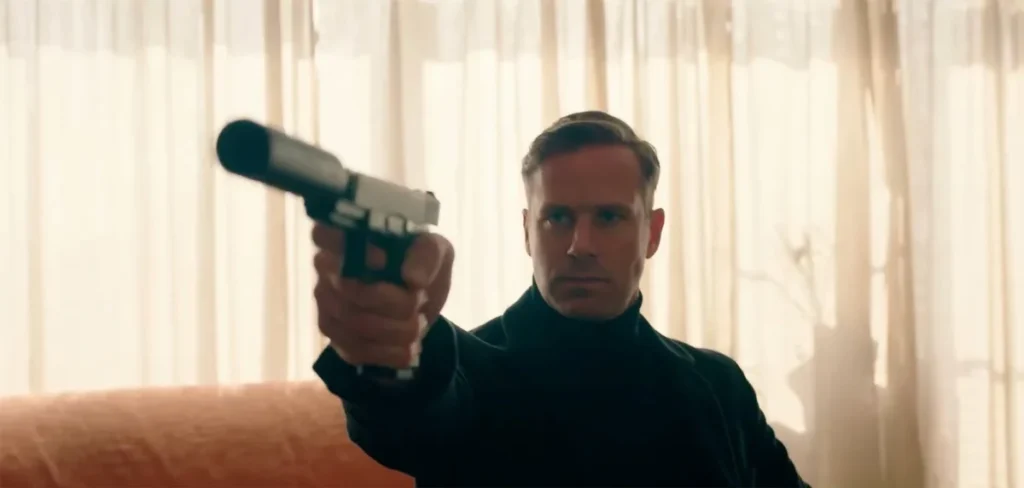

Quiver has unveiled the official trailer for "Citizen Vigilante," an action-thriller helmed by the prolific German filmmaker Uwe Boll, marking his return to feature filmmaking since "First Shift" released a few years prior. The film stars Armie Hammer in a role that signifies his attempt at a professional resurgence. This release arrives amidst ongoing public discourse surrounding Hammer’s career and personal life, a context that inevitably shapes the reception of any new project he undertakes. The trailer itself, released via YouTube, offers a glimpse into a narrative that Boll has described as "an action film inspired by real events, based on real cases and a commentary about injustice."
The film’s plot centers on Sanders, an American expatriate residing in Zagreb, Croatia. Sanders, portrayed as a wealthy businessman who inherits a substantial real estate empire, is also depicted as emotionally scarred and isolated. This personal turmoil, coupled with a perceived breakdown in the justice system, compels him to adopt the persona of a vigilante. He embarks on a mission to target criminals, rapists, and corrupt judicial figures who have allegedly evaded meaningful consequences. As Sanders’s clandestine operations escalate, his actions gain significant traction, both online and within traditional media outlets. This public attention positions him as a divisive figure: a wanted criminal in the eyes of law enforcement, yet an unlikely folk hero to a segment of the populace.
The narrative further introduces Interpol Chief Henry, played by Costas Mandylor, who views Sanders not as a hero but as a dangerous threat to societal order. Chief Henry initiates an aggressive international pursuit, aiming to apprehend Sanders before his influence and the vigilante movement he inspires spiral out of control. The supporting cast comprises local actors from Croatia, reflecting the film’s primary filming location and lending an air of authenticity to the international setting.

Uwe Boll, a filmmaker with a substantial and often controversial filmography, has been a consistent presence in the direct-to-video and independent film circuits for years. His previous directorial efforts include titles such as "Blackwoods," "House of the Dead," "Alone in the Dark," "BloodRayne," "Seed," "Postal," and the "Rampage" trilogy, among many others. "Citizen Vigilante" continues Boll’s trend of producing films that often delve into themes of societal breakdown, individual justice, and the limitations of established institutions. The film’s production is credited to Uwe Boll and Boris Velican, with Event Film and Borvel Film serving as production companies.
Release and Distribution Strategy
"Citizen Vigilante" is slated for a direct-to-Video on Demand (VOD) release on June 19th, 2026. This distribution strategy is a common approach for films of this genre and production scale, allowing for wider accessibility without the traditional theatrical release window and its associated marketing costs. The timing of the release in early summer suggests an attempt to capture audience attention during a period often associated with increased leisure time and home entertainment consumption.
Contextualizing Armie Hammer’s Role
The casting of Armie Hammer in a leading role is a significant aspect of "Citizen Vigilante’s" public profile. Hammer’s career experienced a precipitous downturn in early 2021 following numerous allegations of sexual assault and abusive behavior. These accusations led to the cancellation of several high-profile projects and a period of public scrutiny that effectively sidelined his acting career. His involvement in "Citizen Vigilante" marks one of his first prominent roles since these allegations surfaced.
The decision to cast Hammer has inevitably sparked debate and discussion. For filmmakers like Uwe Boll, who often operate outside the mainstream studio system, casting actors facing career challenges can be a strategic choice, potentially securing talent that might otherwise be unavailable. However, for audiences and industry observers, it raises questions about accountability, rehabilitation, and the ethical considerations of providing a platform to individuals accused of serious misconduct. The film’s trailer and subsequent marketing efforts are likely to be closely scrutinized for how they address or sidestep these controversies.

Uwe Boll’s Cinematic Philosophy and "Citizen Vigilante"
Uwe Boll has frequently articulated a perspective that critiques systemic failures and champions individual agency, often in extreme or violent forms. His films often explore themes of corruption, power imbalances, and the frustration of ordinary citizens with ineffective or compromised institutions. "Citizen Vigilante," with its premise of a wealthy businessman taking justice into his own hands, aligns with these recurring motifs in Boll’s work.
The filmmaker’s assertion that the film is "inspired by real events" and a "commentary about injustice" suggests an intent to tap into contemporary societal anxieties. In an era marked by widespread concerns about crime, judicial leniency, and political corruption, the concept of a vigilante figure who operates outside the law to achieve perceived justice can resonate with certain audiences. However, the portrayal of such a figure also carries inherent risks, potentially glorifying violence or simplifying complex societal issues.
Potential Repercussions and Audience Reception
The success or failure of "Citizen Vigilante" will likely be measured not only by traditional metrics like viewership numbers but also by the broader public and critical response. The film’s association with both Uwe Boll and Armie Hammer places it in a unique position. Boll’s dedicated fanbase, often drawn to his unvarnished and often provocative filmmaking style, may embrace the project. Conversely, critics and a more mainstream audience might approach it with skepticism, given the controversial nature of both the director and the lead actor.
The film’s direct-to-VOD release strategy mitigates some of the pressures associated with a wide theatrical rollout, allowing it to find its audience more discreetly. However, in the digital age, online discourse can amplify both praise and criticism rapidly. Social media platforms and film review sites will likely become key arenas for discussion and debate surrounding "Citizen Vigilante," its themes, and its controversial figures.

The narrative of a wealthy individual leveraging his resources to enact justice, while simultaneously becoming a public figure, also touches upon themes of class, privilege, and the public’s fascination with figures who challenge established norms. The film’s commentary on injustice, as described by Boll, will be crucial in determining whether it offers a nuanced exploration of these complex issues or a simplistic endorsement of vigilantism.
Broader Implications for the Film Industry
The release of "Citizen Vigilante" could be seen as a micro-case study in the evolving landscape of film production and distribution, particularly concerning actors facing public backlash. It highlights the continued willingness of some independent filmmakers to work with talent that has been ostracized by larger studios. This raises ongoing questions about redemption, forgiveness, and the role of art in reflecting or shaping societal attitudes.
Furthermore, Uwe Boll’s sustained output, despite often facing critical dismissal, underscores the viability of direct-to-video and VOD markets for filmmakers with a distinct vision and a dedicated following. The ability to bypass traditional gatekeepers allows for a more direct connection with an audience that may not be catered to by mainstream cinema.
The film’s exploration of vigilante justice, a recurring trope in popular culture, also invites analysis of how contemporary narratives engage with this theme. In a world grappling with issues of systemic inequality and perceived governmental overreach, the allure of the lone hero who takes matters into his own hands remains potent, yet the ethical implications of such actions are increasingly subject to scrutiny. "Citizen Vigilante" arrives at a time when these discussions are more prevalent than ever, and its reception will undoubtedly be shaped by these broader societal conversations. The film’s success, or lack thereof, will be a point of interest for industry observers and audiences alike, as it navigates the intersection of controversial talent, provocative themes, and a shifting distribution paradigm.