
Architectural Context and Neighborhood Heritage
The property is situated in Portland’s East End, a neighborhood characterized by its dense concentration of Victorian-era architecture and its proximity to Casco Bay. Munjoy Hill, once a predominantly working-class enclave for immigrants working on the nearby Grand Trunk Railway, has undergone a significant cultural and economic transformation over the last two decades. Today, it is one of the most sought-after residential areas in Maine, prized for its views of sailboats and the "calendar islands" of the bay.

The home itself dates back to approximately 1850, a period when Portland was expanding rapidly as a commercial port. Homes from this era often feature a mix of Greek Revival and Italianate influences, though many in the East End were built with a sturdy, utilitarian vernacular suited to the coastal climate. Over 170 years, the house had been subjected to various renovations and subdivisions, leaving behind what the designers described as an "awkward warren of doorways" and "stairs to nowhere"—remnants of back staircases from when the building likely served as a multi-unit dwelling. The challenge for Witherbee and Barton was to resolve these spatial inconsistencies without erasing the "playful quirks" that define the building’s character.
The Design Philosophy: Heirloom-Driven Restoration
The homeowners approached Insides Studio with a curated "trove of treasures." This included a needlepoint rug that had transitioned through various apartments, an antique cabinet formerly owned by a grandmother, a rooster weathervane, and a series of 18th-century satirical engravings by William Hogarth. In modern interior design, such items are often relegated to secondary roles; however, Barton and Witherbee opted for a "slow design" approach, where the architecture was modified to accommodate the objects.

This methodology is reflected in the dining room, where the walls are finished in Farrow & Ball’s "String No. 8," a warm, neutral tone that provides a gallery-like backdrop for the family’s eclectic furniture. The space is grounded by a custom oilcloth rug by Black Point Mercantile and features a modernist hanging lamp by Ron Rezek, juxtaposed against antique dining chairs sourced from M. Kardana. The inclusion of a 20th-century tortoise glass trumpet vase and a metal leaf sculpture by Elizabeth Atterbury exemplifies the designers’ ability to mix high-modernist elements with traditional craftsmanship.
Spatial Chronology and Structural Challenges
The renovation followed a logical progression, starting with the heart of the home. The kitchen was the initial focus, requiring a complete transformation of its millwork and layout. A significant hurdle was a chimney that occupied valuable floor space, along with a non-functional pass-through that hinted at the home’s previous service-oriented layout.

The Kitchen and the "Living Pantry"
Rather than removing the pass-through, the designers reimagined it as a "working, living pantry." This small transitional space between the kitchen and dining room was polished into a dedicated area for displaying dishware, antique molds, and the family’s extensive cookbook collection. This decision transformed a structural vestige into a highly functional organizational hub. The kitchen millwork, executed by Good Cube Studio, introduced a sense of contemporary order while respecting the home’s scale.
The Living Room and Library
The project then moved to the former parlor, which was converted into a library and music room. This space presented the most complex spatial challenge due to the fixed positions of a fireplace and a piano. To maximize the 3,000-square-foot footprint, the designers installed custom bookshelves and a banquette reading nook in the window, featuring cushions by Home Remedies Maine. The lighting choices—including Dana Arbib "Fusto" sconces from Tiwa Gallery and a Noguchi Akari pendant—provide a warm, layered glow that highlights the family’s collection of Hogarth engravings above the piano.

The Playroom: Order Within Chaos
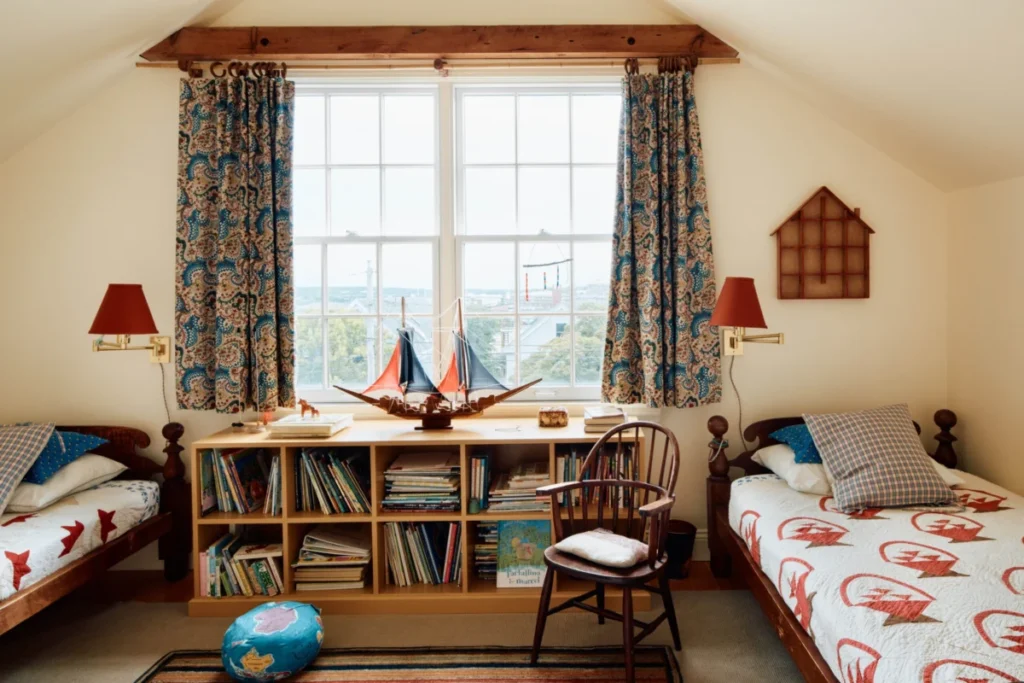
A dedicated playroom was designed to embrace what the homeowners call "cozy chaos." The designers leaned into the room’s irregular geometry, sealing off unneeded doorways to create a more cohesive flow. Hidden cabinets were installed to manage toy storage, while a small homework desk paired with an Artek Aalto 60 stool provides a dedicated workspace for the children. East London Cloth café curtains filter the Maine sunlight, creating a soft, focused environment.
Materiality and Local Craftsmanship
A defining feature of the Insides Studio aesthetic is the sophisticated use of textiles. Throughout the Munjoy Hill home, tactile elements are layered to create a sense of history and comfort.

- Textile Integration: The primary bedroom features a bedskirt made from 1980s Ralph Lauren fabric, while a primary bathroom is accented with a Baina Matheson bath sheet in moss and an Autumn Sonata shower curtain.
- Custom Millwork: North Road Woodwork provided the custom bookshelves and benches that allow the home’s various collections to be displayed intentionally.
- Antique Sourcing: The first-floor bathroom features an antique medicine cabinet found at a Maine flea market, paired with contemporary Rejuvenation mirrors and Charlotte Perriand sconces.
This reliance on local Maine artisans and high-end European textiles creates a global-yet-local feel, appropriate for a port city like Portland.
Supporting Data: The Value of Preservation
The renovation of the Munjoy Hill property aligns with broader trends in the American luxury real estate market. Data from the National Trust for Historic Preservation suggests that "older, smaller, better" buildings often contribute to more resilient and culturally vibrant neighborhoods. In Portland, where the median home price has seen a steady increase, the investment in high-quality interior architecture and the preservation of 19th-century shells significantly enhances property valuation.

Furthermore, the "slow design" movement—which prioritizes the use of inherited and antique items—is increasingly recognized for its sustainability. By reusing furniture and textiles across generations, the homeowners have reduced the carbon footprint associated with new furniture manufacturing and shipping, a factor that is increasingly important to the demographic of young families moving into Portland’s East End.
Broader Impact and Design Implications
The success of the Munjoy Hill project demonstrates that 19th-century homes do not need to be "gutted" to accommodate modern life. Instead, by working with the "stairs to nowhere" and the "Frankensteined" layouts of the past, designers can create spaces that feel both authentic and innovative.

The project also highlights the psychological importance of "personal relics." As noted by the homeowner, the items passed down from parents and grandparents are "practical and poignant." In a rapidly changing digital world, the physical presence of family history within the home provides a sense of continuity and grounding.
Kacee Witherbee and Juliana Barton have proved that the most successful designs are often those that listen to the house. By observing the way light hits a 170-year-old window or how a family moves through a warren of doors, Insides Studio has crafted a residence that is not just a place to live, but a vessel for the family’s future history. The home stands as a testament to the idea that the most modern way to live is often by surrounding oneself with the best of the past.