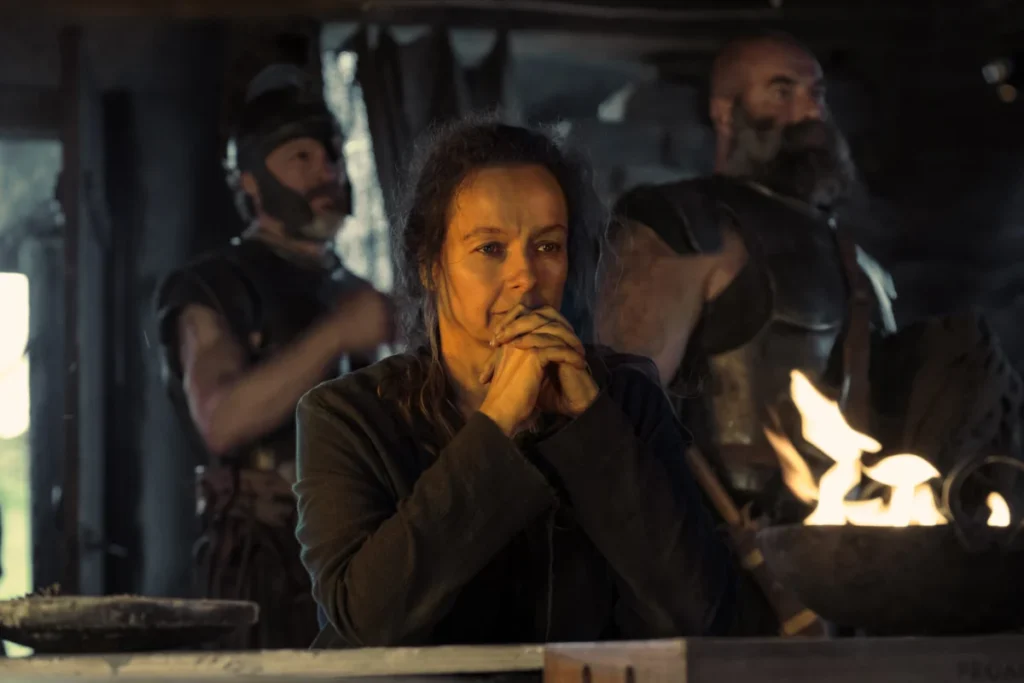

Christopher Nolan’s highly anticipated epic, The Odyssey, a cinematic reimagining of Homer’s ancient tale, has captivated audiences and critics alike, not least for a performance that has garnered singular praise from the visionary director himself. Despite a star-studded ensemble cast featuring Hollywood heavyweights such as Matt Damon, Anne Hathaway, Zendaya, and Tom Holland, it is the British actress Samantha Morton, in the pivotal role of the sorceress Circe, who has emerged as a surprising focal point of the film’s pre-release discourse and subsequent critical reception. Nolan’s extraordinary commendation of Morton’s work, drawing a parallel to Heath Ledger’s iconic portrayal of the Joker in The Dark Knight, has ignited significant interest, setting an exceptionally high bar which, by all accounts, Morton has not only met but resoundingly exceeded.
The Genesis of Buzz: Nolan’s High Praise
The buzz surrounding Morton’s performance began weeks before the film’s official premiere, largely fueled by Christopher Nolan’s own emphatic statements. In an interview with The Los Angeles Times on July 7, 2026, Nolan declared, "There are no limitations on her performance. After one of her takes, the crew gave her a great round of applause…. The last time that had happened [in one of my movies] was with Heath Ledger on The Dark Knight." This statement, from a filmmaker renowned for his meticulous craft and often reserved public commentary, immediately resonated across the industry. The comparison to Heath Ledger’s posthumously Oscar-winning performance, a benchmark for on-screen intensity and transformative acting, signaled to audiences and critics that something truly remarkable was in store. Such an endorsement from Nolan is not merely a compliment but a profound testament to an actor’s unique ability to transcend the script and deliver an unforgettable cinematic moment.
Circe Unveiled: A Barnburning Sequence
Morton’s pivotal sequence as Circe, the enigmatic witch-goddess from the mythical island of Aeaea, is described as a "barnburning" moment that dramatically shifts the film’s extensive narrative energy. The scene unfolds as the desperate survivors of Odysseus’s crew, washed ashore on a mysterious beach, seek refuge. Circe, perceiving their primal desperation, famously transforms them into pigs – a sequence brought to life with Christopher Nolan’s signature commitment to "dazzling practicality" rather than heavy reliance on digital effects. This commitment to tangible, in-camera magic underscores Nolan’s artistic vision and enhances the visceral impact of Morton’s performance.
The narrative then pivots with the arrival of Odysseus himself, played by Matt Damon. It is only after Odysseus kills a man disguised as a deer, a symbolic act of understanding and defiance, that he convinces Circe to revert his men to human form. Following this, Morton delivers a monologue with "singular verve," wherein Circe lays out the perilous path Odysseus must navigate to return to Ithaca and his awaiting family. This monologue is not merely exposition; it is a moment of profound character revelation, imbued with Morton’s distinctive ability to convey complex emotions and ancient wisdom through understated yet powerful delivery. Her performance captures Circe’s multifaceted nature – simultaneously menacing and guiding, ancient and strangely contemporary.
A Career Defined by Depth: Samantha Morton’s Journey
Samantha Morton’s ascent to this highly praised role is the culmination of a dynamic and varied career spanning over three decades. Born in Nottingham, England, Morton began acting at the remarkably young age of 12, forging a path marked by a consistent commitment to raw, authentic performances. Her early career saw her navigate the British television landscape before gaining international recognition for her powerful dramatic roles.
Morton has twice been recognized by the Academy Awards: first, for her supporting role as Hattie in Woody Allen’s 1999 film Sweet and Lowdown, where she delivered a largely non-verbal yet deeply expressive performance, and subsequently for her leading turn as Sarah in Jim Sheridan’s 2002 semi-autobiographical drama In America. These nominations cemented her reputation as an actress capable of immense emotional depth and nuance.
In more recent years, Morton has skillfully balanced leading roles in critically acclaimed television projects, such as Catherine de’ Medici in The Serpent Queen and Margaret Wells in Harlots, with impactful, albeit shorter, appearances on the big screen. Her ability to command attention and "make her presence count" in just a few minutes of screen time has become a hallmark of her work. This was evident in her performances in awards contenders like 2022’s The Whale, where she played the estranged wife Mary, and She Said, portraying Zelda Perkins, a former assistant to Harvey Weinstein. In both films, Morton’s brief but explosive scenes were credited with "rejiggering the whole chemistry of the film," solidifying her status as a reliable and transformative presence, regardless of the role’s size.

The Odyssey, however, marks a different kind of moment for Morton. It is not just another impactful short role, but a performance that has transcended the typical "scene-stealer" label to become a central talking point in a major Christopher Nolan production. The film’s grandeur and Nolan’s directorial prowess would ensure the visual memorability of Circe’s mystical sequence on its own. That Morton’s performance manages to stand out to such a degree speaks volumes about her unique talent.
The Audition and Creative Process: A Deep Dive
Morton’s path to playing Circe began unexpectedly. Despite her extensive career, she maintains a long-standing relationship with her agents, who have championed her since she was 19. "They’re always rooting for me and suggesting me to casting directors for things," Morton shared with The Hollywood Reporter. This advocacy eventually led to a phone call that would change her trajectory: "Christopher Nolan would like to meet you." Morton recounted her emotional reaction, crying with disbelief and excitement at the prospect of meeting a filmmaker she admired. At the time, she was unaware of the project’s details, let alone the specific role she was being considered for.
Intriguingly, Morton confessed to not having a deep familiarity with Homer’s The Odyssey from her schooling, having been a child actor who missed much of traditional education. Her initial knowledge was largely limited to popular culture references, including a parody episode of The Simpsons. However, upon reading Nolan’s script, she was "blown away" by its contemporary feel and profound resonance.
Her approach to developing Circe was rooted in a deeply personal and instinctive method. While acknowledging the importance of research, Morton deliberately chose not to delve into external interpretations, such as Madeline Miller’s popular novel Circe. She recounted a past experience playing Jane Eyre where extensive research led to conflict with the script. For Circe, she vowed to avoid being "bogged down by everybody else’s interpretation, view, opinion." Instead, she adopted an "old-fashioned" approach, focusing solely on the character as written on the page by Nolan.
Morton’s interpretation of Circe was remarkably contemporary and relatable. "She felt like my sister, my mother, my gran, my aunt, my neighbor," Morton explained. "She felt very real and very condensed." Morton emphasized what she termed "the essential will of Circe," praising Nolan’s ability to create such a fully realized character within a relatively short screen time. She connected with Circe as "every woman," aiming to infuse the role with her own authentic self, to "possess it and own it and be it." This deeply internalized approach allowed her to inhabit the mythical figure with an unparalleled sense of grounding and humanity.
On Set Challenges and Triumphs: Immersed in the Magic
The filming of Circe’s sequence, despite its epic scale and profound impact on the film, spanned approximately ten days. Morton expressed a desire for it to have lasted longer, so immersed was she in the experience. Nolan’s well-documented preference for practical effects over CGI was a significant factor in the production of Circe’s transformations. Morton, having grown up with a love for practical horror films like The Evil Dead and fantasy epics like The NeverEnding Story and The Dark Crystal (with its puppetry), found herself particularly excited by the "magic of it all."
During the actual filming, Morton described being "in Circe mode," fully present and not distracted by the technical complexities around her. Her focus was entirely on getting the character right, detaching from the reality of a film set. She viewed Circe’s creations – the transformed men – as extensions of the goddess’s mind, becoming "one with" them, akin to a puppeteer inhabiting their puppets. This deep immersion allowed for an organic, unforced performance, even leading to spontaneous moments, such as her unexpected humming during a take, which surprised even herself upon reflection. This anecdote highlights the raw, improvisational energy she brought to the role, a testament to her complete surrender to the character.
Nolan’s directorial style proved to be a perfect fit for Morton’s approach. Known for his collaborative spirit and trust in his actors, Nolan provided extensive preparation time and guidance. Morton lauded his notes as consistently "poignant and relevant and right," enhancing her performance rather than dictating it. "If you’re working with somebody brilliant, it makes you better," she stated, emphasizing the mutual trust and respect that characterized their collaboration.

Beyond the Screen: Morton’s Philosophy and Resilience
Morton’s ability to "take charge" on such an epic production, facing a massive crew and acclaimed co-stars, is deeply rooted in her personal history and professional philosophy. Having grown up in the foster care system and children’s homes, she learned early on to fight for her voice and relevance. "I had to fight just to have a voice or to be relevant," she reflected. This experience instilled in her a profound sense of self-worth and the conviction that "I have a right to be here. I’m a human being. I have a right to be here. We’re all just as important as each other."
This core belief has shaped her approach to every project, regardless of its scale or the fame of her collaborators. Recalling her experience on Steven Spielberg’s Minority Report, working alongside Tom Cruise, Morton emphasized the need to "park all of that outside reality stuff at the door, walk in and do the job." For Morton, the set is a space for collaborative work, where hierarchy is set aside in favor of collective effort to create the best possible film. This grounded perspective allows her to approach even the most intimidating productions with confidence and focus, contributing to her reputation as a reliable and dedicated professional.
Her consistency in delivering powerful performances, even in limited screen time, has led some to describe her as "reliable." Morton attributes this to her commitment: "I’ll give it 150 percent, but also I’m really aware it’s not about me." She sees herself as a "good egg" who "turns up with a little bag and gets on with it and then goes away," avoiding the extraneous drama often associated with filmmaking. Her pure love for acting, coupled with her humility, allows her to seamlessly transition between diverse roles, from a historical queen to a mystical goddess, consistently delivering performances that resonate deeply with audiences and critics.
Implications and Future Prospects
Christopher Nolan’s public championing of Samantha Morton’s performance in The Odyssey carries significant weight within the film industry. Such an endorsement from a director of Nolan’s stature not only elevates Morton’s profile but also serves as a powerful validation of her three-decade-long career dedicated to profound, character-driven acting. For an actress who has experienced the "ups and downs" of the industry, including criticism regarding physicality, Nolan’s recognition is deeply emotional and validating. It underscores her talent and unwavering commitment to her craft.
The comparison to Heath Ledger’s Joker is particularly potent. Ledger’s performance became a cultural touchstone, showcasing the profound impact a single, transformative role can have. While Circe’s screen time may be relatively brief in The Odyssey, Nolan’s comments suggest that Morton has achieved a similar level of unforgettable impact. This could lead to a renewed spotlight on her versatility and talent, potentially opening doors to even more high-profile and challenging roles.
Currently, Morton is taking a hiatus from acting, dedicating her time to writing a screenplay and making music, pursuits that further underscore her creative breadth. However, the resounding success of her turn as Circe is likely to reignite demand for her unique abilities. Her performance in The Odyssey solidifies her status not just as a reliable character actor, but as an essential artistic force capable of anchoring and elevating even the most ambitious cinematic endeavors. It is a moment of profound recognition for an actress who has consistently proven the power of depth, presence, and unwavering dedication to her art.