
The Aesthetic of Restraint: Narrative and Visual Overview
Set in British Hong Kong in 1962, the narrative follows two neighbors, Chow Mo-wan (Leung), a journalist, and Su Li-zhen (Cheung), a shipping clerk, who move into adjacent apartments on the same day. Their lives intersect through the shared realization that their respective spouses are engaging in an extramarital affair with one another. Rather than confronting their partners directly or embarking on a vengeful liaison, the protagonists begin a series of clandestine meetings to process their grief.
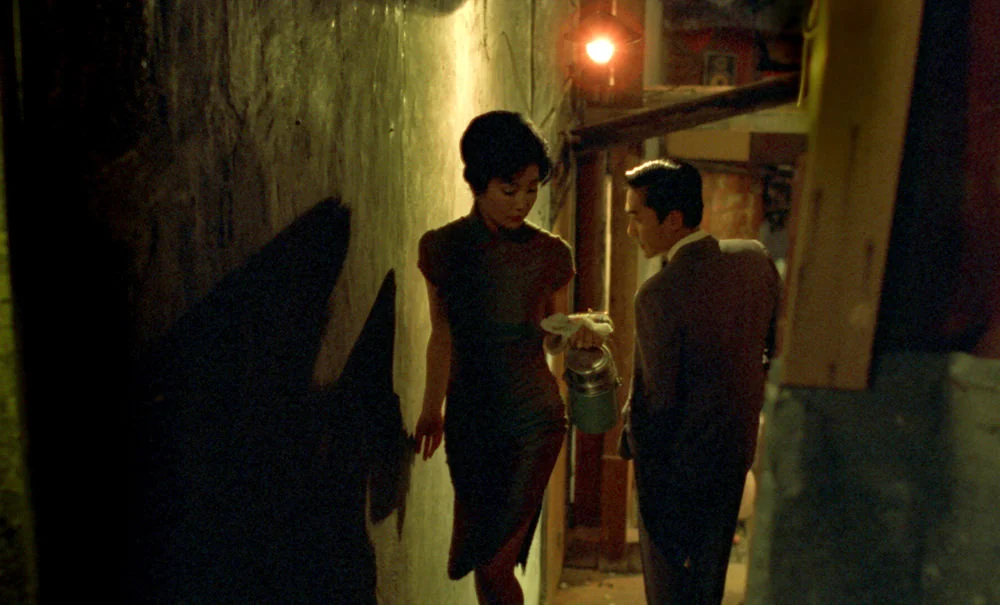
The film is characterized by a "physical, tactile approach" to storytelling. Director Wong Kar-wai utilizes sensory details—the steam from noodle stalls, the lingering haze of cigarette smoke in rainy alleyways, and the rhythmic clicking of manual typewriters—to recreate the claustrophobic atmosphere of 1960s Hong Kong tenement life. This specificity of time and place serves a dual purpose: it provides a lush backdrop for the central performances while emphasizing the social surveillance of the era, where the inquisitive eyes of landladies and neighbors dictate the boundaries of propriety.
Critics have frequently noted that the film is less a traditional love story and more a meditation on the "mood" surrounding love. The relationship between Mr. Chow and Mrs. Chan is defined by what remains unsaid and undone. By choosing to play-act the discovery of their spouses’ affair and rehearse potential confrontations, the characters trap themselves in a cycle of re-enacting their own injuries. This psychological loop suggests a darker undercurrent to their bond; they are perhaps less in love with each other than they are enamored with the shared melancholy of their circumstances.

The Production Paradox: Improvisation and Artistic Conflict
The making of In the Mood for Love is as storied as the film itself, characterized by a protracted and often chaotic production process. Wong Kar-wai is famous for his improvisational style, often beginning production without a completed script and relying on the chemistry of his actors to find the heart of the story. This method resulted in a grueling 15-month shoot that tested the endurance of the cast and crew.
The lack of a definitive script was a particular point of contention for Maggie Cheung. The actress has stated in subsequent interviews that the uncertainty of the characters’ trajectories made it difficult to maintain a consistent emotional arc. This tension reached a breaking point during the filming in Bangkok, which served as a stand-in for 1960s Hong Kong. The production’s haphazard nature also led to the departure of legendary cinematographer Christopher Doyle midway through the project. Doyle, who had been a frequent collaborator of Wong’s, was replaced by Mark Lee Ping-bin, who worked to maintain the film’s signature saturated color palette and voyeuristic framing.
Despite the internal friction, the improvisational approach allowed for the discovery of the film’s most iconic sequences. Wong originally shot scenes that depicted the characters consummating their relationship, including a sequence in a hotel room. However, during the editing process, he decided to excise these moments, realizing that the film’s power lay in the characters’ refusal to "be like" their unfaithful spouses. This editorial choice transformed the movie from a standard drama of infidelity into a profound exploration of moral discipline and the agony of the "almost."
Costume as Chronology: The Role of the Cheongsam
One of the most celebrated aspects of the film is its costume design, handled by William Chang Suk-ping, who also served as the film’s editor and production designer. Maggie Cheung wears 21 different cheongsams (also known as qipao) throughout the film’s 98-minute runtime. These garments are not merely aesthetic choices; they function as a primary narrative device.

Because the film utilizes a repetitive, elliptical editing style—often showing the characters walking to the same noodle stall or passing each other in the same cramped hallway—the changing patterns of the cheongsams are often the only indication that time has passed. The dresses, characterized by high collars and tight tailoring, mirror the social restrictions placed upon Mrs. Chan. They are beautiful but restrictive, symbolizing the "social constrictions" that prevent her from following her heart. The evolution of the floral and geometric prints reflects the shifting emotional states of the protagonists, moving from muted tones to vibrant, clashing patterns as the internal pressure of their hidden relationship intensifies.
The Hitchcockian Shadow: Psychological Subtext and Vertigo
Wong Kar-wai has explicitly linked the film’s psychological DNA to the works of Alfred Hitchcock, specifically Vertigo (1958). In an interview with LA Weekly, Wong noted that he viewed Tony Leung’s character through a lens of "darkness," comparing his sympathetic screen presence to that of Jimmy Stewart.
Wong argued that the audience’s perception of Mr. Chow and Mrs. Chan as "the good guys" is largely a result of the actors’ inherent likability. However, the director pointed out that their behavior—meeting in secret to obsessively act out fictitious scenarios of betrayal—borders on the pathological. "Nobody sees any darkness in these characters," Wong observed, "and yet they are meeting in secret to act out fictitious scenarios… I think this happens because the face of Tony Leung is so sympathetic."
This reading shifts the film’s genre from romance to a psychological thriller of the soul. The characters are not just victims of their spouses; they are participants in a mutual delusion. By re-enacting the affair, they are able to experience the thrill of transgression without the moral guilt, even as it prevents them from achieving true emotional catharsis or moving forward with their lives.

Historical and Cultural Framework: 1960s Hong Kong
The film serves as a nostalgic yet critical look at the Shanghainese diaspora in Hong Kong. Following the 1949 revolution in China, many wealthy and middle-class families from Shanghai fled to Hong Kong, bringing with them their distinct dialect, cuisine, and fashion. Mrs. Chan and Mr. Chow are part of this community, living in a sub-divided apartment building where the boundaries of private life are porous.
The film captures a specific transitional period in Hong Kong’s history, before the rapid modernization of the late 1960s and 70s. The heavy reliance on traditional Shanghainese values—such as "face" and communal reputation—acts as the primary antagonist of the film. The characters are constantly aware of the "Bitter Kitten" nature of their social circle; a single late-night arrival or a misplaced item can spark rumors that would destroy their standing in the community. This historical context provides the necessary stakes for their restraint; their hesitation is not merely a personal choice but a survival strategy in a rigid social hierarchy.
Global Impact and Critical Legacy
Since its premiere at the 2000 Cannes Film Festival, In the Mood for Love has solidified its status as a masterpiece of global cinema. At Cannes, Tony Leung became the first Hong Kong actor to win the Best Actor award, and the film was granted the Technical Grand Prize for its cinematography and production design.
In the decades following its release, the film’s stature has only grown. In 2016, a BBC poll of 177 film critics from around the world ranked In the Mood for Love as the second-best film of the 21st century, surpassed only by David Lynch’s Mulholland Drive. The film’s influence is evident in the "slow cinema" movement and in the work of directors who prioritize atmosphere and visual subtext over traditional plot progression.

The 2020 4K restoration of the film, overseen by Wong Kar-wai himself, brought the movie back to international theaters, introducing its "painfully beautiful" leads to a new generation of viewers. The restoration highlighted the film’s intricate sound design and the haunting score by Shigeru Umebayashi and Michael Galasso, particularly "Yumeji’s Theme," which has become synonymous with the film’s sense of longing.
Conclusion: The Persistence of Memory
Ultimately, In the Mood for Love remains a definitive exploration of the human heart’s capacity for both devotion and self-destruction. It posits that the most powerful loves are those that are never realized, preserved forever in the amber of memory and missed opportunities. By focusing on the "mood" of love rather than its consummation, Wong Kar-wai created a universal story that resonates across cultural boundaries.
The film concludes with a sequence at Angkor Wat, where Mr. Chow whispers his secrets into a hole in a stone wall and plugs it with mud—a metaphor for the private griefs we carry and the stories we choose never to tell. It is a fitting end for a film that argues that beauty, however tragic, is often found in the silence between heartbeats and the shadows of what might have been.