
Veteran actor John Leguizamo has garnered widespread critical acclaim for his poignant portrayal of Eumaeus in Christopher Nolan’s highly anticipated adaptation of The Odyssey, a role that has been hailed as a significant departure from the typecasting that has often defined his illustrious 40-year career. Leguizamo’s performance, described as the emotional "heartbeat" of the film, sees him embody Odysseus’s loyal swineherd, Eumaeus, bringing a profound vulnerability and depth to a character often relegated to the periphery in past interpretations of Homer’s epic. This pivotal role not only showcases Leguizamo’s often-underutilized dramatic range but also represents a personal and professional zenith for the Colombian-American actor, who has frequently voiced his frustration with Hollywood’s tendency to cast him in stereotypical "villain or aggressor or perp" roles. Nolan’s audacious vision for The Odyssey has been lauded for its bold casting choices, challenging traditional industry norms and paving the way for a more inclusive representation in historical narratives.
A Career of Versatility, Often Constrained
John Leguizamo’s four-decade journey in the entertainment industry has been characterized by remarkable versatility, spanning film, television, and acclaimed one-man stage shows. From his early breakout roles in films like Carlito’s Way (1993) and Romeo + Juliet (1996), where he first collaborated with director Baz Luhrmann, to his recurring work with Jon Favreau in projects such as Chef (2014) and The Mandalorian (2019), Leguizamo has consistently demonstrated an ability to inhabit a diverse array of characters. His collaborations with Luhrmann, notably including Moulin Rouge! (2001), showcased his flamboyant theatricality, while his work with Favreau highlighted his comedic timing and dramatic presence.
However, despite his extensive filmography and critical success, Leguizamo has often found himself battling against a pervasive issue in Hollywood: typecasting. He has frequently spoken about the industry’s narrow perception of Latino actors, stating, "It’s as if, because I’m a Latin man, I always have to play the villain or the aggressor or a perp." This sentiment reflects a broader historical trend in Hollywood where actors of color, particularly Latino performers, have struggled to secure roles that transcend stereotypical depictions, limiting their opportunities for complex, nuanced characters. This systemic issue has historically confined many talented individuals to a narrow band of roles, hindering their artistic growth and perpetuating problematic representations on screen.
It is on the stage that Leguizamo has truly found unbridled artistic freedom and garnered significant accolades. His solo performances, including Mambo Mouth (1991), Freak (1998), and Latin History for Morons (2017), have earned him Emmys and Tonys, along with widespread critical acclaim. These one-man shows, deeply personal and often autobiographical, allowed Leguizamo to explore complex themes of identity, culture, and history, showcasing a profound talent for storytelling and character creation that the big screen often failed to capture. These theatrical triumphs served as powerful reminders of the depth and breadth of his capabilities, demonstrating that his potential extended far beyond the confines of typical cinematic roles.
Nolan’s Vision: Redefining Eumaeus
The casting of John Leguizamo as Eumaeus in Christopher Nolan’s The Odyssey emerged as a deliberate and visionary choice, signaling Nolan’s intent to reinterpret the classic epic with fresh perspectives. Nolan, an Oscar-winning director renowned for his intricate narratives, intellectual depth, and visually spectacular filmmaking (e.g., Inception, Dunkirk, Oppenheimer), has a history of pushing cinematic boundaries. His decision to cast Leguizamo in a role traditionally perceived as minor in Homer’s epic poem, and to expand its emotional resonance, underscores his reputation as an auteur who champions unexpected artistic pairings.
Nolan sought out Leguizamo specifically for the role, seeing in him qualities that defied conventional typecasting. During an initial two-hour lunch meeting, Nolan shared his personal aspirations and struggles, fostering a connection that Leguizamo described as "beautiful sharing," revealing a director who was "so present and so vulnerable." It was during this meeting that Nolan presented Eumaeus to Leguizamo not just as a character, but as "the most loyal character in Western literature." This description resonated deeply with Leguizamo, who identifies loyalty as a profound personal virtue and a significant aspect of Latin culture. This specific framing of the character by Nolan was crucial, offering Leguizamo a unique entry point into Eumaeus’s psyche and motivations, distinguishing this portrayal from any previous cinematic or literary interpretation.
In Nolan’s The Odyssey, Eumaeus transcends his literary origins to become a central figure in the narrative. As the faithful servant of Odysseus (Matt Damon), Eumaeus grapples with profound grief over his master’s prolonged absence, a grief that is both personal and deeply tied to his sense of purpose. While holding out hope for Odysseus’s return, he shrewdly operates behind the scenes, counseling Odysseus’s son, Telemachus (Tom Holland), on leadership and deftly maneuvering to protect Odysseus’s wife, Penelope (Anne Hathaway), and their family from the chaos threatening Ithaca. This expanded role allows Eumaeus to be a pivotal emotional anchor, navigating the complexities of loyalty, despair, and resilience. Nolan’s decision to cast Leguizamo, known for his dynamic stage presence and ability to convey complex emotions, brought an unexpected gravity and humanity to Eumaeus, making him a character capable of anchoring the film’s emotional core amidst its epic scale.
The Odyssey’s Grand Scale and Intimate Core

The production of Christopher Nolan’s The Odyssey is emblematic of the director’s signature style, characterized by monumental scope and a meticulous dedication to practical filmmaking, often utilizing IMAX cameras for breathtaking visuals. The film was shot in awe-inspiring locations, including a 900-foot cliff overlooking the Mediterranean, where Leguizamo performed amidst crashing winds and challenging natural elements. These grand, often inaccessible environments, though visually stunning, presented significant logistical and physical demands for the cast and crew, yet Nolan’s commitment to authenticity meant embracing these practical challenges.
Despite this epic backdrop, Nolan masterfully creates moments of profound intimacy. Leguizamo recounts filming a "fever dream" scene within a small shack, with a massive 300-pound camera positioned directly over his face, and Nolan himself standing directly behind it. This hands-on approach, where Nolan is "right behind the camera, old-school," rather than observing from a remote "Video Village," fostered an environment of intense presence and connection between director and actor. This proximity allowed Leguizamo to feel "really seen," enabling him to tap into "really difficult, painful emotions from the depth of my soul," even amidst the overwhelming scale of the production. This duality—epic grandeur intertwined with raw, personal vulnerability—is a hallmark of Nolan’s filmmaking and central to The Odyssey‘s narrative power, allowing Leguizamo’s delicate performance to resonate deeply within a vast cinematic canvas.
Embracing Eumaeus: A Transformative Performance
Leguizamo’s portrayal of Eumaeus is a testament to his commitment to method acting, a technique he credits with profoundly changing his approach to performance. For The Odyssey, this involved an intense physical and emotional transformation. Nolan envisioned Eumaeus as an aged, sight-impaired character, a creative choice that required Leguizamo to undergo extensive prosthetic makeup and wear specially fabricated, hand-painted lenses designed to simulate cataracts. These lenses rendered him legally blind on set, compelling him to internalize the experience of impaired vision.
To prepare for this, Leguizamo engaged in rigorous research and immersive exercises. He studied a high school friend who is legally blind, observing her movements and coping mechanisms. He then practiced navigating his own home with the lights off, memorizing furniture and spaces, mirroring the strategies his friend shared. This methodical approach allowed him to embody the character’s physical challenges authentically, rather than merely imitating them. The aging makeup process itself was arduous, taking six hours on the first day, involving intricate layering by artist Luisa Abel, and techniques like "squeezing the throat and putting glue" to stretch the skin and create age spots.
Beyond the physical transformation, Leguizamo delved into the emotional core of Eumaeus. The character’s unwavering loyalty to Odysseus, his master, and his singular purpose in life—to serve and protect Odysseus’s family—became deeply personal for Leguizamo. He identified strongly with Eumaeus’s sense of duty, linking it to the deep-seated value of loyalty within Latin culture. This connection allowed emotions to flow more freely, making choices for the character feel organic and authentic. Leguizamo found that playing a character closer to his own internal values, rather than a diametrically opposed "villain," allowed him to "mine the depths of the subtleties of all of [his] life experience," resulting in an unprecedented level of vulnerability on screen. The climactic moments of Eumaeus’s emotional breakdown upon Odysseus’s disguised return, where "all of the emotions bubble to the surface," were particularly intense, marking a rare on-screen display of profound vulnerability for the actor. This profound personal and professional investment transformed Eumameus into a fully realized, deeply moving figure, resonating far beyond his traditional role in the epic.
Behind the Scenes: Camaraderie and Craft
The intense production environment of The Odyssey fostered a unique camaraderie among the cast and crew, particularly between John Leguizamo and his co-star, Matt Damon, who plays Odysseus. Despite the gravity of their on-screen relationship, their off-screen dynamic was marked by genuine connection and humor. Leguizamo fondly recalls an incident on set when, during a freezing day of filming where he was dressed in minimal costume, Nolan took off his own coat to offer it to Leguizamo. Matt Damon, ever the comedian, quipped, "I’ve been in the ocean for six months being whipped around and you give him the coat!" highlighting the warm, collegial atmosphere that prevailed.
The bond between Leguizamo and Damon extended beyond the set, with the two exchanging numbers and maintaining a friendship. Damon notably attended one of Leguizamo’s stage plays, a gesture Leguizamo described as "beautiful," and they even shared an experience attending a World Cup match together, witnessing Colombia play Portugal in Miami. Leguizamo describes Damon as "a really genuine, regular, cool guy, and he’s funny. He’s funny as fuck," emphasizing the ease and enjoyment of their interactions. This authentic connection off-screen undoubtedly informed the profound loyalty and emotional depth visible in their characters’ on-screen relationship, particularly in the pivotal scenes where Odysseus, disguised, interacts with his devoted servant.
Beyond cast interactions, Leguizamo provided further insight into Nolan’s distinctive directorial style. Nolan’s preference for being physically present behind the camera, eschewing the common practice of monitoring from a "Video Village," created an immersive environment for the actors. Leguizamo noted that Nolan’s direct presence allowed him to feel "really seen," which was crucial for his method acting approach. He described Nolan watching him "work myself into a mood… talking to myself, jumping up and down, hitting myself, yelling, crying," and then seamlessly transitioning into the scene. This fascination with the actor’s process, coupled with his hands-on directing, allowed for a deeper connection and a more profound exploration of character, ultimately enhancing the raw, emotional power of Leguizamo’s performance.
Global Premiere and Critical Acclaim

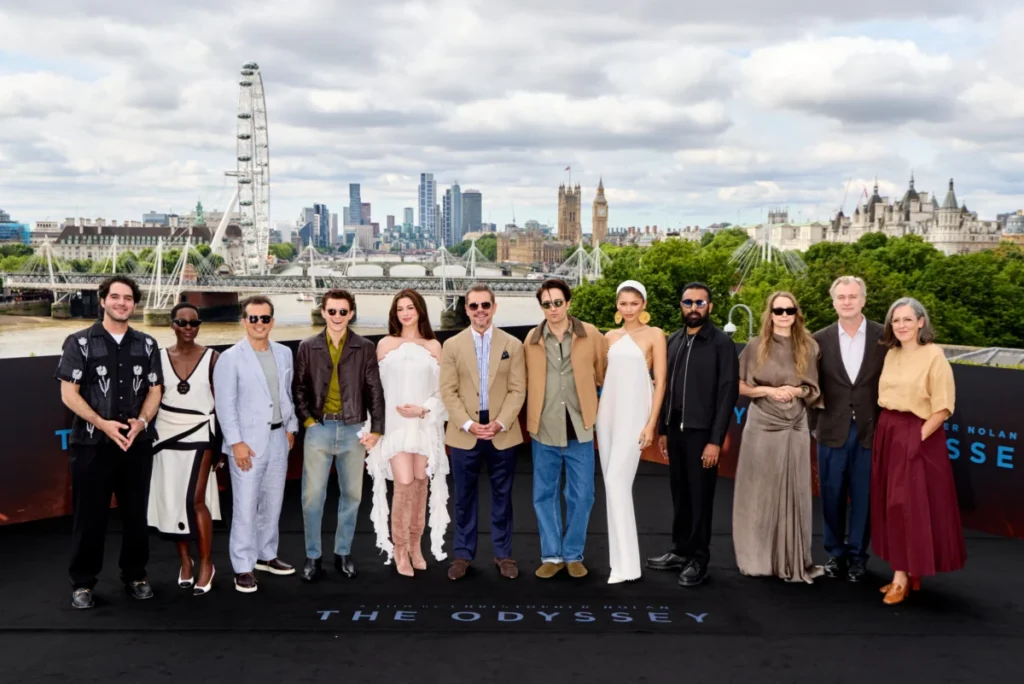
The rollout of Christopher Nolan’s The Odyssey was an event of monumental proportions, reflecting the immense anticipation surrounding the director’s latest epic. John Leguizamo described the London premiere as the "biggest premiere I’ve ever been a part of in my entire life," eclipsing even the spectacular Cannes premiere of Moulin Rouge!. The event featured a colossal Trojan Horse installation and a star-studded red carpet lineup that included the film’s ensemble cast: Matt Damon, Anne Hathaway, Tom Holland, Zendaya, Robert Pattinson, Lupita Nyong’o, Charlize Theron, Benny Safdie, Himesh Patel, and Samantha Morton. The sheer number of high-profile attendees necessitated an unconventional "prom-style, sideways" arrangement for photo opportunities, underscoring the film’s unprecedented scale and star power.
Beyond the public spectacle, Leguizamo cherished the more intimate moments during the global tour, such as sharing dinner with Lupita Nyong’o, Charlize Theron, Nolan, and his wife, or observing Matt Damon with his children. These glimpses into the personal lives of his celebrated colleagues provided a grounding contrast to the overwhelming public fanfare.
The initial viewing of the film for Leguizamo and his wife was a deeply personal and emotional experience. They watched it in Nolan’s preferred theater, Lincoln Square 13, opting for the "optimal" Row G, in a sparsely populated auditorium. Leguizamo recounted the overwhelming impact of the film: "The score is so unbelievably beautiful." His wife, who typically doesn’t cry at movies, was "weeping" and gripped his hand, prompting his own tears. He attributed his emotional reaction, in part, to Matt Damon’s "incredible monologue at the end where he has remorse over his whole entire life," recognizing "the beauty of what Chris did." This early, powerful reception from Leguizamo and his wife foreshadowed the widespread emotional resonance the film would have with audiences and critics alike, particularly for the depth of its character performances.
Beyond Typecasting: A New Era for Period Dramas
Christopher Nolan’s The Odyssey stands as a groundbreaking cinematic achievement, not only for its epic scope and artistic ambition but also for its profound impact on casting conventions, particularly within the genre of period dramas. John Leguizamo lauded the film’s "unbelievably representative" casting, which actively dismantles long-standing barriers in Hollywood. Historically, period films have been predominantly characterized by "all white and all British-sounding" casts, perpetuating a narrow and often historically inaccurate portrayal of diverse societies. Nolan’s The Odyssey decisively breaks this mold by featuring a diverse ensemble with American accents, a choice Leguizamo found "so refreshing" and "more accessible, feels more real."
This approach aligns with a growing movement in the industry towards "colorblind casting," a practice famously exemplified by Lin-Manuel Miranda’s Broadway phenomenon Hamilton. Hamilton demonstrated that casting actors of diverse backgrounds in historical roles not only revitalizes classic narratives but also makes them "so vital, so relatable, so fresh" for contemporary audiences, leading to unprecedented success. Leguizamo passionately asserts that people of color were always present throughout history, challenging the notion that diverse representation in period pieces is anachronistic: "We were all around back then. It wasn’t like we just appeared out of nowhere as a spontaneous generation."
The implications of The Odyssey‘s casting choices are far-reaching. By placing actors like John Leguizamo in pivotal, emotionally rich roles outside of their typical typecast limitations, Nolan has demonstrated that talent transcends ethnicity and that diverse casting can enhance, rather than detract from, the authenticity and resonance of historical narratives. This trend signifies a hopeful shift towards a more inclusive and representative future for Hollywood, where narratives of all eras can authentically reflect the global tapestry of humanity, providing expanded opportunities for a wider range of actors and enriching the cinematic experience for all audiences.
A Personal Zenith
For John Leguizamo, the experience of working on Christopher Nolan’s The Odyssey and his acclaimed performance as Eumaeus represents a profound personal and professional milestone. He articulated a powerful sense of "arrival," describing this period in his career as "the zenith." After four decades in an industry that often struggled to see beyond his ethnicity, this role provided an unparalleled opportunity to fully showcase his dramatic capabilities and embody a character that resonated deeply with his own values.
Leguizamo reflected on the significance of Nolan’s trust: "To be a part of something like that, of a master, craftsman, innovator, a visionary — it’s just so incredible that he saw something in me that would help him bring his dream to fruition." This recognition from a director of Nolan’s caliber is, for Leguizamo, "an incredible compliment that I’ll take with me for the rest of my life." The role of Eumaeus allowed him to channel "all my gifts and everything, all my talent and all my hard work," culminating in a performance that has garnered critical acclaim and deeply moved audiences.
This sense of "landing" or "arriving" signifies more than just a successful project; it speaks to a culmination of years of dedication, overcoming professional frustrations, and finally having his multifaceted talent fully acknowledged on a global stage. Leguizamo’s Eumaeus is not merely a character in a film; it is a powerful statement about artistic potential, representation, and the enduring power of a visionary director to challenge perceptions and unlock new creative horizons for even the most seasoned performers. This transformative role in The Odyssey solidifies John Leguizamo’s legacy as an actor of immense depth and versatility, marking a pivotal moment in his distinguished career and a significant contribution to the evolving landscape of contemporary cinema.