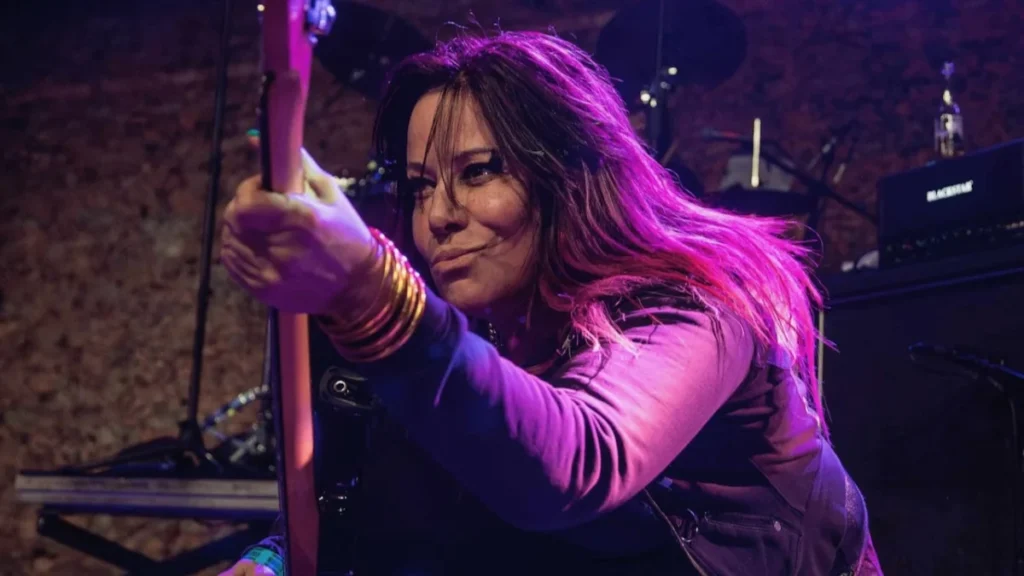

The music world is mourning the profound loss of Jennifer Finch, the foundational and enduring bassist of the trailblazing feminist rock ensemble L7, who passed away at the age of 59. Finch’s death, confirmed late Saturday, July 18th, 2026, followed a courageous but ultimately short battle with an aggressive form of brain cancer, news of which had only recently been made public, galvanizing an outpouring of support from fans and the broader music community.
The somber announcement came from her bandmates in L7, who released a heartfelt statement expressing their profound grief. "We are shattered by the loss of our beloved bandmate, sister and friend Jennifer Finch, whose fierce spirit, humor and boundless creativity helped shape L7 and changed all of our lives forever," the group conveyed. Their message continued, "Jennifer was a true original who lived entirely on her own terms, and the impact she made on music, art and everyone lucky enough to know her cannot be measured. We love her beyond words and will carry her with us always. Rest in power our dear friend." This poignant tribute underscored Finch’s pivotal role not just as a musician, but as a vibrant and influential personality within the alternative rock landscape, embodying the raw energy and unapologetic ethos that defined L7.
A Battle Publicly Supported: Community Rallies for Finch
Finch’s diagnosis of an aggressive brain cancer had been revealed just days prior to her passing, sparking an immediate and overwhelming wave of solidarity across the globe. A GoFundMe campaign was swiftly launched with the aim of providing essential financial relief, covering costs associated with in-home nursing care, crucial physical and speech therapy, specialized medical equipment, and other vital necessities during her final weeks. The rapid and generous response from the public was a testament to Finch’s widespread admiration and the deep connection she forged with her audience and peers throughout her illustrious career. At the time of her death, the campaign had already amassed close to an astonishing $400,000, significantly surpassing its initial goals and demonstrating the immense collective desire to support her. This unprecedented fundraising success highlighted the profound impact Finch had on countless lives, showcasing a community united in its desire to alleviate her and her family’s burden during an incredibly challenging time. The funds raised will now stand as a powerful testament to the lasting affection and respect held for her, potentially aiding her family in managing final arrangements or contributing to a related cause in her memory.
Chronology of a Rebel Spirit: Jennifer Finch’s Musical Journey
Born and raised in the vibrant, eclectic music scene of Los Angeles, Jennifer Finch’s artistic inclinations emerged early, though her path to becoming a revered rock bassist was unconventional. Her initial foray into music was not primarily as an instrumentalist, but rather rooted in a broader creative sensibility that encompassed photography and a keen eye for the cultural zeitgeist of the burgeoning punk and alternative movements.
Early Collaborations and the Genesis of a Scene (Mid-1980s)
Before co-founding L7, Finch was a vital part of the burgeoning underground music scene in Los Angeles during the mid-1980s. She first gained recognition as a member of Sugar Babydoll, a short-lived yet historically significant punk outfit. This early collaboration was notable for featuring other musicians who would go on to achieve iconic status in alternative rock: future Hole frontwoman Courtney Love and Babes in Toyland founder Kat Bjelland. Though Sugar Babydoll’s discography was minimal, its existence underscored Finch’s position at the nexus of a burgeoning movement, connecting her with the architects of what would become the riot grrrl and grunge scenes. These formative experiences undoubtedly honed her raw aesthetic and rebellious spirit, laying the groundwork for her future endeavors, characterized by an unvarnished approach to music and performance.
It was in 1986 that Finch found her true musical home, joining forces with guitarists and vocalists Donita Sparks and Suzi Gardner. Together, they formed L7, a band that would quickly transcend the confines of the Los Angeles club circuit to become one of the most influential and pioneering feminist rock bands of its era. Their name, a slang term for "square" or "uncool," ironically embodied their anti-establishment ethos and their refusal to conform to prevailing industry standards or gender expectations, carving out a unique and uncompromising space in the male-dominated rock landscape.
L7’s Ascent: From Underground to Mainstream (Late 1980s – Mid 1990s)
When Finch joined L7, her bass playing was, by her own admission, rudimentary. Her primary passion then was photography, a skill she would continue to cultivate throughout her life, eventually seeing her work exhibited in prestigious venues like the Rock and Roll Hall of Fame. However, what Finch initially lacked in technical proficiency, she more than compensated for with an electrifying, almost primal stage presence. In a candid 2019 interview with Please Kill Me, Finch famously remarked, "I knew I’d have to make up for my inability to play [with attitude]." This self-aware declaration perfectly encapsulated her approach: an embrace of raw energy, visceral performance, and an unapologetic attitude that became a hallmark of L7’s identity. She channeled her photographic eye into an understanding of visual impact, transforming herself into an undeniable force on stage whose captivating movements and intense focus commanded attention.
Finch’s contributions extended far beyond her formidable stage persona. Her astute networking skills and inherent industry savvy were instrumental in elevating L7’s status from a revered LA underground act to a nationally recognized force. She possessed a unique ability to forge connections and navigate the complex music business landscape, directly contributing to the band securing larger gigs and broader exposure, culminating in their highly visible appearance at Lollapalooza 1994. This participation in one of the decade’s most iconic touring festivals significantly broadened their audience and cemented their status as a major player in the alternative rock explosion, placing them alongside acts like The Smashing Pumpkins, Beastie Boys, and Green Day, and exposing their uncompromising sound to millions.
L7’s discography, shaped by Finch’s rhythmic foundation and creative input, stands as a powerful testament to their enduring legacy. She contributed to five of the band’s studio albums, each a milestone in the development of grunge and alternative rock:
- L7 (1988): Their eponymous debut on Epitaph Records, a raw and energetic introduction to their sound, blending punk aggression with nascent grunge sensibilities. Tracks like "Bite the Wax Tadpole" and "Runnin’ Hot" showcased their unpolished power and cemented their place in the burgeoning independent scene.
- Smell the Magic (1990): Released on Sub Pop, the label synonymous with grunge, this album garnered critical acclaim and a wider audience, featuring tracks like "Shove," which became an indie hit, and "Fast and Frightening," showcasing the band’s burgeoning songwriting prowess and heavier sound. Finch’s bass lines provided a visceral backbone to the album’s powerful tracks, helping define their signature sonic identity.
- Bricks Are Heavy (1992): Their most commercially successful album, released on Slash Records, featured the hit single "Pretend We’re Dead" and solidified L7’s place in the mainstream. It was a critical and commercial breakthrough, peaking at number 169 on the Billboard 200 and achieving gold status in some regions, a remarkable feat for a band of their uncompromising style. Finch’s distinctive bass work on tracks like "Everglade" and "Wargasm" demonstrated her evolving musicality and command of heavy, driving rhythms.
- Hungry for Stink (1994): Following up on the success of Bricks Are Heavy, this album continued to showcase their aggressive, unvarnished sound and further cemented their reputation for hard-hitting rock, with songs like "Andres" and "Fuel My Fire" continuing to push their sonic boundaries.
- Smell the Rats (2019): A triumphant return after a long hiatus, proving their enduring relevance and creative vitality. Finch’s return to the lineup was integral to the album’s authentic L7 sound, contributing to tracks like "Burn Baby" and "The Dispatch."
Beyond her role as bassist, Finch was also a talented songwriter, penning several notable tracks independently. Her solo writing credits include "(Right On) Thru," a track known for its raw energy and directness, "Everglade," which showcased a slightly more melodic yet still powerful side, "One More Thing," and "Shirley," each contributing uniquely to the L7 canon and highlighting her multifaceted artistic contributions, often imbued with a fierce independence and keen observation.
Departure, Hiatus, and Triumphant Return (1996 – 2014)
In 1996, Jennifer Finch made the difficult decision to depart L7. Her exit was prompted by a confluence of personal tragedies and professional pressures, including the devastating death of a close friend who worked as a roadie for the band, combined with growing concerns over her financial future in an often unforgiving music industry. This period marked a significant shift for L7, which continued with other bassists before eventually entering an extended hiatus in 2001, leaving a void that fans keenly felt.
However, the story of Jennifer Finch and L7 was far from over. In 2014, much to the delight of their dedicated fanbase, L7 announced a reunion tour featuring the classic lineup, including Finch. Her return was met with widespread enthusiasm, and she remained an integral part of the band until her passing. The reunion not only brought their iconic live shows back to stages worldwide but also led to the release of Smell the Rats in 2019, demonstrating that their creative fire and collective chemistry remained undimmed. Finch’s presence was crucial to the reunion’s authenticity, reassuring fans that the true spirit of L7, characterized by its unapologetic feminist punk rock, was intact.
Beyond L7: A Multifaceted Artist
Jennifer Finch’s creative energies were not confined solely to L7. She was a prolific artist with diverse interests and projects that showcased her broad talents. She founded her own punk group, The Shocker, further exploring her musical vision and continuing to contribute to the underground scene with her distinctive style and lyrical themes.
Her presence also extended to other iconic moments in 90s alternative rock. In a poignant gesture of solidarity and respect, Finch appeared in Hole’s music video for "Doll Parts," stepping in for bassist Kristen Pfaff, who had tragically died of an overdose in June of that year. This act underscored the tight-knit and often challenging realities of the grunge era, where musicians frequently supported each other through personal and professional adversities, forming a resilient, if sometimes fragile, community.
As mentioned, photography was a lifelong passion for Finch. She meticulously documented much of her career and the vibrant scenes she inhabited through her camera lens. Her compelling photographic work, which captured the raw energy and candid moments of her life and the music world, was eventually featured in several prestigious exhibits, including within the revered halls of the Rock and Roll Hall of Fame. This recognition cemented her status not only as a musician but as a significant visual artist whose perspective offered a unique insight into a pivotal musical era, capturing the unvarnished reality of life on the road and behind the scenes.
The Enduring Legacy of a Pioneer
Jennifer Finch’s passing leaves an irreplaceable void in the landscape of alternative rock. Her impact, both as a musician and as a cultural figure, is profound and multifaceted. She was a vital force in L7, a band that not only produced powerful, uncompromising music but also fiercely challenged the patriarchal norms of the music industry. L7, with Finch as its fierce rhythmic anchor, was a beacon for women in rock, demonstrating that female musicians could be as aggressive, loud, and unapologetic as their male counterparts, without compromise. They were instrumental in carving out a space for female artists to express rage, frustration, and power, paving the way for countless artists who followed and proving that authenticity and raw talent could break through any barrier.
Her personal journey, from a self-proclaimed rudimentary bassist who compensated with unparalleled attitude to a respected songwriter and visual artist, embodies the punk ethos of self-creation and artistic integrity. Finch’s story is a testament to the power of personality and passion in shaping a musical identity that transcended mere technical skill, proving that visceral impact often outweighs technical virtuosity in the realm of true rock and roll. Her unwavering commitment to living on her own terms, as noted by her bandmates, resonated deeply with a generation seeking liberation from societal constraints and yearning for genuine, unadulterated expression.
The overwhelming response to her GoFundMe campaign is a powerful testament to the love and respect she commanded, not just from fans but from across the music community. It highlights the strong bonds within the music community and the deep connection between artists and their audience. Jennifer Finch’s memory will continue to inspire. Her fierce spirit, her groundbreaking work with L7, and her dedication to artistic expression have left an indelible mark on music and culture. She will be remembered not just as a bassist, but as a pioneer, a rebel, and a true original whose influence will reverberate for generations to come. Her "Rest in Power" is a fitting epitaph for a life lived with unwavering conviction and a profound impact on the world she helped to shape.