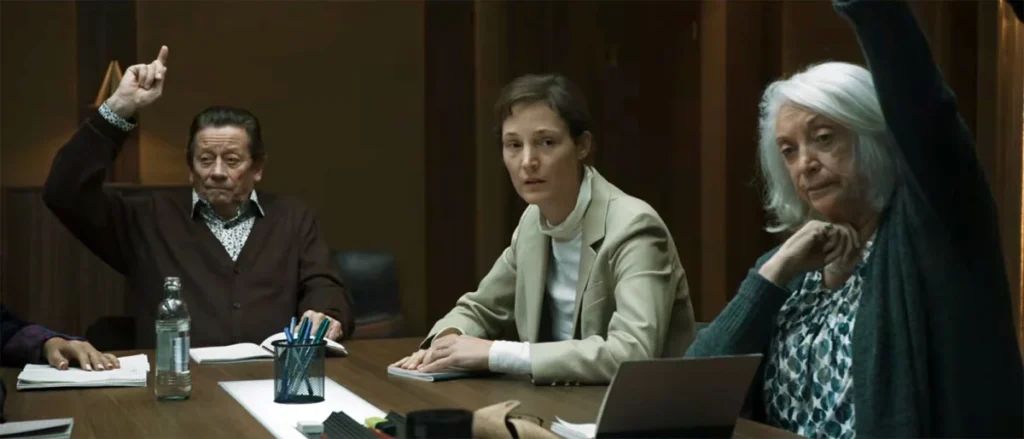

The landscape of modern legal thrillers has received a provocative and unconventional addition with the official trailer release of Re-Creation by distributor Kino Lorber. Directed by the celebrated Irish filmmaker Jim Sheridan in collaboration with co-director David Merriman, the film serves as a contemporary conceptual evolution of Sidney Lumet’s timeless 1957 jury-room classic, 12 Angry Men. Rather than opting for a traditional theatrical rollout, the production bypassed cinemas entirely, premiering initially at the 2025 Tribeca Film Festival before making its way directly to Video-on-Demand (VOD) platforms for home viewing.
Rooted in one of the most high-profile and deeply controversial real-life criminal investigations in modern Irish and French history, Re-Creation dramatizes a fictionalized trial and subsequent jury deliberation examining the 1996 murder of French television producer Sophie Toscan du Plantier. The project brings together an acclaimed ensemble cast featuring Vicky Krieps as Juror #8, alongside performances from Aidan Gillen, Colm Meaney, John Connors, and Jim Sheridan himself. As studios increasingly experiment with alternative distribution pipelines, Re-Creation arrives amid a growing cinematic subgenre exploring the complexities of the judicial process, echoing thematic elements found in recent releases such as Clint Eastwood’s Juror #2.
Background Context and the Real-Life Case
To fully appreciate the narrative framework of Re-Creation, one must understand the haunting shadow cast by the actual events of December 1996. Sophie Toscan du Plantier, a 39-year-old French film and television producer, was found brutally murdered outside her holiday home in the remote coastal area of Schull, County Cork, Ireland, just days before Christmas. The crime sent shockwaves through the quiet rural community and triggered an exhaustive transnational investigation that would span decades, straining diplomatic relations between Ireland and France while exposing profound flaws in investigative procedures.
The primary suspect in the decades-long saga was British journalist Ian Bailey, who lived near the victim’s property. Although Bailey was never charged by Irish authorities due to what the Director of Public Prosecutions deemed an insufficient evidentiary threshold, he became the target of intense public scrutiny, media sensationalism, and civil litigation. In a landmark legal proceeding that unfolded in Bailey’s absence, a French court convicted him in absentia of murder in 2019, sentencing him to 25 years in imprisonment.

Despite the French conviction, Irish courts repeatedly denied French extradition requests, ruling that returning Bailey to France would violate his constitutional rights due to systemic flaws in how the initial Irish police investigation was conducted. Bailey steadfastly maintained his innocence until his death in early 2024, leaving behind a legacy defined by unanswered questions, competing narratives, and an absence of definitive forensic closure. It is precisely this vacuum of absolute certainty that Sheridan and Merriman exploit in Re-Creation, transforming a real-world miscarriage of closure into an intellectual exercise in societal judgment.
Chronology of Production and Distribution
The genesis of Re-Creation traces back to an original concept conceived by Jim Sheridan, a six-time Academy Award nominee renowned for his profound explorations of justice, institutional corruption, and Irish history through films such as My Left Foot (1989), The Field (1990), and In the Name of the Father (1993). Partnering with first-time narrative feature director David Merriman—best known for his documentary and social-advocacy work, including Rock Against Homelessness—Sheridan sought to craft a hybrid cinematic experience that blurs the lines between documentary investigation and dramatic recreation.
Financed independently and produced by Fabrizio Maltese and Tina O’Reilly, the film completed principal photography ahead of its international debut. The timeline of the project highlights a measured approach to festival circuits and targeted distribution:
- December 1996: The murder of Sophie Toscan du Plantier occurs in County Cork, setting off a decades-long international legal battle.
- May 2019: A French court convicts British journalist Ian Bailey in absentia, a verdict unrecognized under Irish jurisdiction.
- January 2024: Ian Bailey passes away in Ireland, leaving the legal case permanently unresolved without a domestic conviction.
- June 2025: Re-Creation makes its world premiere at the Tribeca Film Festival, drawing critical attention for its bold structural premise.
- October 2026: Kino Lorber acquires and officially releases the trailer alongside an immediate VOD rollout, bypassing traditional theatrical distribution entirely.
Supporting Data and Ensemble Cast Dynamics
At its structural core, Re-Creation operates as a chamber drama driven almost entirely by the psychology of its ensemble cast. The narrative centers on twelve jurors assembled in a closed room, tasked with weighing the evidence, evaluating the testimonies, and determining the theoretical guilt or innocence of the late Ian Bailey—portrayed in the film’s complex fabric by Colm Meaney—for the murder of Sophie Toscan du Plantier.

The film relies heavily on the nuanced performances of its international cast:
- Vicky Krieps anchors the dramatic tension as Juror #8, serving as the moral compass and the primary dissenting voice who pushes back against a rushed consensus, mirroring Henry Fonda’s iconic role in 12 Angry Men.
- Colm Meaney steps into the shadow of the central figure, embodying the gravity and complexity associated with the media figure at the heart of the controversy.
- Aidan Gillen and John Connors round out the deliberation room, bringing palpable tension, ideological friction, and ideological diversity to the jury box.
- Jim Sheridan not only co-directs and co-writes the picture but also makes an on-screen appearance, infusing the production with his characteristic auteur presence.
Official Responses and Artistic Intent
In promotional statements accompanying the launch, the filmmaking duo emphasized that Re-Creation was never intended as a definitive reinvestigation or a judicial verdict, but rather as an exploration of how human beings construct narratives of guilt.
"We are not trying to retry the case in a court of law; we are trying to examine how a society forms its judgments," Sheridan noted during the film’s festival press cycle. By establishing a trial that never physically took place in an actual courtroom, the directors shift the burden of proof directly onto the cinematic audience. The dramatic structure forces viewers to confront their own biases regarding circumstantial evidence, media influence, and the inherent fallibility of human memory.
Co-director David Merriman highlighted the collaborative nature of blending narrative fiction with deep investigative roots. "Working with Jim allowed us to tap into the cinematic language of classic courtroom dramas while utilizing a modern, almost documentary-style immediacy," Merriman explained. "The jury room becomes a microcosm of public opinion—divided, emotional, and searching for a truth that may no longer be discoverable."
Broader Impact and Cinematic Implications

The release of Re-Creation arrives at a fascinating juncture for the legal thriller genre. In recent years, Hollywood and independent sectors alike have demonstrated a renewed appetite for stories that interrogate the mechanics of justice rather than simply celebrating procedural victories. From Clint Eastwood’s Juror #2—which similarly examines the agonizing ethical dilemma of a juror harboring a secret conflict of interest—to hybrid documentary-dramas that deconstruct real crimes, audiences are increasingly drawn to narratives that reject neat, Hollywood resolutions.
By opting to release the film directly to VOD via Kino Lorber rather than pursuing a wide theatrical release, the distributors have acknowledged the shifting economics of specialty cinema. Prestige adult-skewing dramas often struggle to find sustainable footprints in standard multiplexes, making digital platforms an increasingly viable sanctuary for challenging, conversation-starting art-house releases.
Ultimately, Re-Creation positions itself as more than just a cinematic footnote to a tragic real-world event. It serves as a haunting philosophical inquiry into the nature of truth, memory, and the justice system. By inviting viewers to sit alongside Vicky Krieps and the fictionalized jury, Jim Sheridan and David Merriman have crafted a cerebral experience that lingers long after the final credits roll, ensuring that the questions surrounding the tragedy in County Cork remain as vital and unsettling as they were nearly three decades ago.