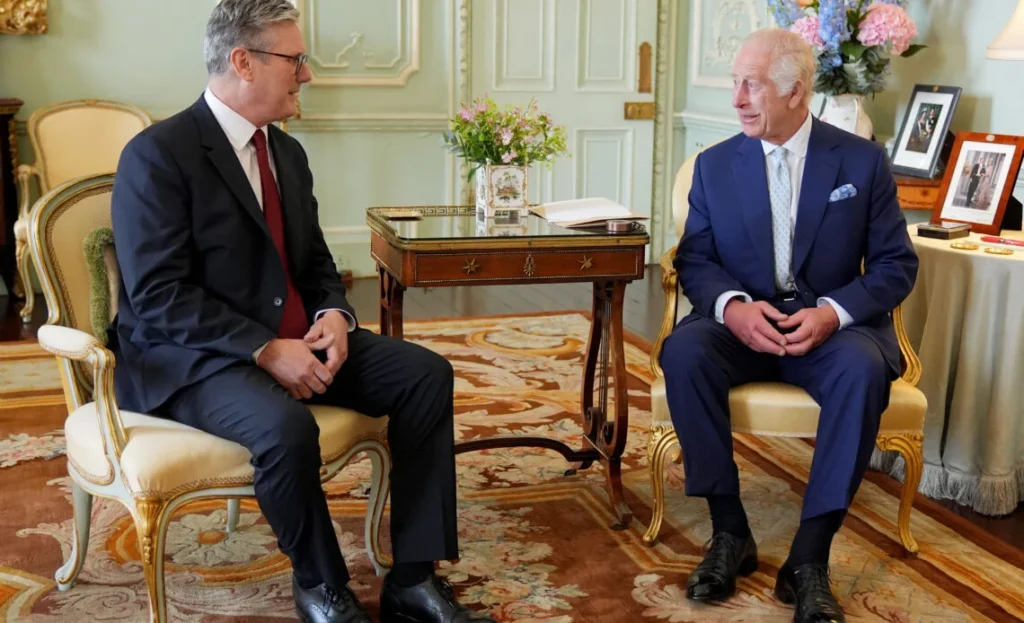

King Charles III was formally notified of Prime Minister Sir Keir Starmer’s impending resignation by the leader himself in a private telephone conversation from Highgrove House, the King’s country residence in Gloucestershire, on the morning of June 22, 2026. This discreet communication preceded Sir Keir Starmer’s public address from Downing Street, where he confirmed the end of his premiership. The timing of this call underscores the constitutional protocol wherein the Monarch is apprised of significant political developments affecting the formation and leadership of His Majesty’s Government.
The resignation announcement itself, anticipated by a significant media presence gathered outside Number 10 Downing Street, marked the culmination of a period of considerable political pressure on Sir Keir Starmer. While the specifics of the conversation between the King and the Prime Minister remain confidential, the confirmation that it occurred prior to the public statement highlights the established practice of the Sovereign being briefed on such matters of state. This tradition, while steeped in historical precedent, continues to be a vital element in the smooth functioning of the UK’s parliamentary democracy.
Constitutional Framework: The Monarch’s Role in Government Formation
The British constitution, uncodified and evolving, vests in the Monarch the formal power to appoint the Prime Minister. Following a general election, or in circumstances of a mid-term resignation, the Sovereign’s primary role is to ensure the formation of a stable government. This process is guided by convention and the fundamental principle of democratic accountability. The King, acting on the advice of his ministers and guided by the will of the electorate, will invite the leader of the party or coalition of parties most likely to command a majority in the House of Commons to form a government.
In the event of a Prime Minister’s resignation during their term, as was the case with Sir Keir Starmer, the established constitutional practice dictates that the King would look to the party holding a parliamentary majority to select a new leader. This new leader would then be formally invited by the Monarch to form a government. This intricate dance of political negotiation and constitutional formality ensures continuity of governance and upholds the democratic mandate. The traditional ceremony of "kissing hands," where a new Prime Minister would formally accept the Sovereign’s commission by kissing the Monarch’s hand, has evolved. While the physical gesture is no longer practiced, the symbolic act of being formally asked by the King to form a government remains a crucial step before a new Prime Minister can officially assume office.
Timeline of Political Transitions Under King Charles III
The premiership of King Charles III has already witnessed a dynamic period of political transitions, with Sir Keir Starmer’s resignation marking the fourth Prime Ministerial handover during his reign.
- September 2022: Upon the passing of Queen Elizabeth II, Charles ascended to the throne.
- October 2022: Following the turbulent premiership of Liz Truss, who served for a mere 49 days, Rishi Sunak became Prime Minister, leading the Conservative Party. His tenure was characterized by efforts to stabilize the economy and navigate post-Brexit challenges.
- July 2024: Prime Minister Rishi Sunak called a snap general election. The outcome saw the Labour Party, led by Sir Keir Starmer, secure a significant parliamentary majority. Sir Keir Starmer formally "kissed hands" with King Charles III on July 5, 2024, becoming Prime Minister.
- June 22, 2026: Sir Keir Starmer announced his resignation as Prime Minister.
The current political landscape suggests that the next individual to be formally invited by King Charles III to form a government is likely to be Andy Burnham. Burnham, who was re-elected to Parliament in early June 2026, has been widely considered a leading contender for the Labour Party leadership. His potential ascent to the premiership would signify a new chapter for the party and the nation.
Factors Leading to Sir Keir Starmer’s Resignation
Sir Keir Starmer’s resignation speech, delivered outside 10 Downing Street, cited internal party sentiment as the primary driver for his decision. He indicated that members of the Labour Party had conveyed to him their belief that he was no longer the optimal leader to secure victory in the next general election. While the next general election is not constitutionally due until 2029, the pressures on Sir Keir Starmer’s leadership appear to have mounted significantly in recent months, prompting this decisive action. This internal party dynamic, often a precursor to significant leadership changes, underscores the complex interplay between party loyalty and public perception in the British political system.
The Next Steps: A New Labour Leader and a Potential Early Return to Balmoral
The Labour Party is now expected to embark on a leadership contest to select Sir Keir Starmer’s successor. Once a new leader is chosen, they will be formally summoned to Buckingham Palace to meet King Charles III. Given the timing of the resignation and the impending summer recess, which is scheduled to conclude on September 1, 2026, it is plausible that the new Prime Minister’s formal investiture could occur at Balmoral Castle, the King’s private residence in Aberdeenshire. This would be a departure from the customary Buckingham Palace setting, highlighting the flexibility and adaptability of royal protocol in response to political exigencies.
The selection of a new Labour leader and their subsequent appointment as Prime Minister will be a pivotal moment. This individual will inherit the responsibility of governing a nation facing a range of domestic and international challenges, from economic recovery and social policy to global security and environmental sustainability. The incoming Prime Minister’s policy agenda and their ability to unite the country will be under immediate scrutiny.
Broader Implications and the Future of British Politics
Sir Keir Starmer’s resignation and the subsequent leadership contest within the Labour Party carry significant implications for the future direction of British politics. The short tenure of his premiership, following a period of significant electoral success, raises questions about the longevity of leadership in an era of rapid political change and evolving public expectations.
The potential ascension of Andy Burnham, or another candidate, to the leadership of the Labour Party will undoubtedly shape the party’s ideological stance and its electoral strategy moving forward. The focus will shift to how the new leader will articulate their vision for the country and how effectively they can rally public support in anticipation of future electoral contests.
Furthermore, the succession of Prime Ministers under King Charles III, from Liz Truss to Rishi Sunak, and now potentially a new Labour leader, underscores a period of notable political flux. This volatility can be attributed to a confluence of factors, including the lingering effects of Brexit, global economic uncertainties, and the evolving nature of political discourse. The coming months will be critical in observing how the new leadership navigates these complex challenges and endeavors to provide stability and direction for the United Kingdom. The constitutional role of the Monarch, while largely symbolic in the day-to-day running of government, remains a crucial anchor in these periods of transition, ensuring the continuity of the state and the adherence to established democratic processes. The upcoming period promises to be a significant one for British governance, as a new leader prepares to take the helm under the watchful eye of the Crown.