
Distributor Dekanalog has officially released the United States theatrical trailer and promotional artwork for Hen, the celebrated international feature directed by acclaimed Hungarian filmmaker György Pálfi. Known alternatively in global markets as The Hen or by its Greek title Kota, the film offers a distinct cinematic perspective by utilizing an animal protagonist to observe the precarious socio-economic realities of contemporary Europe. Following its initial global rollout, which included a high-profile festival debut and international theatrical runs throughout early 2026, the film is scheduled for a limited release in United States cinemas this November.
Plot Overview and Narrative Framework
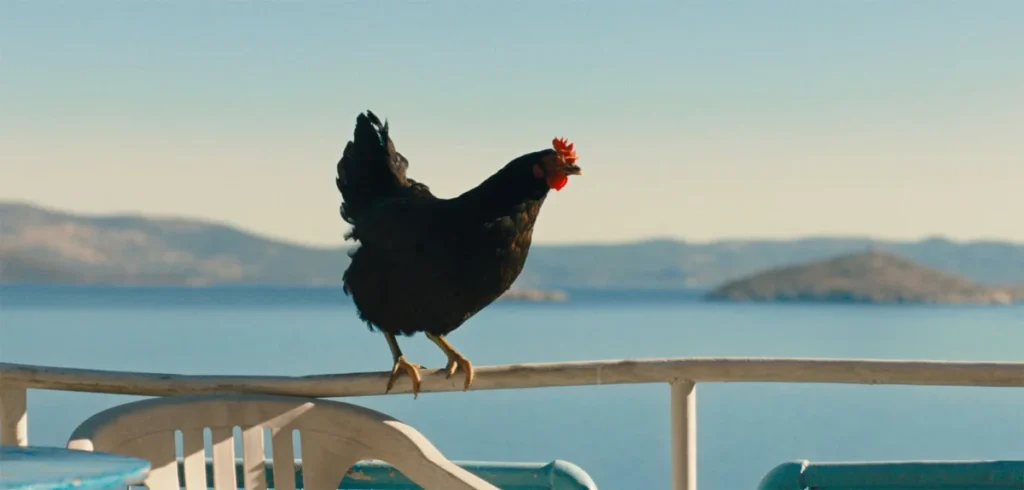
The narrative centers on a resilient Leghorn chicken that manages to break free from the bleak, confined conditions of an intensive industrial farming facility. Driven by an instinctual desire to find a secure environment to protect her eggs and raise her brood, the bird embarks on an arduous overland journey across the picturesque yet rugged landscape of Greece.

Her travels ultimately lead her to a fading, family-operated seaside restaurant struggling to maintain its footing. The establishment, however, is far from a tranquil haven. It is quietly entangled in illicit activities, serving as an unwitting node in a local human smuggling operation tied directly to the broader Mediterranean migrant crisis. Captured by the restaurant’s elderly proprietor—portrayed by actor Yannis Kokiasmenos—the bird finds herself thrust into a micro-ecosystem defined by desperation, criminal coercion, and familial dysfunction. As she navigates this environment, she bears witness to greed, petty thievery, and the predatory dynamics exploited by criminal networks operating along vulnerable coastal borders.
Production Insights and an Unusual Casting Process
Shot entirely on location in Greece, Hen adopts a style of animal-centric storytelling reminiscent of classic arthouse cinema, drawing immediate thematic parallels to Robert Bresson’s Au Hasard Balthazar and Jerzy Skolimowski’s Oscar-nominated donkey drama Eo. Rather than relying on computer-generated imagery or a single trained animal, Pálfi and his production team cast eight distinct real-life Hungarian chickens to share the demanding lead role.
The avian ensemble consists of hens named Eszti, Szandi, Feri, Enci, Eti, Enikő, Nóra, and Anett. Managing multiple animals for a feature-length narrative required meticulous patience from the crew, allowing the production to capture authentic behavioral moments that ground the film’s broader allegorical ambitions in realism. The screenplay was co-written by director György Pálfi and Zsófia Ruttkay, maintaining the filmmaker’s trademark penchant for avant-garde framing and structurally unconventional storytelling.

Chronology and International Exhibition Timeline
Hen has maintained a steady and deliberate distribution trajectory since completing production. The project achieved its world premiere in September 2025, screening within the prestigious Platform section at the Toronto International Film Festival (TIFF). Festival programmers praised the film for its stylistic audacity and its ability to merge whimsical animal observation with urgent sociopolitical commentary.
Following its festival circuit run, the film expanded to various European territories during the first half of 2026. It secured a theatrical release in Hungary in April 2026, followed by a theatrical opening in the United Kingdom in May 2026. Dekanalog has now slated the film for its official North American theatrical rollout, with select US screenings scheduled to begin on November 6, 2026.
Director Background and Collaborative Production

György Pálfi has established a formidable reputation as one of Hungary’s most provocative and visually distinct contemporary auteurs. His prior filmography includes Hukkle (2002), Taxidermia (2006), Final Cut: Ladies & Gentlemen (2012), Free Fall (2014), His Master’s Voice (2018), and Perpetuity (2021). Known for pushing the boundaries of traditional narrative structures, Pálfi often employs stark imagery and dark humor to dissect human nature, social decay, and institutional failure.
Hen represents a collaborative international coproduction involving companies across three nations: Thanassis Karathanos and Martin Hampel representing Germany, Costas Lambropoulos representing Greece, and Giorgos Kiriakos representing Hungary. This cross-border partnership allowed the production to leverage regional funding mechanisms and secure authentic Greek coastal settings that enhance the film’s atmospheric authenticity.
Critical Reception and Thematic Implications
Critical reception from international festival screenings has highlighted the film’s delicate balancing act between fable and stark realism. Reviewers have noted that by positioning a humble farm animal as the primary witness to complex human suffering—such as human trafficking and the migrant crisis—Pálfi avoids heavy-handed didacticism, instead allowing the viewer to absorb the moral weight of the environment through an unblinking, neutral lens.

The choice of a Leghorn chicken, a breed synonymous with industrial egg production, emphasizes themes of commodification and escape. In interviews and festival notes, the creative team has underscored that the bird’s struggle against the elements and human predation mirrors the broader displacement and vulnerability experienced by marginalized populations in the region. By examining both the literal pecking order of the farm coop and the metaphorical pecking order of a crumbling criminal enterprise, Hen offers a layered critique of survival ethics in modern society.
As the film approaches its November theatrical debut in the United States, audiences and arthouse exhibitors alike anticipate how this unconventional piece of cinema will resonate with domestic viewers. With its unique blend of European arthouse traditions, animal performance, and pressing contemporary themes, Hen stands as a notable addition to the 2026 independent film landscape.