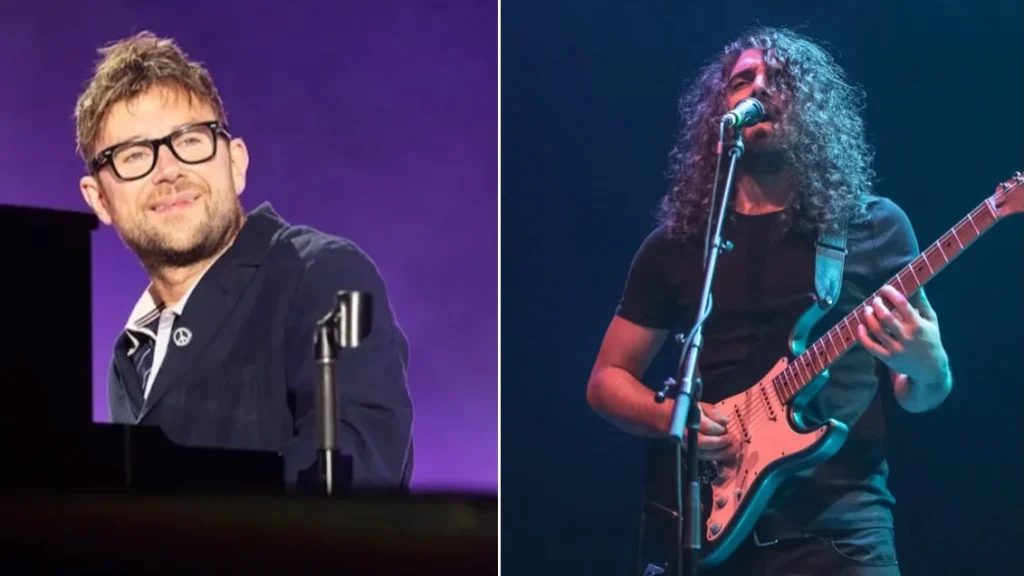

A notable dispute erupted at the Roskilde Festival on Thursday, July 2nd, 2026, when UK psych-doom outfit Uncle Acid & the Deadbeats publicly accused Damon Albarn and his acclaimed virtual band Gorillaz of instigating the premature termination of their performance. The accusation, disseminated via social media, ignited a conversation among festival-goers and industry observers regarding artist conduct, festival logistics, and sound management at large-scale multi-stage events. The incident has drawn differing accounts from the involved parties, creating a complex narrative around the events of that evening.
The Incident Unfolds: A Clash of Stages
The core of the controversy stems from the simultaneous scheduling of two distinct acts on different stages at one of Europe’s most prominent music festivals. Gorillaz, a global headliner known for their eclectic blend of genres and animated personas, were slated to perform at 10:00 p.m. on the Orange Stage, Roskilde’s largest and most iconic platform. Concurrently, Uncle Acid & the Deadbeats, a band recognized for their heavy, psychedelic doom metal sound, were scheduled to commence their set at 10:15 p.m. on the Lagune Stage, a smaller but still significant venue located approximately half a mile from the Orange Stage.
The physical proximity of the stages, despite the half-mile distance, introduced a potential for sound bleed, a common challenge at large festivals. What transpired during the initial minutes of Uncle Acid’s performance quickly escalated into a backstage and on-stage drama that left a segment of the audience bewildered and ultimately, disappointed.
Accusations from the Doom Camp
Uncle Acid & the Deadbeats were swift to voice their discontent, taking to Instagram to issue a scathing statement. They alleged that Damon Albarn, whom they pointedly referred to as a "pop diva," exhibited highly unprofessional behavior. According to the band, Albarn "threw a hissy fit while we played, threatened to storm off stage before finally getting our set shut down because we were ‘too loud.’" The statement further criticized Gorillaz, asserting they were "the only headliner of the whole weekend who couldn’t cope with playing at the same time as other artists."
The band elaborated on the sequence of events, claiming they only managed to play for approximately 25 minutes before their performance was forcibly halted. "Unfortunately, we only managed 25 minutes of assaulting his precious ears from our stage half a mile away before his goons came over and pulled the plug," the statement read. Uncle Acid also contested the "too loud" rationale, stating, "Despite us being below the festival dB limit and offering to turn down FOH [Front of House] to continue the show, they wanted us off." This particular detail highlights a key point of contention: whether the band was indeed exceeding permissible sound levels or if the issue was one of perceived interference rather than actual violation.
Damon Albarn’s On-Stage Comments and Perceived Frustration
While Damon Albarn or Gorillaz’s official representatives did not immediately issue a direct response to Uncle Acid’s accusations, Albarn’s own actions and comments during Gorillaz’s set on the Orange Stage provided a public glimpse into the situation from his perspective. Captured on camera and subsequently circulated online, Albarn was heard addressing the crowd, expressing his apparent frustration with audible interference.
"Is it supposed to be possible for me to hear the other music so clearly?" Albarn reportedly asked the audience, gesturing towards the direction of the Lagune Stage. He then added, with a seemingly passive-aggressive tone, "We can just stop playing and listen to the other thing instead, that’s fine with me." These remarks, delivered live to thousands of Gorillaz fans, have been interpreted by many, including Uncle Acid, as direct evidence of Albarn’s dissatisfaction and a potential catalyst for the subsequent action taken against the psych-doom band’s set. His comments, delivered in real-time, underscored the live operational challenges presented by the simultaneous performances and the headliner’s sensitivity to ambient sound.
Roskilde Organizers’ Official Stance: Weather and Technicalities
In stark contrast to Uncle Acid’s pointed accusations, Roskilde Festival organizers offered a different explanation for the abrupt cancellation of the Lagune Stage performance. Their official statement attributed the interruption to environmental and technical factors, sidestepping any mention of artist complaints or specific demands from Gorillaz.
"The interruption was caused by a combination of wind conditions and technical factors that affected the sound production," the organizers stated. They further generalized the challenges of managing such a large event, adding, "When hosting a large outdoor live event, changing weather conditions can sometimes create operational challenges." This explanation implies that the decision to cut the set was a logistical one, driven by unforeseen circumstances rather than inter-artist conflict.
However, this official explanation did not fully satisfy Uncle Acid or their supporters, who viewed it as an attempt to deflect responsibility and shield the headliner from criticism. The discrepancy between the two narratives forms the crux of the controversy, leaving the public to weigh the credibility of each account.
Drummer Jon Rice Weighs In with Stronger Language
The band’s initial Instagram post was further amplified by Uncle Acid’s drummer, Jon Rice, who took to his own Instagram Story to provide a more detailed and vociferous rebuttal to both Roskilde’s explanation and Albarn’s perceived conduct. Rice directly challenged the festival’s claim, particularly the "technical difficulties" and "wind conditions."
"Apologies to everyone who attended Roskilde Festival with the intentions of watching the full Uncle Acid set last night. We were forced to cut our set short by Gorillaz due to what they called ‘technical difficulties,’ when in reality they could faintly hear the sound coming from our stage in between their songs and decided to throw a bitch fit, threatening to pull their gig entirely if we didn’t stop playing. We can’t apologize enough for the premature end of our set but it wasn’t our call to make," Rice wrote.
Rice then introduced a crucial piece of counter-evidence: a comparison to another headliner’s experience. He pointed out that The Cure, who headlined on a previous day of the festival, also played simultaneously with another band, Monolord, from the same Lagune Stage. "Funnily enough, The Cure (who headlined the festival on a previous day) played at the same time as Monolord and could faintly hear the sound from the same stage we played on, but powered through like professionals," Rice asserted. This comparison served to underscore Uncle Acid’s belief that Gorillaz’s reaction was an isolated incident of intolerance rather than a universal operational necessity.
Furthermore, Rice reiterated the band’s adherence to festival regulations regarding sound levels: "Our Front of House sound engineer was 2dB below the festival mandated decibel limit for the entirety of our gig as well, so the ‘we were playing too loud’ excuse doesn’t hold water." This technical detail directly contradicts the premise that Uncle Acid was violating sound regulations, reinforcing the argument that the decision was driven by Gorillaz’s preference.
The Human Cost and Scathing Criticism
Beyond the technicalities, Rice also highlighted the negative impact on the festival staff and the audience. He accused Gorillaz of placing Roskilde Festival staff in an unenviable position, forcing them to deliver the difficult news to both Uncle Acid and their waiting fans.
"In addition to all of this, Gorillaz put the entire staff organizing Roskilde Festival in a horrible position, firstly having to deliver the news to us that we wouldn’t be able to play the remaining 30 minutes of our set and then having to tell thousands of very agitated fans who paid good money to see ALL of the bands that our set would not continue," Rice stated. He noted the crowd’s vocal disapproval, reporting a "very loud ‘SHAME ON YOU’ chant" directed at the festival staff, which he felt was misdirected. "They didn’t deserve the very loud ‘SHAME ON YOU’ chant the crowd leaned into when receiving the final verdict, but Gorillaz sure as f**k do," he concluded.
Rice’s final volley was a stark and unvarnished attack on Albarn and Gorillaz’s artistic integrity: "’Cartoon band’ indeed. All in all, @damonalbarn and @gorillaz are soft as baby st. FK ‘EM." This incendiary language, while unprofessional, clearly communicated the depth of frustration and perceived disrespect felt by Uncle Acid & the Deadbeats.
The Decibel Debate and Festival Logistics
The dispute at Roskilde Festival brings into sharp focus the intricate logistical challenges inherent in orchestrating large-scale multi-stage music events. Festivals like Roskilde, which can host over 130,000 attendees and feature hundreds of artists across numerous stages, operate under stringent sound regulations. These regulations typically involve decibel limits (dB) at various points across the festival grounds to minimize noise pollution for nearby communities and ensure a reasonable listening experience for different stages.
Sound bleed, the phenomenon where sound from one stage carries over to another, is an almost unavoidable aspect of such events. Festival organizers often employ sophisticated sound engineering techniques, directional speaker arrays, and strategic stage placement to mitigate this. However, factors like wind direction and atmospheric conditions can significantly impact how sound travels, making precise control exceptionally difficult.
Uncle Acid’s assertion that their Front of House engineer was 2dB below the mandated festival limit is a critical piece of information. If accurate, it suggests that the issue was not a breach of official rules, but rather a subjective annoyance for Gorillaz. This raises questions about the hierarchy of artists at festivals and whether headliners hold de facto veto power over concurrent performances, regardless of adherence to official regulations. The distance of half a mile between the Orange and Lagune stages is considerable, yet sound, especially low frequencies common in heavy music, can travel far, particularly on a relatively flat festival site.
Broader Context: Roskilde Festival’s Reputation
Roskilde Festival, held annually in Roskilde, Denmark, boasts a rich history dating back to 1971. It is one of the oldest and largest music festivals in Europe, renowned for its diverse lineup spanning rock, pop, electronic, and world music, as well as its non-profit ethos. The festival prides itself on a strong community spirit and a reputation for smooth, professional organization. Incidents like the one involving Uncle Acid and Gorillaz are relatively rare, making this particular dispute stand out.
The festival’s official explanation, focusing on weather and technical factors, aligns with its general approach of maintaining a neutral, problem-solving stance in operational difficulties. However, the direct accusations from Uncle Acid challenge this narrative, potentially impacting perceptions of the festival’s impartiality and its ability to manage artist relations when conflicts arise. The incident could subtly influence how artists perceive the festival’s handling of simultaneous performances and sound management in the future.
Impact on Artists and Audience
For Uncle Acid & the Deadbeats, the truncated set was a significant blow. Festivals are crucial platforms for bands to reach new audiences, solidify their fanbase, and fulfill contractual obligations. Cutting a set short, especially one that was eagerly anticipated by dedicated fans, can lead to frustration and a sense of injustice. The band’s strong public reaction reflects not only their personal annoyance but also their commitment to their audience.
For Gorillaz and Damon Albarn, the incident, regardless of the veracity of the claims, presents a potential PR challenge. While Gorillaz’s established global fanbase might largely overlook the controversy, the accusations of "pop diva" behavior and being "soft as baby s**t" could resonate within certain segments of the music community, particularly among fans of heavier, independent genres who might already harbor skepticism towards mainstream acts. The comparison to The Cure’s "professional" handling of sound bleed further amplifies the criticism leveled against Albarn.
The most immediate impact was on the thousands of festival-goers who had planned to experience the full Uncle Acid set. Disappointed fans, some of whom had traveled specifically for the performance, expressed their frustration online, adding another layer to the public discourse surrounding the event. The "SHAME ON YOU" chant reported by Rice highlights the collective disappointment and the sense that the audience’s experience was compromised.
The Industry Perspective: Sound Management at Festivals
This incident underscores a perennial tension in the festival industry: balancing the artistic demands of headliners with the operational realities of a multi-stage environment and the contractual obligations to all performing artists. Sound engineers and festival organizers continuously strive to optimize sound dispersion, but perfect isolation across stages is often an unattainable ideal.
The debate over "sound bleed" often becomes a subjective one. What one artist perceives as negligible background noise, another might find fundamentally disruptive to their performance, especially if their music relies on intricate dynamics or quieter passages. When a headliner expresses such discomfort, festivals are often compelled to act decisively to ensure the main attraction’s performance proceeds without incident, given the immense financial and reputational stakes involved. However, this raises ethical questions about fairness to smaller acts and the potential for a power imbalance to dictate operational decisions.
Looking Ahead
Despite the contentious incident, both Gorillaz and Uncle Acid & the Deadbeats are continuing with their respective busy schedules. Gorillaz have a forthcoming North American tour slated and are engaged in international art exhibitions, supporting their latest album, The Mountain. Their global stature ensures that this Roskilde controversy is likely to be a momentary blip in their extensive career.
Meanwhile, Uncle Acid & the Deadbeats have their own hefty tour schedule slated for the fall, suggesting they are moving forward from the Roskilde disruption. While the immediate anger may subside, the memory of the incident and the strong words exchanged are likely to linger, serving as a cautionary tale within the music festival circuit about the complexities of simultaneous performances and the dynamics between artists.
The Roskilde Festival itself will undoubtedly review the incident, though their public statements maintain the stance of an unavoidable operational challenge. The unresolved nature of the dispute, with conflicting accounts and strong public accusations, ensures that the "Roskilde Ruckus" will remain a talking point in the music industry for some time to come.