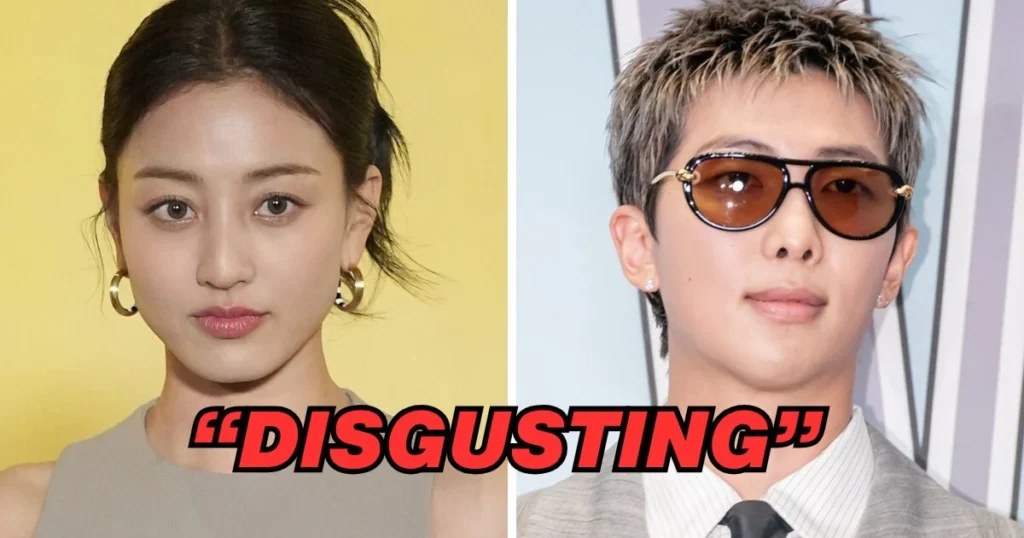

Jihyo, the leader of the globally renowned K-pop group TWICE, has found herself at the center of a polarizing online discourse following a recent interview in which she credited BTS and other senior artists for "paving the way" for the current generation of South Korean musicians. While Jihyo’s remarks were intended to convey humility and a sense of professional gratitude, they have instead ignited a firestorm of criticism across various social media platforms. Critics argue that her statement inadvertently diminishes the monumental contributions of female artists in the industry, leading to accusations of internalized misogyny and a disregard for the historical milestones achieved by women in K-pop.
The controversy began following the publication of an interview with Forbes, where Jihyo reflected on the rapid globalization of K-pop and TWICE’s place within that trajectory. During the conversation, she specifically singled out BTS as a primary force that cleared the path for groups like hers to find success on the international stage. "We’re just following in their footsteps, and I’m grateful for what they’ve done for us," Jihyo stated. She further elaborated on the shifting landscape of the music industry, noting that the absence of modern tools like Instagram and TikTok challenges during her early career made the current level of global reach even more impressive.
The Context of the "Paved the Way" Discourse
The phrase "paved the way" is one of the most contentious and emotionally charged expressions within the K-pop community. It is often used by fans to denote which artists were responsible for breaking the initial barriers to entry in foreign markets, particularly the United States and Europe. For years, this narrative has been a point of contention between different "fandoms," with supporters of various groups claiming the title for their respective idols.
Historically, the expansion of K-pop is viewed in generations. The first generation saw artists like BoA and TVXQ making significant inroads into the Japanese market. The second generation, featuring acts like BIGBANG, Wonder Girls, Girls’ Generation, and 2NE1, began to see traction in the West. The Wonder Girls, notably, were the first South Korean group to enter the Billboard Hot 100 in 2009 with "Nobody." However, it was the third generation, led by BTS and followed closely by groups like BLACKPINK and TWICE, that saw K-pop transition from a niche interest to a mainstream global phenomenon.
Jihyo’s decision to explicitly name BTS as the group that paved the way was seen by many as a factual acknowledgment of their unprecedented commercial success, including multiple number-one hits on the Billboard charts and sold-out stadium tours worldwide. However, for a segment of the K-pop audience, her comments felt like a betrayal of the female artists who fought similar battles in a male-dominated industry.
Analysis of Netizen Reactions and Allegations of Misogyny
The backlash against Jihyo was swift and characterized by a high degree of intensity. On X (formerly Twitter), several posts went viral, criticizing the TWICE leader for what they perceived as a lack of solidarity with her female peers. One user expressed frustration by stating, "Imagine a woman crediting their success to useless men. Asslicking them the same way ur fandom does wont get u anywhere girl." This sentiment was echoed by others who felt that Jihyo’s comments ignored the hard work of female idols who faced unique challenges, including stricter beauty standards and more intense public scrutiny.
A significant portion of the criticism centered on the concept of "internalized misogyny." Some netizens argued that by attributing the success of the entire genre to a male group, Jihyo was reinforcing a patriarchal narrative that overlooks the agency and achievements of women. "Women like her who love bootlicking men and attribute all the success to them while discrediting the other women who worked stupendously hard to make it are so icky," wrote another critic.
Furthermore, some fans of rival groups took the opportunity to point out that TWICE itself has been a massive contributor to the "Hallyu" (Korean Wave). TWICE holds the record for the most music video views for a K-pop girl group at one point and has consistently been one of the top-selling physical act in South Korea and Japan. To these fans, Jihyo’s humility felt like an unnecessary self-deprecation that harmed the standing of all female artists.
The Evolution of Global Content Channels
In her interview, Jihyo also touched upon the technological shift that has aided K-pop’s growth. She noted that when TWICE debuted in 2015, the digital infrastructure for global music promotion was vastly different. "We didn’t have Instagram or TikTok challenges back in the day," she remarked. "When I debuted, we had content channels, which became globalized and grew in number. I think that really helped K-pop artists to make their presence strong on the global stage."

This observation is supported by industry data. The rise of short-form video content has become a cornerstone of K-pop marketing. According to industry reports, TikTok challenges can increase a song’s stream count by significant percentages, often propelling older tracks back into the charts. Jihyo’s point was that while the "path" was paved by predecessors, the "tools" to walk that path have become more sophisticated, allowing for a faster and more widespread dissemination of Korean culture.
However, even this part of her statement was scrutinized. Some argued that by focusing on the ease of modern promotion, she was inadvertently downplaying the struggles of her own group’s early years, as well as those of the female groups that preceded her who had to rely on traditional media and physical touring without the aid of viral social media algorithms.
Chronology of the Controversy
The timeline of the event suggests a rapid escalation typical of modern celebrity discourse:
- Early July 2026: Jihyo participates in an in-depth interview with Forbes regarding TWICE’s ongoing global influence and their future trajectory.
- July 11, 2026 (Morning): The interview is published online. Initially, fans celebrate the feature, highlighting Jihyo’s professionalism and the group’s longevity.
- July 11, 2026 (Mid-day): Specific quotes regarding BTS and "paving the way" are extracted and shared on social media platforms.
- July 11, 2026 (Afternoon): The discourse shifts from the interview as a whole to a focused debate on gender dynamics in K-pop. Anti-fans and disgruntled netizens begin tagging the artist and the group in derogatory posts.
- July 11, 2026 (Evening): The topic trends globally on X, with "internalized misogyny" and "Jihyo" appearing in the top trending categories in South Korea, the United States, and Southeast Asia.
Broader Implications for the K-pop Industry
The backlash against Jihyo highlights a growing tension within the K-pop industry regarding gender and representation. As K-pop becomes more globalized, the expectations placed on idols—particularly women—have expanded. They are no longer expected just to perform, but to serve as symbols of empowerment. When an idol’s statement conflicts with the "girl power" narrative favored by international fans, the repercussions can be severe.
Industry analysts suggest that this incident may lead to more cautious PR strategies for idols during international interviews. While humility is a highly valued trait in South Korean culture, the global market often prioritizes assertive self-advocacy. Jihyo’s attempt to balance these two cultural expectations appears to have missed the mark with a vocal segment of the Western audience.

Moreover, the incident underscores the intense rivalry between fandoms. In many cases, the "backlash" is fueled not just by genuine social concerns, but by "fan wars" where supporters of one group use any perceived misstep by a rival group’s leader to gain a sense of moral or cultural superiority.
The Role of BTS in the Narrative
It is also worth noting the role of BTS in this controversy. As the group that has arguably achieved the most significant breakthroughs in the West, they are often the benchmark against which all other K-pop success is measured. For Jihyo to credit them is a recognition of the logistical and commercial reality that BTS opened doors for K-pop to be played on American radio and featured in major US awards shows. However, the sensitivity of the "paved the way" argument means that any mention of BTS in this context by another artist is likely to be viewed through a lens of partisan fandom politics.
Conclusion
As of now, neither JYP Entertainment nor Jihyo has issued an official response to the online criticism. In the past, the agency has often chosen to let such social media storms pass without comment, focusing instead on upcoming promotional activities. TWICE continues to be one of the most successful acts in the world, and while this controversy has certainly caused a stir, it remains to be seen whether it will have any long-term impact on the group’s brand or Jihyo’s reputation as a respected leader in the industry.
The debate serves as a stark reminder of the complexities of the K-pop world, where a single sentence in an interview can become a lightning rod for discussions on history, gender, and the very nature of success in the digital age. Whether Jihyo was being a humble junior or an "internalized misogynist" remains a matter of perspective, but the intensity of the reaction confirms that the "paved the way" debate is far from over.