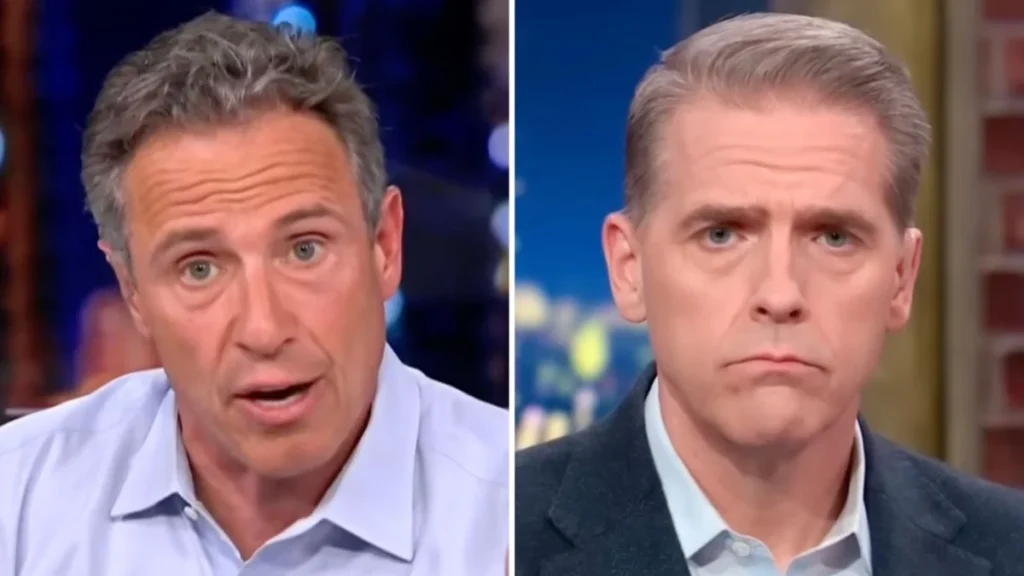

The political punditry landscape, often characterized by its heated debates and sharp exchanges, saw a notable flare-up recently when Chris Cuomo, now a host at NewsNation, directly addressed and criticized his former CNN colleague, Scott Jennings. Cuomo’s commentary, delivered on his program, targeted Jennings’ recent public outburst on CNN NewsNight, where the conservative commentator was captured using expletives during a contentious discussion. The incident, which occurred on Thursday, April 30th, has now drawn a pointed rebuke from Cuomo, who characterized Jennings with strong language and questioned his conduct and broader political stances.
The Genesis of the Confrontation: A Debate Over Iran Policy
The televised dispute that triggered Cuomo’s response unfolded on CNN NewsNight with Abby Phillip. The segment featured a heated exchange between Scott Jennings, a Republican strategist and former White House staffer under President George W. Bush, and Adam Mockler, a commentator associated with MeidasTouch, a progressive political action committee. The core of their disagreement centered on President Donald Trump’s foreign policy regarding Iran, specifically the lack of discernible political concessions the United States had reportedly secured.
Mockler, the younger of the two participants at 23 years old, pressed Jennings to articulate any specific political gains made by the U.S. in its dealings with Iran. Mockler’s line of questioning was framed within a broader critique of prolonged military engagements and their financial implications, stating, "We all know that Scott Jennings is more than happy to defend a war with a country that starts with letters ‘I-r-a’ that we are currently failing, that is going to put us trillions and trillions of dollars more in debt." He further drew a parallel to past conflicts, referencing Jennings’ tenure in the Bush administration and its justification for the Iraq War, implying a pattern of defending costly and potentially ill-advised military actions.
The debate escalated when Mockler, attempting to emphasize his points, made gestures with his hands. This physical action appeared to be the catalyst for Jennings’ sharp retort. Visibly angered, Jennings shouted at Mockler, "Get your f** hand out of my face!" The expletive-laden outburst was captured on air and subsequently circulated, becoming the focal point of media attention and Cuomo’s subsequent critique.
Cuomo’s Scathing Rebuttal: Characterization and Allegations
Chris Cuomo did not mince words in his assessment of Jennings’ behavior. Labeling Jennings as “CNN’s resident MAGA-lomaniac,” Cuomo introduced the segment on his NewsNation program by airing a clip of the incident. He then proceeded to dissect Jennings’ conduct, posing a rhetorical question: "Now, when this happened, I asked, what 48-year-old man talks to a kid 25 years younger than him like that?" Cuomo’s implication was that Jennings’ reaction was indicative of a deeper deficiency, suggesting, "One who’s got nothing else."
Cuomo further linked Jennings’ current stance to his past professional experience, referencing his role in the Bush administration. He stated, "When one who did work for the Bush administration that sold us the BS about weapons of mass destruction in Iraq, you’d think he’d have some type of shame. But there’s no shame in the game, and he knows how to play the rage bait game." This accusation suggests that Jennings, by engaging in what Cuomo perceives as performative anger, is deflecting from his inability to logically defend current foreign policy or perhaps his own past policy endorsements.
Allegations of Hypocrisy: A Pattern of Behavior?
Adding another layer to his critique, Cuomo presented evidence suggesting that Jennings’ outburst was not an isolated incident. He aired a clip from a previous NewsNight episode, from 2024, where Jennings was seen engaging in a similarly heated exchange with academic Michael Eric Dyson. In that instance, Jennings was observed pointing his finger in Dyson’s face during a debate.
Cuomo used this comparison to highlight what he deemed hypocrisy. "What a punk!" Cuomo exclaimed, observing the footage. "He did the same thing. You see what I’m saying? What’s different is Professor Michael Eric Dyson, the man on your screen, looking at him with contempt. Why? He handled it differently because he has a better handle on adulting than Jennings, but also because he had the facts and the law on his side." This statement implies that while both individuals engaged in aggressive body language, Dyson’s demeanor was more composed and intellectually grounded, whereas Jennings’ reaction was characterized as immature and lacking substantive backing.
Cuomo clarified his intentions, stating that he did not wish for negative repercussions for Jennings, such as termination. "This is all just a distraction from his true deficiency," Cuomo asserted. "He can’t justify what’s happening in Iran beyond ‘the regime sucks.’" This suggests Cuomo believes Jennings’ aggressive tactics are a substitute for a well-reasoned argument regarding U.S. foreign policy in the region.
Mockler’s Perspective: Authenticity and Recurring Behavior
Adam Mockler, the commentator at the center of the original CNN incident, later appeared on Chris Cuomo’s program to offer his perspective. When asked if Jennings’ outburst was merely performative or a genuine expression of anger, Mockler stated unequivocally, "No, that was a genuine, serious moment."
Mockler elaborated on his repeated interactions with Jennings on CNN, describing a pattern of behavior. "When it comes to Scott Jennings, I sat with him at this same table, that same table week after week after week and then listen to him lie about the timelines of the war, not bound to any sort of facts or even decorum," Mockler claimed. He characterized Jennings as consistently exhibiting arrogance and condescension, stating, "He’s a big a**hole on that show. I’m gonna say it. He’s the one who is constantly smug and condescending. That’s his entire bit." Mockler expressed his bewilderment that his own assertive questioning, which he felt mirrored the energy Jennings often directed at others, led to such a strong reaction.
Contextualizing the Iran Debate: A Complex Geopolitical Landscape
The disagreement between Jennings and Mockler occurred against the backdrop of a complex and volatile geopolitical situation involving Iran. For decades, U.S. policy towards Iran has been shaped by a range of factors, including concerns over its nuclear program, support for regional proxy groups, human rights record, and broader geopolitical rivalries.
The Trump administration, in particular, adopted a policy of "maximum pressure," withdrawing from the Joint Comprehensive Plan of Action (JCPOA) in 2018, a multilateral agreement aimed at curbing Iran’s nuclear ambitions. This withdrawal was accompanied by the imposition of stringent economic sanctions designed to cripple Iran’s economy and force it to negotiate a new, more comprehensive deal.
Critics of this policy, such as Mockler, often point to the lack of significant political concessions from Iran and the detrimental impact of sanctions on the Iranian population. They argue that the approach has not achieved its stated objectives and has instead led to increased regional tensions and instability. Supporters, including figures like Jennings who align with the "maximum pressure" strategy, contend that such measures are necessary to counter Iran’s destabilizing activities and that concessions would only embolden the regime.
The debate over "political concessions" is multifaceted. It can refer to diplomatic agreements, changes in Iranian foreign policy, or even internal political shifts within Iran. The difficulty in definitively measuring such concessions, particularly in the context of an adversarial relationship, often fuels the passionate arguments seen in public forums.
Analyzing the Implications: Punditry, Polarization, and Policy
The public exchange between Cuomo and Jennings, stemming from the CNN incident, highlights several significant trends in contemporary political discourse.
1. The Rise of "Rage Bait" and Performative Anger: Cuomo’s accusation that Jennings "knows how to play the rage bait game" points to a broader phenomenon in media where emotionally charged reactions, often fueled by anger or outrage, can garner significant attention and engagement. This can incentivize commentators to adopt more extreme or confrontational personas, potentially at the expense of nuanced policy discussion.
2. The Blurring Lines Between Commentary and Conflict: The incident underscores the increasingly blurred lines between political commentary and personal conflict. When debates devolve into personal attacks or expletive-laden outbursts, it can detract from the substance of the issues being discussed and alienate viewers seeking informed analysis.
3. The Enduring Impact of Past Administrations: Cuomo’s reference to the Bush administration and the Iraq War suggests that the legacies of past foreign policy decisions continue to shape current political debates. The justifications used for past conflicts, such as the alleged presence of weapons of mass destruction, remain a point of contention and a basis for skepticism regarding new military engagements or aggressive foreign policy stances.
4. The Role of Media Platforms in Amplifying Disputes: CNN, as a major news network, provides a platform for these debates. The subsequent commentary by figures like Chris Cuomo on a competing network demonstrates how these incidents become fodder for broader media narratives and inter-network rivalries.
5. The Challenge of Foreign Policy Justification: The core of the disagreement—the justification for U.S. policy towards Iran—remains a highly contentious and complex issue. The lack of clear, universally accepted metrics for success in foreign policy allows for a wide range of interpretations and fuels partisan divides.
6. Generational Differences in Political Discourse: Mockler’s age and his reference to Jennings’ past experience highlight potential generational differences in how political issues are approached and debated. Younger commentators may be more critical of established foreign policy norms and more inclined to question the justifications for prolonged conflicts.
Conclusion
The confrontation between Chris Cuomo and Scott Jennings, ignited by an on-air expletive, serves as a microcosm of the broader challenges facing political discourse in the United States. It exposes the tensions between partisan advocacy, the pursuit of substantive policy debate, and the allure of performative anger. While Jennings’ outburst on CNN NewsNight may have been a moment of genuine frustration for him, as Mockler suggests, Chris Cuomo’s sharp critique frames it as symptomatic of a larger pattern of deflection and a lack of substantive argumentation. As these public figures continue to engage in these exchanges, the focus for many observers will remain on whether the discourse can transcend personal animosity and engage more deeply with the complex policy challenges at hand. The ongoing situation with Iran, a country with which the U.S. has a long and fraught relationship, demands a level of reasoned analysis that such heated exchanges can often obscure.