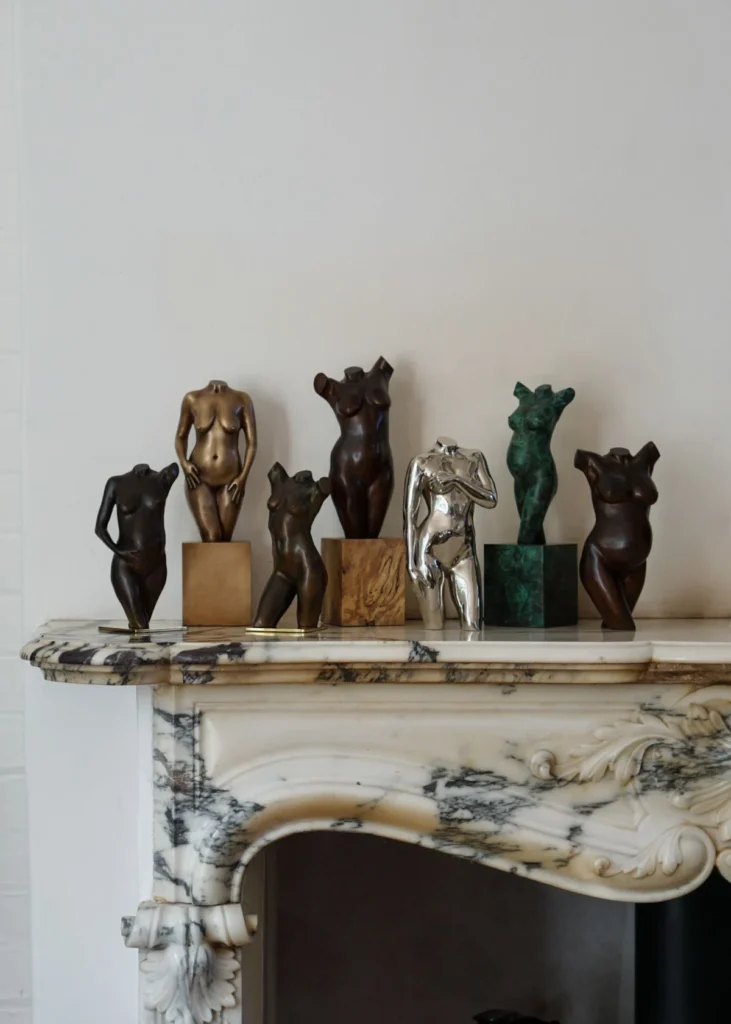

Pregnancy has long been documented through a variety of conventional mediums, ranging from the clinical precision of framed ultrasound triptychs to the personal intimacy of the "selfie-bump" photo series. For decades, the standard for maternity commemoration involved professional photography sessions, often featuring staged interactions where older siblings or partners posed with the expectant mother’s exposed abdomen. While these keepsakes remain deeply cherished by families, a new movement in the intersection of technology and fine art is redefining how the maternal form is preserved. The rising trend of 3D-rendered pregnancy statues marks a shift toward personalized statuary that serves both as a private memento and a sophisticated piece of home decor, effectively transforming the biological milestone of gestation into a permanent objet d’art.
This contemporary phenomenon, while powered by modern 3D-scanning technology, finds its roots in a lineage of artistic expression that spans the entirety of human history. The depiction of the pregnant female form is perhaps one of the oldest subjects in art, dating back to the Stone Age. Archaeological finds, such as the Venus of Willendorf—a small figurine estimated to have been carved nearly 30,000 years ago—suggest that humanity has always sought to immortalize the physical manifestation of fertility and life-bearing. Throughout the centuries, this theme has been explored by masters of various eras, from the classical sculptures of antiquity to the modernist interpretations of the 20th century. Notable examples include Edgar Degas’s bronze studies of the human form, Pablo Picasso’s 1950 sculpture Pregnant Woman, and even more contemporary, albeit controversial, works like Daniel Edwards’s life-size depiction of Britney Spears. The current trend toward bespoke 3D busts is essentially the democratization of this high-art tradition, allowing individual women to commission works that were once the exclusive domain of museum-grade artists.

The Genesis of Studio Bust and the Customization Movement
The modern commercialization of this art form is driven by entrepreneurs who recognized a gap between mass-produced maternity products and prohibitively expensive traditional bronze casting. Mads Montagu-Andrews, the founder of Studio Bust, conceived the idea for her company during her second pregnancy. Having participated in a public-art project during her first pregnancy that resulted in a line drawing, she sought a more dimensional medium for her second. However, she found that traditional bronze casting was financially inaccessible for the average consumer. This realization led to the founding of Studio Bust, a company that utilizes 3D scanning and printing to create high-end sculptures at a fraction of the cost of traditional methods.
The process typically involves a detailed 3D scan of the subject’s torso, which is then refined digitally. The final product is often an armless and headless bust, a stylistic choice that evokes the aesthetic of classical Greek and Roman ruins, such as the Aphrodite of Cyrene. By stripping away the identifying features of the head and limbs, the focus remains entirely on the architectural curves of the pregnant torso, allowing the piece to function as an abstract sculpture. These pieces are fabricated from various materials, including biodegradable plastics and luxe finishes like lacquer, stone-like lyme, or bronze powder that oxidizes over time to develop a natural patina. Pricing reflects the complexity and material of the work, with entry-level pieces starting around $850 and solid bronze commissions exceeding $5,500.
Technological Advancements and Market Expansion
The growth of this niche market is supported by significant advancements in photogrammetry and additive manufacturing. Unlike traditional molding and casting, which can be physically taxing and invasive for an expectant mother, 3D scanning is non-contact and rapid. This technological ease has allowed companies like Milestonable to expand the service even further. Founded by Charlotte Geerse following a multi-year journey with IVF, Milestonable offers a unique service for women who may have missed the opportunity to be scanned during their pregnancy. By using historical photographs to recreate a 3D model, the company allows mothers to commission "post-facto" statues, bridging the gap between past memories and physical reality.

The expansion of these services reflects a broader trend in the "maternity economy," a sector that has seen a surge in demand for personalized, high-value goods. Market analysts suggest that the shift toward bespoke sculptures is part of a larger consumer move toward "experiential luxury"—products that tell a personal story while maintaining a high aesthetic standard. The integration of 3D printing into the home decor market has also normalized the idea of custom-manufactured art, making it a logical step for maternity commemoration.
Celebrity Endorsements and the "Time Portal" Effect
The trend has gained significant cultural momentum through the participation of high-profile figures. Model and media personality Sofia Richie Grainge commissioned a work from Studio Bust during her first pregnancy with her daughter, Eloise. Richie Grainge has described the resulting sculpture as a "time portal," a sentiment echoed by many consumers who find that the three-dimensional nature of the statue captures the reality of the experience more viscerally than a flat photograph. British media personality Ashley James, who utilized Milestonable for her second pregnancy, emphasized the emotional utility of the statues. For James, the sculpture served as a tool for body neutrality and self-love, providing a tangible reminder of the body’s capabilities during a period of rapid physical change.
For many women, the appeal lies in the discretion of the medium. While a large-scale photograph of a naked pregnant body might feel too intimate for public display in a home, a bronze or stone bust is often perceived as sophisticated decor. This "stealth" aspect allows the memento to reside on a bookshelf or a mantle, blending in with other art pieces while holding profound personal significance for the owner.

Historical Chronology of Pregnancy in Art
To understand the weight of this trend, it is necessary to view it through the lens of art history. The following timeline highlights the evolution of the pregnant form as a subject of artistic study:
- Circa 28,000–25,000 BCE: The Venus of Willendorf is created, representing one of the earliest known depictions of the female form, emphasizing fertility through exaggerated maternal features.
- Classical Antiquity: Greek and Roman sculptures occasionally depicted fertility goddesses, though the focus often remained on idealized, non-pregnant forms.
- 1434: Jan van Eyck’s The Arnolfini Portrait sparks centuries of debate regarding whether the female subject is depicted as pregnant, highlighting the symbolic power of the "expectant" silhouette in Western painting.
- Late 19th Century: Edgar Degas creates wax and bronze sculptures that explore the raw, unidealized movements of the female body, including the maternal form.
- 1950: Pablo Picasso completes Pregnant Woman, a bronze sculpture that uses ceramic vessels to form the breasts and abdomen, emphasizing the "vessel" nature of the body.
- 2005: Marc Quinn’s Alison Lapper Pregnant, a monumental marble sculpture of a disabled pregnant woman, is displayed in London’s Trafalgar Square, challenging societal norms regarding the maternal body.
- 2020s: The rise of 3D scanning companies like Studio Bust and Milestonable allows for the mass-personalization of pregnancy sculpture, moving the medium from the museum to the private residence.
Psychological Implications and the "Generational Heirloom"
The shift toward 3D statues also carries psychological weight. Psychologists specializing in maternal health note that the "fourth trimester"—the period immediately following birth—is often a time of identity shift and body dysmorphia for many women. Having a physical representation of the body at its most transformative stage can serve as a grounding mechanism. It reframes the "flaws" or changes associated with pregnancy as part of a sculptural whole, promoting a sense of pride in the body’s resilience.
Furthermore, these statues are increasingly being marketed and viewed as "generational heirlooms." Unlike digital photos that may be lost to obsolete hardware or paper photos that fade, a bronze or high-quality resin bust is designed to last for centuries. This longevity creates a unique connection between mother and child. As referenced in popular culture—most notably in the television series Fleabag, where a stolen bronze bust modeled after the protagonist’s late mother serves as a central emotional anchor—these objects carry a gravity that transcends their material value. They become a physical manifestation of a family’s origin story.

Broader Impact on the Art and Decor Industries
The success of pregnancy statuary is likely to influence other areas of the bespoke art market. We are seeing a burgeoning interest in "body-positive" decor where consumers commission scans of their bodies at various stages of life—not just during pregnancy—to celebrate aging, fitness milestones, or recovery from illness. This suggests a move away from the "generic" art found in big-box retailers toward a home environment filled with objects that have deep biographical significance.
From a journalistic perspective, the rise of the pregnancy statue is more than just a passing fad in the parenting industry; it is a convergence of ancient artistic impulse and cutting-edge technology. It reflects a societal shift toward the public celebration of the maternal form and a rejection of the idea that the pregnant body should be hidden or merely documented in a clinical fashion. As 3D printing technology becomes even more accessible and material options continue to expand, it is expected that these "personal goddesses" will become a standard fixture in the modern home, standing as silent, sophisticated witnesses to the beginning of a new life.