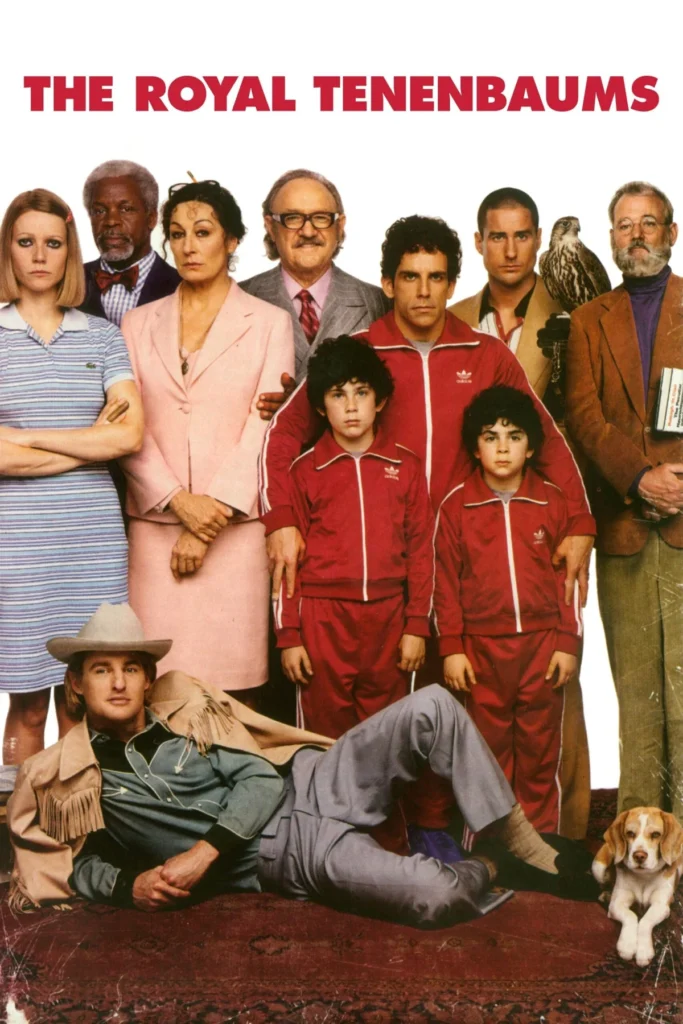

Released in the winter of 2001 by Touchstone Pictures, Wes Anderson’s third feature film, The Royal Tenenbaums, stands as a monumental achievement in modern American cinema. Directed by Anderson from a screenplay co-written with his frequent collaborator Owen Wilson, the film assembled an extraordinary ensemble cast featuring Gene Hackman, Anjelica Huston, Gwyneth Paltrow, Ben Stiller, Luke Wilson, Owen Wilson, Danny Glover, and Bill Murray. Over two decades since its initial theatrical run, the film continues to be analyzed not only for its tragicomic narrative structure but also for its profound influence on production design, costume artistry, and the codification of the distinct cinematic vernacular that would come to define Anderson’s storied career.

Main Facts and Narrative Framework
At its core, The Royal Tenenbaums functions as a domestic tragicomedy examining the corrosive nature of family trauma, arrested development, and the long shadow cast by exceptionally gifted parents. The plot centers on the estranged Tenenbaum family: Royal (Gene Hackman), an expelled patriarch and fraudulent lawyer; Etheline (Anjelica Huston), an archaeologist and matriarch who kept the family afloat; and their three adopted and biological children—Chas (Ben Stiller), Margot (Gwyneth Paltrow), and Richie (Luke Wilson)—all of whom achieved extraordinary professional and intellectual milestones in childhood before experiencing severe burnout and psychological stagnation in adulthood.

The narrative instigates when Royal, facing eviction from his hotel and a fabricated terminal illness, decides to reintegrate himself into the lives of his family under false pretenses. This intrusion acts as a catalyst, dragging the chronically depressed and emotionally paralyzed siblings out of their isolated routines and forcing them to confront decades of unresolved grievances. Despite dealing with heavy thematic elements such as attempted suicide, severe addiction, infidelity, and the psychological fallout of familial abandonment, the film maintains a remarkably light, whimsical touch. This tonal balancing act is achieved through meticulous framing, a deadpan delivery style, and an inherent affection for characters who are fundamentally flawed and barely functional.
Chronology of Production and Aesthetic Evolution

The development of The Royal Tenenbaums followed the critical success of Anderson’s sophomore feature, Rushmore (1998). Production commenced around late 2000 in New York City, transforming Upper Manhattan and Harlem into a stylized, storybook version of the metropolis that felt curiously frozen in time, evoking the aesthetic sensibilities of the late 1970s.
During principal photography, the production was famously marked by friction between director Wes Anderson and veteran actor Gene Hackman. Reports from the set indicated that Hackman’s traditional, volatile approach to acting frequently clashed with Anderson’s ultra-precise, mannered directorial demands. Rather than forcing Hackman into the rigidly choreographed, robotic cadence exhibited by the rest of the cast, Anderson ultimately allowed the veteran actor to deliver a classic, unfiltered performance. Film historians and critics have since noted that this stylistic dissonance was not a flaw, but a brilliant narrative device. While every other character moves with a deliberate, trauma-induced stillness and speaks in a heavily curated, unnatural cadence, Royal Tenenbaum careens through scenes with chaotic, unfiltered energy. This stark contrast visually and performatively underscores Royal’s total disconnection from the emotional reality of his family.

Supporting Data and Visual Architecture
The visual language of The Royal Tenenbaums relies heavily on environmental storytelling, utilizing production design and costume curation as primary narrative vehicles rather than mere background dressing. Designed under the artistic direction of producer Wes Anderson and production designer David Wasco, the Tenenbaum family home at 111 Archer Avenue is an overwhelming sensory experience. Painted in vivid pinks and accented with rich wood paneling, antiquarian books, and eccentric paraphernalia—such as a rooftop flagpole and a telephone booth hidden beneath the staircase—the house serves as a physical manifestation of the family’s insular, arrested psyche.

Costume designer Karen Patch played a pivotal role in establishing the psychological profiles of the characters through their wardrobes. The costume design intentionally highlights the concept of arrested development. The Tenenbaum children, despite reaching middle age, remain visually trapped in the exact aesthetic of their adolescent heydays. Margot Tenenbaum wears a signature Fendi fur coat and Lacoste tennis dress, an outfit she has maintained since her youth. Richie Tenenbaum is permanently attired in a tan tailored suit paired with a athletic headband and wristbands, reflecting his identity as a former tennis prodigy. Chas Tenenbaum and his sons wear matching red Adidas tracksuits—a deliberate uniform born out of the trauma of his wife’s accidental death, symbolizing a desperate, protective need for control and unity in an unpredictable world.
Official Responses and Critical Reception Upon Release

Upon its theatrical release on December 14, 2001, in limited release before expanding in January 2002, The Royal Tenenbaums received largely positive reviews from critics, though its reception was initially more polarizing than that of Rushmore. Reviewers praised the film’s ambition, its visual opulence, and the stellar performances of the ensemble cast, particularly Gene Hackman, whose portrayal of the scoundrel patriarch earned him a Golden Globe Award for Best Actor in a Motion Picture – Musical or Comedy.
However, some contemporary critics argued that the film’s heavy reliance on stylized artifice risked overshadowing its emotional core. Over time, critical consensus shifted dramatically. Retrospective evaluations have elevated the film to a masterclass in modern auteur cinema. It currently holds a prominent position on numerous lists compiling the greatest films of the 21st century, celebrated specifically for its groundbreaking synthesis of deadpan comedy and genuine pathos.

Broader Impact and Cultural Implications
The cultural footprint of The Royal Tenenbaums extends far beyond traditional film criticism, deeply influencing fashion, interior design, and independent filmmaking over the past two decades. The distinct color palettes, symmetrical framing, and deadpan aesthetic popularized by Anderson in this film helped birth an entire visual subgenre in contemporary media.

In the realm of fashion, the "Tenenbaum aesthetic"—typified by Margot’s mink coat and loafers, Richie’s tennis wear, and Chas’s tracksuits—has repeatedly resurfaced on global runways and streetwear collections. Major fashion houses frequently cite Karen Patch’s costume design as a primary reference for autumnal tailoring and nostalgic sportswear integration.
Furthermore, the film’s nuanced handling of mental health, gifted child syndrome, and dysfunctional family dynamics resonated deeply with audiences, paving the way for a wave of melancholic indie comedies that explore trauma without resorting to cynical despair. By treating its roster of eccentric, failed geniuses with profound kindness and empathy, The Royal Tenenbaums established a new standard for how modern cinema addresses the complexities of familial reconciliation. Two decades on, the film remains a definitive touchstone of American cinematic art, proving that even the most fractured family structures can be rendered with breathtaking beauty, wit, and enduring grace.