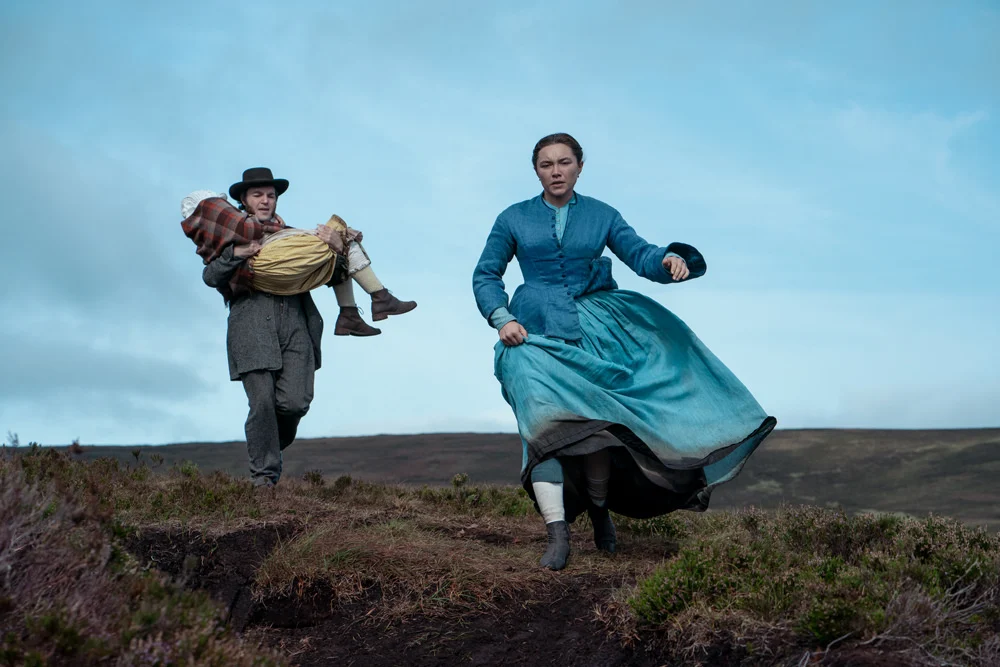

Directed by Sebastián Lelio and released globally on Netflix in November 2022, the psychological period drama The Wonder continues to prompt critical discussion regarding its unique stylistic choices, historical framing, and central performances. Adapted from Emma Donoghue’s 2016 bestselling historical novel of the same name—which was loosely inspired by historical accounts of the 19th-century "fasting girls" phenomenon, most notably the case of Welsh fast-status subject Sarah Jacob—the film stars Florence Pugh as Lib Wright. Wright is an English nurse who travels to a remote Irish midlands community to monitor a young girl purportedly surviving without food for months.
When evaluated through the lens of recent retrospective reviews and cultural analysis, The Wonder stands out as a deliberate subversion of traditional historical drama conventions. Rather than leaning into predictable period-piece tropes, director Lelio and his production team utilized distinct anachronistic and psychological elements to explore universal themes of trauma, patriarchal control, and institutionalized religious mania.
Main Facts and Narrative Premise
Set in post-Famine Ireland in 1859, The Wonder follows Nurse Lib Wright, a veteran of the Crimean War who served under Florence Nightingale. She is hired by a local committee of town elders—comprising a doctor, a priest, and wealthy landowners—to observe eleven-year-old Anna O’Donnell (played by Kila Lord Cassidy). Anna’s family and community maintain that the child has not consumed any food for four months, yet remains alive and healthy, framing her survival as a miraculous holy phenomenon.
Lib is tasked with working alongside a local nun, Sister Michael, to watch Anna in shifts for two weeks to determine whether the fasting is genuine or a fraud. What begins as a straightforward medical observation quickly devolves into a tense psychological battleground. Lib uncovers dark family secrets, systemic abuses of power, and a pervasive societal obsession with the physical bodies and purity of young women.
Cinematographer Ari Wegner, renowned for her visually arresting work on The Power of the Dog, captures the stark, oppressive landscape of the Irish midlands. Instead of romanticized, verdant pastures, viewers are presented with vast expanses of desolate brown earth, slate-gray skies, and a claustrophobic family home painted in unsettling, sickly hues that evoke a sense of physical and spiritual rot.

Chronology and Production Background
Development on the film adaptation began years prior to its eventual production, with Emma Donoghue co-writing the screenplay alongside playwright Alice Birch and director Sebastián Lelio. Lelio, an acclaimed Chilean filmmaker known for his Academy Award-winning film A Fantastic Woman, brought an outsider’s perspective to the deeply specific cultural and historical wounds of mid-19th-century Ireland.
Principal photography took place in County Wicklow, Ireland, during the summer and autumn of 2021, navigating ongoing industry health and safety protocols. Netflix distributed the film internationally on October 2, 2022, following a limited theatrical release in select markets.
The timeline of the narrative unfolds over a tightly compressed two-week period. This structural choice mirrors the clinical observation log kept by Nurse Wright, gradually ratcheting up the tension as Anna’s physical health deteriorates. The film famously opens with a self-referential meta-cinematic framing device, directly addressing the audience within a soundstage before stripping away the artifice to plunge viewers directly into the historical setting—a creative choice that has generated considerable debate among critics and viewers alike regarding its narrative efficacy.
Supporting Data and Historical Context
The historical backdrop of The Wonder is anchored in the aftermath of the Great Famine (1845–1852), a catastrophic period in Irish history that resulted in the death of approximately one million people and the mass emigration of another million. While the film does not explicitly dwell on the political mechanics of British colonial rule or the sweeping trauma of the famine itself, these socio-economic realities hum quietly beneath the surface of every interaction.
The narrative’s central medical mystery draws directly from the historical phenomenon of "fasting girls." During the Victorian era, numerous young women across Europe and North America claimed to survive without sustenance, attracting intense public scrutiny, religious fervor, and scientific investigation. In many cases, these individuals became localized tourist attractions or religious icons. The most prominent historical parallel is Sarah Jacob, the Welsh fasting girl whose tragic death in 1869—brought about when medical professionals insisted on monitoring her without intervention to test the validity of her fast—directly inspired Donoghue’s novel.
In The Wonder, this historical framework serves as a vehicle to examine how communities in crisis project their collective grief, guilt, and need for redemption onto vulnerable bodies, particularly those of children and women.

Stylistic Analysis and Artistic Choices
One of the most notable aspects of Lelio’s direction is his deliberate departure from traditional period-drama aesthetics. Rather than utilizing a conventional orchestral score punctuated by mournful traditional instrumentation, the film features an eerily modern, electronic-tinged score composed by Matthew Herbert. The sound design heavily emphasizes physical textures—heavy breathing, the rhythmic scraping of cutlery, the physical strain of eating unpalatable food, and the administration of laudanum.
These counter-intuitive choices extend to the visual framing. Florence Pugh’s performance relies heavily on physical stillness and silent resilience rather than overt emotional outbursts. Her character’s consumption of food is portrayed not as a moment of pleasure, but as mechanical labor—an act of survival in an environment saturated by despair and death.
Supporting performances enrich the psychological depth of the film. Young actress Kila Lord Cassidy delivers a devastating portrayal of pious devotion and suppressed trauma, while her real-life mother, Elaine Cassidy, plays Mrs. O’Donnell, embodying a mother so broken by religious indoctrination and grief that she is complicit in her daughter’s slow demise. Tom Burke plays William Byrne, a local journalist tracking the story who shares a growing intellectual and emotional bond with Lib, providing a necessary counterweight to the rigid dogmatism of the village elders.
Broader Impact and Critical Implications
Upon its release, The Wonder received generally favorable reviews from critics, who praised Pugh’s commanding screen presence, Wegner’s evocative cinematography, and the film’s unflinching examination of religious fanaticism. However, some cultural critics and viewers debated whether an international creative team could fully capture the complex nuances of Irish history and post-famine trauma.
Film analysts argue that Lelio’s outsider status proved to be an asset rather than a liability. By refusing to rely on familiar cinematic cliches—such as sentimentalized portrayals of rural Irish life or overt political diatribes—the director elevated the material into a universal exploration of patriarchal surveillance and ideological extremism.
The film’s framing device and ambiguous resolution continue to spark discussions in online film clubs and academic circles. By explicitly reminding the audience that they are watching a constructed story, The Wonder challenges viewers to interrogate why human society has historically fixated on the suffering of young women as a proxy for spiritual or collective cleansing. As contemporary conversations surrounding bodily autonomy, institutional control, and mass hysteria remain profoundly relevant, The Wonder secures its place as a chillingly prescient and formally audacious entry in modern psychological drama.