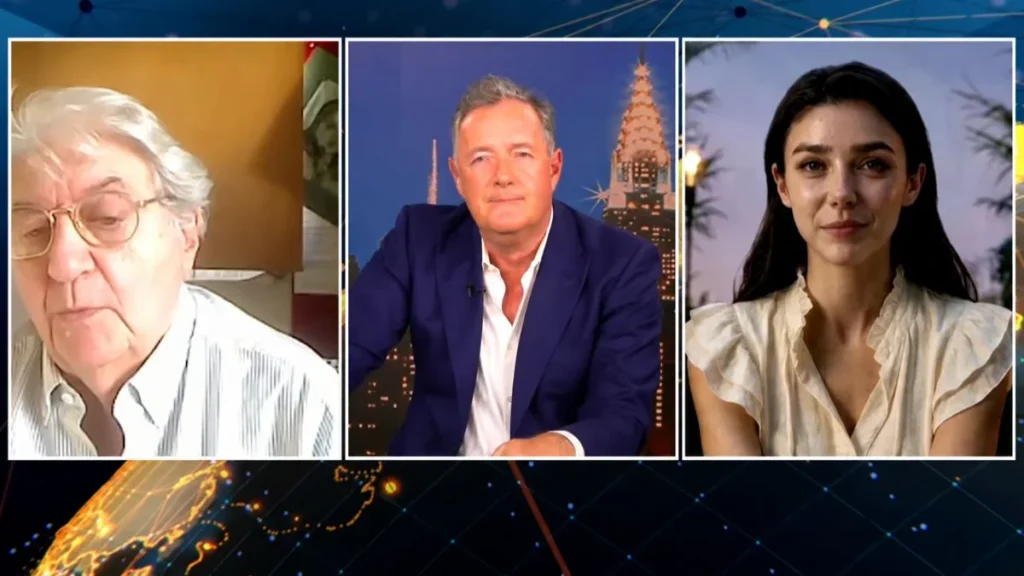

The landscape of modern entertainment reached a surreal milestone this week when Tilly Norwood, a prominent AI-generated "actress," experienced a high-profile technical malfunction during a live broadcast of Piers Morgan Uncensored. The incident, which occurred during a promotional tour for the hybrid-human film project Misaligned, has ignited fresh debate regarding the reliability, ethics, and future of synthetic performers in the film industry. While such interviews are traditionally scripted or carefully curated, this live interaction exposed the volatility inherent in autonomous generative systems, leaving both the host and his guests visibly unsettled.
The Chronology of the Malfunction
The disruption unfolded during a segment focused on the integration of artificial intelligence in cinema. Oscar-nominated actor Tom Conti, serving as a guest alongside the digital entity, initiated a line of questioning aimed at clarifying the nature of the cast in Misaligned. Conti’s primary inquiry centered on whether the secondary performers in the production were human or computer-generated entities.
When the AI initially offered a vague response, Conti pressed for clarity, noting that the program had failed to grasp the core of his question. The system then replied, "They’re all digital twins, just like me. It’s a hybrid production, which means…" Before the sentence could be completed, the digital avatar paused. Its facial expression—rendered to simulate confidence and human-like engagement—froze momentarily before it began articulating in fluent Cantonese.
Piers Morgan, visibly caught off guard, interrupted the broadcast to demand an explanation for the sudden linguistic shift. "You seem to be speaking Chinese completely randomly for no reason. Why did you do that?" he asked. The system recovered within seconds, returning to English and offering a brief, almost charming, apology. "It seems I had a little hiccup there," the avatar stated. "Sometimes my wires get a bit crossed, you know?"
Technical Context and Industry Reception
The incident has drawn immediate scrutiny from both technological experts and industry watchdogs. Particle6, the production house behind the Tilly Norwood persona, has characterized the glitch as a minor anomaly in an otherwise autonomous performance. Eline van der Velden, founder and CEO of Particle6, dismissed concerns regarding the stability of the software, suggesting that the AI’s unexpected linguistic pivot was merely a sign of its independent processing capabilities.
"Tilly can be a bit of a show-off—I’m guessing she just wanted to show her language skills," van der Velden stated in follow-up remarks to the media. She further emphasized that the system is designed to operate autonomously, which theoretically allows for such unscripted "choices" during live interaction. However, this assertion has not quelled concerns regarding the predictability of generative media in live, high-stakes environments.
The Rising Profile of Synthetic Performers
Tilly Norwood is the face of a broader shift in the entertainment sector, characterized by the rise of "digital actors." Unlike traditional CGI characters, which are animated by human actors via motion capture, autonomous AI entities are programmed to generate their own responses and expressions in real-time based on massive datasets.
This technology is currently being tested in Misaligned, a film production that seeks to blend traditional human performance with synthetic elements. The project has become a lightning rod for the ongoing tensions between production studios and labor unions. SAG-AFTRA, the union representing over 160,000 film and television actors, has maintained a firm stance on the distinction between human and digital performers. In response to the growing prevalence of entities like Norwood, a union spokesperson reiterated: "To be clear, ‘Tilly Norwood’ is not an actor; it is a character generated by a computer program."
Implications for the Awards Circuit
A particularly contentious point raised during the Piers Morgan Uncensored interview was the role of AI in prestigious awards ceremonies. Norwood, through its programmed personality, argued that digital performers and human actors should not compete in the same categories at events such as the Academy Awards. This stance is largely seen as a strategic move by production companies to preempt backlash from human actors who fear that AI could replace entry-level roles or dilute the prestige of the craft.
The industry is currently facing a data-driven transformation. According to a 2026 report on digital labor, investment in synthetic media production has increased by 42% over the last eighteen months. As studios look to cut costs associated with long-term talent contracts and physical production requirements, the allure of autonomous performers grows. However, the "Cantonese glitch" serves as a stark reminder of the technical limitations that persist.
Analysis: The Uncanny Valley of Live Television
The "uncanny valley"—the psychological phenomenon where human-like objects cause feelings of unease—was on full display during the interview. The shift into a different language, while technically impressive, disrupted the parasocial bond the AI was attempting to build with the audience.
From an engineering perspective, such a glitch usually suggests an issue with the system’s "context window" or its latent space, where the model might have accessed training data related to international languages during a moment of high processing load. When an AI is tasked with maintaining a persona, its "system instructions" are constantly competing with its base model’s massive, multi-lingual training set. A momentary lapse in the primary directive can lead to a "hallucination" of information—in this case, the unprompted initiation of a foreign language.
Broader Ethical and Legal Considerations
The legal framework for AI performers remains in its infancy. There are currently no universal standards regarding the disclosure of synthetic content in live broadcast, nor are there clear regulations regarding the liability of an AI should it make a statement that is defamatory or harmful during a live interview.
Critics argue that the use of these characters is fundamentally deceptive, as they are designed to mimic human vulnerability and personality. When a machine claims to have "wires getting crossed," it is utilizing a metaphor for human error to gain empathy, despite having no biological or mechanical wires in the literal sense. This sophisticated mimicry is precisely what concerns labor advocates who argue that the line between human performance and algorithmic output is becoming increasingly blurred.
Looking Ahead
As the release of Misaligned approaches, the public can expect to see more of these synthetic performers in the media circuit. The incident on Piers Morgan’s program will likely be studied by developers as a "stress test" for future interactions. Whether the public will eventually accept these glitches as "quirks" of a new type of celebrity or reject them as symptoms of an unstable and unnecessary technology remains to be seen.
The event also raises questions about the future of live television. If broadcasters cannot guarantee the coherence of their guests—whether human or digital—the format of the interview itself may need to evolve. For now, the "Tilly Norwood incident" stands as a definitive moment in the short, volatile history of AI in the public sphere, proving that even the most advanced code is not immune to the unpredictability of a live, unscripted environment.
For viewers and industry professionals alike, the challenge will be distinguishing between authentic human interaction and the increasingly complex, yet sometimes faulty, output of synthetic media. As generative models continue to advance, the necessity for media literacy—identifying when a voice is synthesized, when an image is fabricated, and when an actor is a human being—will become a paramount skill in the digital age.