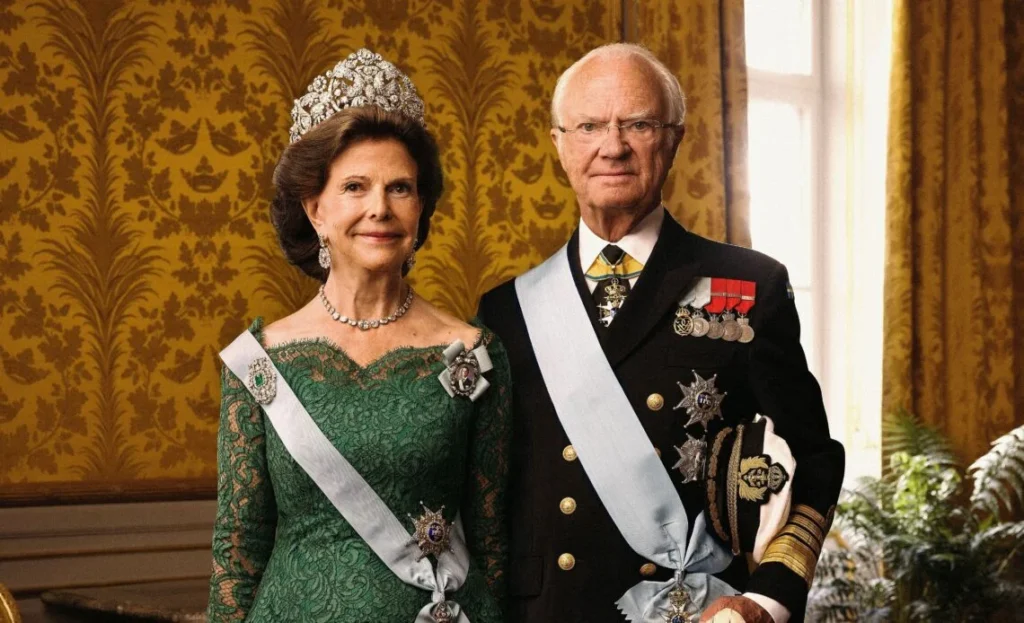

As King Carl XVI Gustaf of Sweden approaches a significant milestone – his 80th birthday on April 30th – he has granted a rare and candid interview, offering a glimpse into his personal reflections on aging and his enduring commitment to his role. In a conversation with Svenska Dagbladet, the King shared a surprisingly relatable anecdote about how he truly feels the passage of time, attributing it not to the grand responsibilities of his office, but to the humble act of navigating his own kitchen.
"When you’re standing in the kitchen and wondering if you should really get up on that ladder to get something from the top shelf," the King revealed, "you do it anyway. But you take it a little more carefully." This lighthearted admission underscores a universal experience of aging, even for a monarch who has occupied the Swedish throne for over five decades. While the King stated that he generally does not feel his age, these small, everyday moments serve as gentle reminders of his advancing years.
This introspective interview precedes a week of official celebrations honouring King Carl XVI Gustaf’s octogenarian milestone. These festivities are set to include a solemn service of thanksgiving and a glittering gala dinner, events expected to draw a distinguished assembly of European royalty and dignitaries, highlighting the King’s long-standing relationships and the significance of his reign within the global monarchical community.
A Lifelong Journey to the Throne
Born Prince Carl Gustaf Folke Hubertus on April 30, 1946, at Haga Palace in Solna, the King’s path to the throne was shaped by both tragedy and the specific succession laws of his era. He was the only son of Prince Gustaf Adolf, Duke of Västerbotten, and Princess Sibylla of Saxe-Coburg and Gotha. His parents already had four daughters, but under Sweden’s then-absolute primogeniture, female heirs were excluded from the line of succession. This meant that young Carl Gustaf was third in line to the throne, behind his father and grandfather.
The course of his early life was dramatically altered in 1947 when his father, Prince Gustaf Adolf, perished in a plane crash. This devastating event propelled the then infant prince to become second in line to the throne, with his grandfather, Crown Prince Gustaf Adolf, now heir apparent. The ascension of his grandfather to the throne as King Gustaf VI Adolf in 1950, when Carl Gustaf was just four years old, officially made him the Crown Prince and heir to the Swedish throne. His upbringing was thus deeply influenced by the expectations and preparation for a future monarch.
A Reign of Transformation and Modernization
King Carl XVI Gustaf ascended to the throne on September 15, 1973, following the death of his grandfather, King Gustaf VI Adolf. His accession marked the beginning of a reign that has witnessed profound societal and constitutional changes in Sweden. He holds the distinction of being the longest-reigning monarch in Swedish history and is currently the longest-serving monarch in Europe, a testament to his enduring presence and dedication.
A pivotal moment in his reign, and indeed in Swedish royal history, was the change in the Act of Succession in 1980. This landmark reform introduced full primogeniture, meaning that the eldest child, regardless of gender, would inherit the throne. This change directly impacted the line of succession for his own children, elevating his eldest daughter, Crown Princess Victoria, to heir apparent ahead of her younger brother, Prince Carl Philip. This modernization of the monarchy has been widely seen as a step towards greater gender equality and a reflection of contemporary societal values.
Reflections on Succession and Popularity
In his interview with Svenska Dagbladet, King Carl XVI Gustaf also spoke with pride about his heir, Crown Princess Victoria. He lauded her for her "strength and ambition," qualities that have undoubtedly contributed to her consistently high popularity ratings among the Swedish public. The King even offered a humorous theory as to why his daughter often surpasses him in public opinion polls. "We’ve seen the old man for so long," he suggested, implying that the public’s familiarity with his long tenure might lead them to seek out a fresh face in the form of the Crown Princess. This self-aware observation highlights a dynamic often seen in long-reigning monarchies, where the heir apparent naturally garners significant attention and affection as the future of the institution.
Despite the acknowledgments of his advancing age, particularly in the context of kitchen-related acrobatics, King Carl XVI Gustaf expressed no immediate intention of abdicating. He indicated his desire to continue his duties "for as long as he has the energy." Given that his primary physical challenge appears to be reaching for items on high shelves, his ninth decade promises to be one of continued engagement and leadership, with the possibility of further extending his record-breaking reign.
The King’s Legacy and the Future of the Monarchy
King Carl XVI Gustaf’s reign has spanned a period of immense change, not only within Sweden but also across the globe. He has navigated the evolution of the monarchy from a more politically involved institution to a largely ceremonial one, adapting the royal family’s role to modern democratic principles. His marriage to Queen Silvia in 1976, a union that brought a commoner to the throne and was celebrated for its genuine affection, further cemented the monarchy’s connection with the people.
The King’s commitment to his duties, coupled with his relatable human moments, has fostered a unique position for him in the hearts of many Swedes. While the future of the monarchy will eventually see Crown Princess Victoria assume the throne, King Carl XVI Gustaf’s enduring presence and his recent candid reflections ensure that his octogenarian birthday is not just a personal milestone but also an occasion to reflect on his significant contributions to Swedish history and the continued evolution of the Swedish crown. The upcoming celebrations will undoubtedly serve as a fitting tribute to a monarch who has dedicated his life to his country and who, even at 80, continues to approach his role with grace, humour, and a steadfast sense of duty. The support for Crown Princess Victoria is evident, yet the King’s continued vigour suggests that the era of Carl XVI Gustaf is far from over, offering a period of stable transition and continued royal presence for the nation.