
A Deep Dive into Domestic Terror
Mysius, known for her atmospheric storytelling and exploration of human complexities, ventures into a more overt thriller territory with The Birthday Party. While sharing the remote, isolated setting and an appetite for darkness seen in her 2022 fantasy drama The Five Devils, this latest offering is noted for its more cohesive narrative structure, moving with a directness that sets it apart from the earlier, more experimental genre-bender. The film’s initial reception highlighted its effectiveness as a nail-biter, a testament to Mysius’s direction and a carefully curated cast. However, the discourse surrounding its conclusion at Cannes underscored a common challenge in genre filmmaking: delivering a satisfying resolution that maintains the established tension and verisimilitude.
The home-invasion thriller, as a subgenre, has a long and often chilling history, tapping into primal fears about the sanctity of one’s personal space and the inherent vulnerability of the domestic sphere. From early examples like William Wyler’s The Desperate Hours (1955) to modern interpretations, these films explore themes of security, psychological violation, and the thin veneer of civility that can be shattered by external threats. The Birthday Party positions itself within this lineage, yet Mysius endeavors to infuse it with a distinctly French sensibility, focusing less on gratuitous violence and more on the psychological torment and the intricate unraveling of trust within a family and between strangers. The film’s engagement with these themes at Cannes, a festival often celebrated for its arthouse fare, also speaks to a growing trend in European cinema to embrace and elevate genre storytelling, bridging the gap between commercial appeal and artistic merit.
Léa Mysius: Charting a Course in French Genre Cinema
Léa Mysius has rapidly established herself as an intriguing filmmaker, consistently pushing boundaries and exploring diverse narrative landscapes. Her directorial debut, Ava (2017), a coming-of-age drama steeped in poetic realism, premiered at Critics’ Week in Cannes, immediately signaling her talent for evocative storytelling. The Five Devils (2022), her sophomore effort, ventured into a complex blend of fantasy, mystery, and family drama, showcasing her willingness to experiment with genre conventions and character-driven narratives. This film, too, screened at Cannes, reinforcing Mysius’s status as a festival favorite.
With The Birthday Party, Mysius makes a deliberate pivot, tackling a more conventional thriller framework. However, her signature style remains evident: a keen eye for atmospheric detail, a deep investment in her characters’ inner lives, and a nuanced approach to tension-building. The adaptation of Laurent Mauvignier’s Histoires de la nuit provided Mysius with a robust literary foundation. Mauvignier, a celebrated French author, is known for his intense, often claustrophobic narratives that delve into the dark corners of human experience and memory. His novel likely offered a rich tapestry of psychological depth and moral ambiguity, which Mysius meticulously translates to the screen. The challenge for any director adapting such a work lies in maintaining the novel’s intricate character studies while translating its inherent suspense into a visual medium, a task Mysius largely achieves in the film’s initial two acts. Her ability to craft palpable dread through character interaction rather than overt brutality is a hallmark of her evolving cinematic language.
The Narrative Core: A Family Under Siege
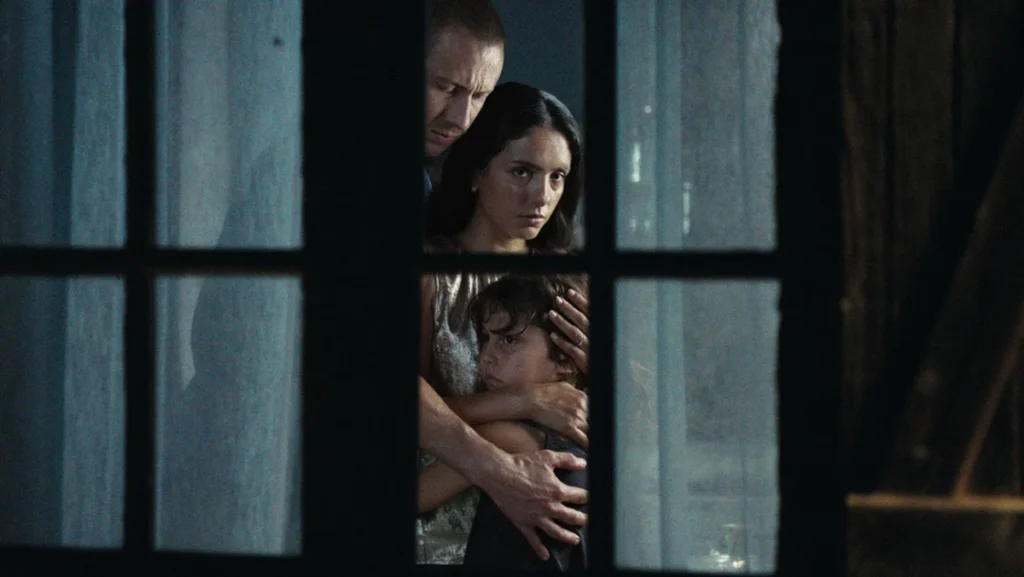
The film’s compelling premise centers on the Bergogne family, whose seemingly idyllic life in rural Western France is shattered over the course of one hellish night. Thomas (Bastien Bouillon), the hardworking patriarch, toils on their small dairy farm, grappling with the economic realities of the agricultural sector. His wife, Nora (Hafsia Herzi), is celebrating her 40th birthday, marked by a career milestone as she’s named head of town-planning at her office job. Their bright preteen daughter, Ida (Tawba El Gharchi), completes the family unit. This portrait of a striving, modern family provides a relatable foundation for the subsequent horror, making their vulnerability all the more acute.
Their sole neighbor is Cristina (Monica Bellucci), a sophisticated Italian artist who lives and works in a distressed-chic studio, a converted barn. Ida frequently visits Cristina on her way home from school, finding solace and inspiration in the artist’s world, a detail that subtly ties Cristina into the family’s orbit and, later, into the unfolding nightmare.
The narrative meticulously lays out crucial pieces of foreshadowing, building an insidious sense of unease. Early on, Nora’s intense reaction to a video Ida posts online of the family dancing – despite its 60,000 views – highlights her fierce desire for privacy and reluctance to be seen on social media. This seemingly minor domestic conflict later resonates with deeper implications regarding Nora’s hidden past. A more overt signal of impending danger arrives with Flo (Paul Hamy), a shifty-looking man who claims to Cristina he’s interested in buying the Bergogne farmhouse. Cristina, sensing something amiss, exhibits a sharp intuition, which proves justified as the man’s true intentions are soon revealed.
Chronology of Terror: An Unfolding Nightmare
The film’s meticulously crafted chronology of events deepens the sense of creeping dread:
- Early Afternoon: Flo’s initial, suspicious visit to Cristina, posing as a potential buyer, is rebuffed, but his presence leaves a lingering unease.
- Late Afternoon: Flo returns, accompanied by his seemingly dim-witted younger brother, Bègue (Alane Delhaye), who has a history in a psych ward. Their eldest brother, Franck (Benoît Magimel), the clear leader, soon joins them.
- Ida’s Discovery: Ida, returning from school, finds Cristina’s studio seemingly empty, even her dog gone. Unbeknownst to her, the brothers have already taken Cristina hostage, specifically to prevent her from warning Thomas.
- Thomas’s Return: Thomas arrives home, oblivious, and begins decorating the farmhouse for Nora’s birthday party. The intruders allow him to enter and start the preparations, heightening the psychological torment by letting him experience a fleeting moment of normalcy before they reveal themselves.
- Nora’s Delayed Arrival: Nora’s journey home from work is deliberately slowed by a flat tire, creating agonizing suspense for both the audience and the characters trapped inside.
- The Confrontation: Upon Nora’s eventual arrival, Franck greets her with an unnerving familiarity, calling her "Leïla." Nora vehemently denies knowing him, but Franck’s persistent claims and subtle hints at a shared past sow seeds of doubt and suspicion in Thomas, adding a layer of marital tension to the terrifying home invasion.
- The Night of Negotiation: The bulk of the film unfolds over a long, hellish night, as the family navigates a chilling negotiation phase with their tormentors. Mysius excels in maintaining this high-wire tension, where physical violence is always a looming threat but psychological manipulation takes center stage.
Psychological Warfare and Unveiled Pasts
Mysius’s screenplay transcends typical home-invasion tropes by delving deep into the psychological violation inflicted by the intruders. Franck and his brothers possess an intimate, unsettling knowledge of the Bergogne family. They are aware of Thomas’s precarious financial situation with the struggling dairy farm, a detail that underscores their calculated malevolence and targets the family’s deepest vulnerabilities. This intellectual and emotional intrusion is far more insidious than mere physical threat, as it strips the victims of their privacy and exposes their personal struggles.
The director’s particular investment in the women of the story—Nora, Ida, and Cristina—is a significant strength. They are not merely passive victims trembling in fear but active strategists, quietly observing and analyzing their captors for any signs of weakness. This nuanced portrayal subverts conventional genre expectations, empowering the female characters with agency and intelligence.
Some of the film’s most compelling scenes involve Cristina and Bègue. Left alone in Cristina’s studio, Bègue attempts to project toughness, but Cristina skillfully identifies his vulnerable "soft underbelly." She offers him a rare moment of sympathy and respectful conversation, discussing her art, treating him like an intelligent adult—a stark contrast to the demeaning treatment he receives from his brothers. A shared glass of wine and a joint blur the lines of their dynamic, creating an almost convivial atmosphere, but always with the underlying threat of violence. Monica Bellucci’s performance as Cristina is particularly strong here, portraying a woman who is not just attempting to escape but intelligently plotting her moves, understanding the need for patience and observation.
Meanwhile, Nora faces relentless psychological pressure from Franck, who forces her to confront parts of her past that she has meticulously kept secret from her family. As she is compelled to acknowledge her history with Franck, marital tensions and trust issues combine with the unpredictable nature of the volatile strangers. Thomas is left to wonder how well he truly knows his wife, adding a profound layer of internal conflict to the external threat. Through all this, Ida, though seemingly engrossed in cartoons in the living room, is depicted as acutely aware of the unfolding drama, her preteen mind processing the terror and the unspoken truths.
Ensemble Performances: The Human Element of Fear
The film’s critical success in its initial acts is undeniably bolstered by its formidable cast. The trio of thugs brings a potent, punchy dynamic to the screen. Benoît Magimel, as the eldest brother Franck, embodies a chilling "Brando phase," his imposing physical presence as unsettling as his menacing words. He exudes a quiet authority that makes him a truly terrifying antagonist. Paul Hamy delivers a magnetic performance as Flo, a livewire bundle of cocky charm and inherent danger, constantly keeping the audience on edge. Alane Delhaye, as Bègue, is almost touching in his portrayal of a character whose lack of self-assurance makes him a poor fit for the criminal life, a truth he likely already comprehends. His scenes with Bellucci are particularly effective in revealing the complex humanity within the criminal element.
However, the standout performance, according to many critics, comes from Hafsia Herzi as Nora. Herzi, already celebrated for her memorable role in Abdellatif Kechiche’s The Secret of the Grain and her exquisite directorial work on the queer coming-of-age drama The Little Sister (which also premiered at Cannes), delivers a performance of profound emotional depth and strategic resilience. She navigates Nora’s escalating terror, the unveiling of her hidden past, and her fierce protectiveness of her family with remarkable nuance. Herzi’s ability to convey both vulnerability and steely resolve underscores her immense talent, positioning her as an actress and director deserving of wider international recognition.
The Critical Juncture: A Promising Start, a Faltering Finish
Despite its numerous strengths—the efficient setup, the crackling tension of the uncomfortable midsection, and the powerful performances—The Birthday Party faces significant criticism for its climactic act. The initial reviews from Cannes frequently highlighted a "wobbly third act" and a "pileup of movie-ish improbabilities" that jarred viewers out of the otherwise immersive experience.
The core issue appears to be a "nagging inattention to verisimilitude," a departure from the grounded realism that Mysius painstakingly builds throughout the film. Specific examples cited include a character bleeding profusely from a gunshot wound who inexplicably puts their pain on hold to address "matters of the heart," an emotional beat that feels forced and unrealistic given the circumstances. Another point of contention is the sudden and "unlikely skill with a rifle" displayed by a character, which is described as a "hoariest Western cliché" that would be dissected in any basic screenwriting class. These narrative choices, while perhaps intended to heighten drama or provide emotional payoff, ultimately undermine the film’s credibility and the audience’s suspension of disbelief.
This phenomenon of a strong film faltering in its conclusion is not uncommon in cinema, particularly within the thriller genre, where a satisfactory and logical resolution can be difficult to achieve after sustained high tension. For The Birthday Party, the contrast between its meticulously crafted psychological horror and the perceived narrative shortcuts in its finale proved to be a significant point of contention for critics and audiences alike.
Broader Implications: French Cinema and International Remake Prospects
The critical reception of The Birthday Party at Cannes, particularly the discussions surrounding its ending, offers interesting insights into the landscape of contemporary French cinema and its engagement with genre. Historically, French cinema has been lauded for its arthouse dramas and auteur-driven works. However, in recent years, there has been a noticeable shift, with more French directors exploring genre filmmaking, from horror and thrillers to science fiction. Mysius’s film is part of this wave, demonstrating a willingness to engage with commercially viable genres while still imbuing them with artistic depth and social commentary. The film’s selection for the Cannes Competition underscores the festival’s evolving embrace of diverse cinematic forms.
Furthermore, the review’s suggestion that "some smart retooling of the wobbly third act could yield a viable property" for an American remake highlights a significant aspect of the global film industry. European genre films, particularly thrillers, frequently attract attention from Hollywood for potential remakes. Success stories like The Grudge (from Japanese Ju-on) or The Ring (from Japanese Ringu) demonstrate the commercial appeal of reinterpreting foreign genre concepts for English-speaking audiences. While some remakes fall short, a property like The Birthday Party, with its compelling premise, strong character work, and psychological depth, holds considerable potential. A re-imagining could address the narrative weaknesses of the original’s climax, offering a second chance to fully realize the story’s immense promise.
In conclusion, The Birthday Party (Histoires de la nuit) stands as a testament to Léa Mysius’s evolving directorial prowess and her commitment to exploring the darker facets of human nature through compelling storytelling. Despite the noted imperfections in its final act, the film’s taut direction, deeply etched characters, and outstanding performances, particularly from Hafsia Herzi, solidify its place as a significant contribution to the home-invasion thriller genre and a noteworthy entry in contemporary French cinema. Its journey from a celebrated novel to a festival-contending film underscores the enduring power of psychological terror and the complex challenges of adapting such narratives for the screen.