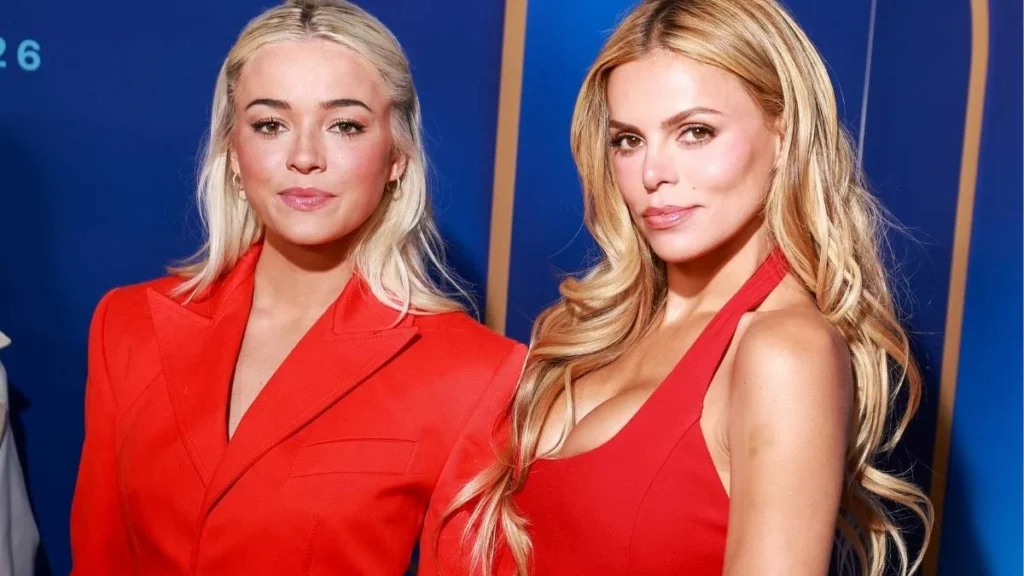

The production of the highly anticipated Baywatch reboot has reportedly become a backdrop for a burgeoning professional rivalry between two of its primary stars, Brooks Nader and Olivia “Livvy” Dunne. As the television industry prepares for the return of the sun-drenched procedural that defined 1990s pop culture, internal reports suggest that a quiet but intense competition has emerged over which actress will inherit the mantle of the show’s most iconic figure: Pamela Anderson. This friction, described by production insiders as a battle for the “Pamela Anderson lane,” highlights the high stakes involved in reviving a franchise that once commanded a global audience of over one billion weekly viewers.
While the original series was an ensemble drama, it was Anderson’s portrayal of C.J. Parker that became the face of the brand, translating into a level of international fame and commercial success that remains the gold standard for swimsuit-centric television. For Nader and Dunne, the reboot represents more than just a high-profile acting credit; it is a strategic opportunity to secure a permanent place in the cultural zeitgeist.
The Strategic Positioning of Brooks Nader and Livvy Dunne
The tension between the two stars is rooted in a fundamental difference in their roles and their respective paths to stardom. Brooks Nader, an established model and Sports Illustrated Swimsuit veteran, enters the production with a significant narrative advantage. Nader portrays Selene, the captain of the lifeguards, a role that places her at the center of the series’ operational hierarchy. Unlike guest stars or recurring characters, Selene is slated to appear in every episode of the reboot, providing Nader with the maximum possible screen time to establish her character as the show’s definitive lead.
In contrast, Olivia Dunne, the LSU gymnast who has become a social media phenomenon and a pioneer of the Name, Image, and Likeness (NIL) era, occupies a different space in the production. Dunne portrays Grace, a junior lifeguard. While her character is currently scheduled for a more limited three-episode arc, her presence on set is bolstered by a massive digital footprint. With a following that dwarfs most traditional television stars, Dunne brings a pre-built audience of millions, a factor that production executives and marketing teams rarely ignore.
Insiders suggest that this disparity—Nader’s narrative dominance versus Dunne’s cultural and social influence—has created a complex power dynamic. Nader’s role as the "captain" on screen has reportedly bled into a desire to maintain a certain seniority off-camera, while Dunne’s sheer popularity makes her a natural contender for the show’s "breakout star" title, regardless of episode count.
Reported Friction on Set and in Public
The rumored rivalry is not confined to the closed sets of the production. Reports of "tension" have surfaced from various sources close to the filming, with some alleging that both actresses have been vocal about their aspirations regarding the Pamela Anderson legacy. The competition reportedly involves discussions about who best embodies the "blonde bombshell" archetype that Anderson perfected, a role that carries significant weight in terms of future endorsements, media covers, and career longevity.
One specific incident that has drawn media attention occurred away from the filming locations, during a high-profile red carpet event for the Sports Illustrated Swimsuit issue. Observers noted that Nader appeared hyper-aware of how Dunne was being captured by the assembled press. Reports indicate that Nader was seen offering specific camera and posing suggestions to ensure that her own best angles were prioritized while being photographed alongside Dunne. Such behavior, while common in the highly competitive world of fashion and entertainment, is being interpreted by industry analysts as a sign of the defensive posture Nader may be taking as Dunne’s profile continues to rise.
The Cultural Weight of the Pamela Anderson Legacy
To understand why this rivalry has become so pronounced, one must look at the historical impact of the original Baywatch series. Running from 1989 to 2001, the show was a juggernaut of syndication, reaching audiences in over 140 countries. At its peak, it was the most-watched television show in the world.
Pamela Anderson, who joined the cast in 1992, became the catalyst for the show’s transition from a standard action-drama to a global phenomenon. Her character, C.J. Parker, was not merely a lifeguard; she was a brand. The "Pamela Anderson lane" refers to this unique intersection of athletic capability, undeniable screen presence, and a specific type of California-inspired aesthetic that resonated across borders. For the actresses in the reboot, filling this lane means inheriting a legacy that can launch a multi-decade career in the same way it did for Anderson, Carmen Electra, and Yasmine Bleeth.
A Timeline of the Baywatch Revival
The path to the current reboot has been long and fraught with high expectations. Following the 2017 feature film starring Dwayne Johnson and Zac Efron, which took a more comedic approach to the material, fans and critics alike called for a return to the earnest, dramatic roots of the original series.
- Early 2023: Initial reports surfaced that Fremantle, the production company holding the rights to Baywatch, was exploring a television reboot.
- Late 2023: Casting calls began, with a specific focus on finding talent that could bridge the gap between traditional television acting and modern social media influence.
- Early 2024: Brooks Nader and Olivia Dunne were confirmed as key members of the cast, representing two different but equally potent forms of modern celebrity.
- Mid-2024: Production began in earnest, with early leaks from the set hinting at the competitive atmosphere between the leads.
- Present: As filming continues, the focus has shifted from the show’s plot to the real-life dynamics of its stars, with the "battle for the red swimsuit" becoming a central narrative in the lead-up to the premiere.
Comparative Analysis: Screen Presence vs. Social Influence
The rivalry between Nader and Dunne serves as a case study for the current state of the entertainment industry. In the 1990s, stardom was built through television ratings and magazine covers. In 2024, it is a hybrid model.
Brooks Nader represents the traditional path. Her career has been built through the elite tiers of the modeling industry and a strategic move into television. By securing the role of the lifeguard captain, she is following the established blueprint for becoming a television star: lead billing, consistent screen time, and character development.
Olivia Dunne represents the new guard. Her value to the production is not measured solely by her performance in three episodes, but by her ability to drive engagement. With over 13 million followers across TikTok and Instagram, Dunne can generate more impressions for the show in a single post than a traditional marketing campaign might achieve in a month. This "influence capital" creates a unique type of leverage that can often overshadow the formal hierarchy of a call sheet.
The tension arises when these two worlds collide. Nader, as the lead, likely expects the deference traditionally afforded to a show’s star. Dunne, as a cultural icon in her own right, possesses a level of fame that does not require lead billing to sustain.
Potential Implications for the Series
While on-set friction is often viewed as a negative, in the world of television promotion, it can serve as a powerful marketing tool. The "rivalry" narrative adds a layer of intrigue to the reboot, encouraging viewers to tune in to see the chemistry—or lack thereof—between the two stars.
From a production standpoint, the competition may actually enhance the final product. If both Nader and Dunne are striving to outshine one another, the result could be more focused and high-energy performances. However, if the tension disrupts the filming schedule or affects the morale of the broader crew, it could present a challenge for showrunners.
Furthermore, the "Pamela Anderson lane" is wide enough to accommodate different types of stardom. The original Baywatch succeeded because it featured a diverse array of personalities. While Anderson was the primary star, the show also elevated the careers of David Chokachi, Alexandra Paul, and Gena Lee Nolin. The modern reboot will likely attempt to replicate this ensemble success, even if the current media focus remains on the Nader-Dunne dynamic.
Official Responses and Industry Outlook
Representatives for both Brooks Nader and Olivia Dunne have remained largely silent regarding the rumors of a rivalry, a standard tactic to maintain professionalism while allowing the "buzz" to continue. Publicly, both stars have shared behind-the-scenes glimpses of the production that suggest a focus on the work, though the lack of joint social media appearances has not gone unnoticed by fans.
Industry analysts suggest that the true winner of this rivalry will be determined not by the number of episodes filmed, but by who captures the public’s imagination once the show airs. The "Pamela Anderson" title is not one that can be assigned by a producer; it is a title bestowed by the audience.
As the Baywatch reboot nears completion, the industry will be watching closely. Whether the friction between Nader and Dunne is a temporary byproduct of a high-pressure set or the start of a long-standing professional feud, it has succeeded in making the reboot one of the most talked-about television events of the upcoming season. The legacy of the red swimsuit remains as potent—and as contested—as ever.