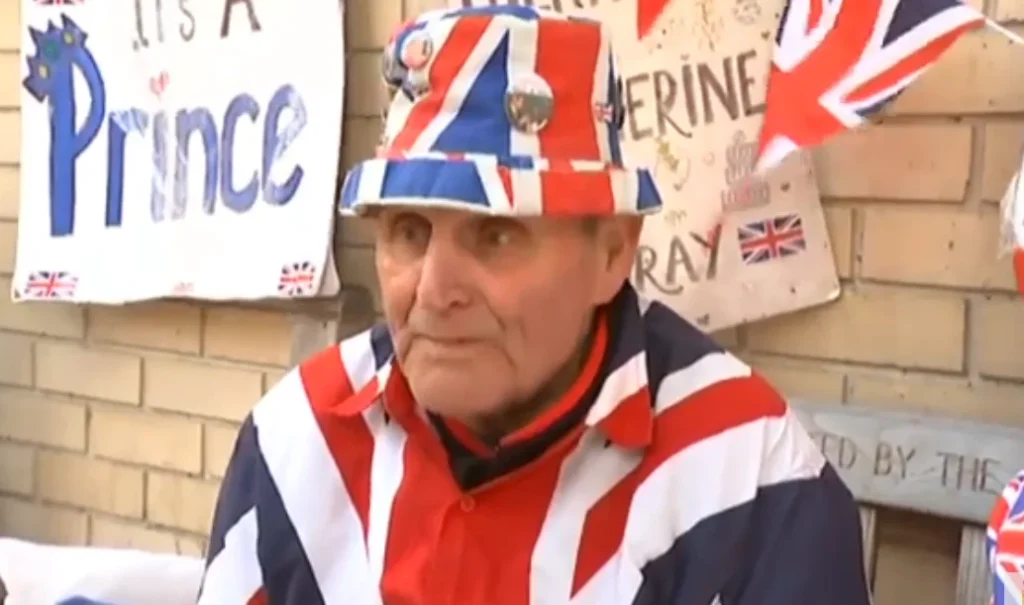

Terry Hutt, a beloved and instantly recognisable figure in the United Kingdom’s landscape of royal enthusiasts, has died at the age of 91. His passing, following a prolonged illness and with his family by his side, marks the end of an era for those who followed his unique brand of loyal devotion to the British monarchy. Mr. Hutt was not merely an observer of royal events; he was an active participant, often securing front-row vantage points through dedicated, sometimes arduous, vigils that spanned decades. His distinctive Union Jack-themed attire, a sartorial tribute to his patriotism and affection for the Crown, cemented his status as a national personality and a symbol of enduring public support for the Royal Family.
Born in London in 1935, Terry Hutt’s lifelong fascination with the monarchy was ignited during a pivotal moment in British history: the Second World War. As a young boy, he had the profound experience of meeting King George VI during a visit to his war-torn neighbourhood. This encounter, which included a gift from the King and his wife, the then-Duchess of York (later Queen Elizabeth The Queen Mother), left an indelible mark on young Terry. This early interaction fostered a deep admiration that would shape his future, transforming him into one of the most dedicated and visible royal fans of his generation.
Mr. Hutt’s commitment to witnessing key royal moments firsthand often involved significant personal sacrifice. He became renowned for his willingness to camp out for extended periods, braving the elements and enduring long waits to secure a prime position for significant events. This dedication was particularly evident during the births of the Cambridge children. In 2013, he famously spent two weeks sleeping on a bench outside St. Mary’s Hospital in Paddington, London, awaiting the arrival of Prince George. This vigil, broadcast widely by media outlets, highlighted his unwavering enthusiasm and captured the public imagination. His presence became a familiar and comforting sight for many, symbolising a tangible connection between the public and the Royal Family.
A Chronicle of Royal Devotion: From Princess Elizabeth’s Wedding to Princess Charlotte’s Debut
Terry Hutt’s royal vigils began early in his life, underscoring the deep roots of his loyalty. At the tender age of 12, he was present at Westminster Abbey for the wedding of Princess Elizabeth to Prince Philip in 1947. This early experience set a precedent for his future engagements, demonstrating a pattern of anticipating and attending major royal milestones.
His commitment continued through the decades, mirroring the evolving narrative of the Royal Family. Nearly seventy years after witnessing Princess Elizabeth’s wedding, Mr. Hutt was once again a prominent figure, this time at St. Mary’s Hospital in 2015 for the birth of Princess Charlotte. His presence in the front row, capturing the first public appearance of the young princess held by her mother, the Duchess of Cambridge, served as a poignant reminder of his enduring dedication. He noted the resemblance of the young princess to a youthful Queen Elizabeth II, a sentiment that resonated with many observing the continuity of royal lineage.
The iconic Union Jack suit, a creation that became synonymous with his name, was not merely a fashion statement but a deliberate and heartfelt expression of his patriotism and his deep affection for the Royal Family. This distinctive attire, often accompanied by a matching hat, made him instantly recognisable and earned him a special place in the public consciousness.
The "Union Jack Man": A Nickname Bestowed by the Monarch
Perhaps one of the most cherished aspects of Terry Hutt’s relationship with the Royal Family was the personal connection he felt, and indeed, that the late Queen Elizabeth II reportedly acknowledged. In a 2016 interview, Mr. Hutt revealed that Queen Elizabeth II herself had bestowed upon him the affectionate nickname "the Union Jack man." He expressed immense pride in this recognition, stating his joy in being able to bring a smile to the Queen’s face whenever she saw him. This anecdotal detail offers a glimpse into the personal interactions that can arise from sustained and visible public engagement, humanising the often-distant relationship between the monarchy and its subjects.
The longevity of his devotion is remarkable. Spanning the reigns of three monarchs – King George VI, Queen Elizabeth II, and now King Charles III – Mr. Hutt witnessed and participated in the significant moments that defined seven decades of British royal history. His life story, therefore, is intricately woven into the fabric of modern British royal observation.
Beyond Royalism: A Champion for Causes
While his passion for the Royal Family was his most public persona, Terry Hutt was also a committed advocate for various causes. His daughter, Tracey Joy, highlighted his broader engagement with society, mentioning his avid campaigning for the National Health Service (NHS) and the restoration of Birnbeck Pier. This reveals a multifaceted individual whose public spiritedness extended beyond royal events to encompass a genuine concern for social welfare and community heritage. His commitment to the NHS, in particular, resonates with a significant portion of the British public who rely on and value the national healthcare system.
Family Tributes and a Legacy of Devotion
The passing of Terry Hutt has elicited heartfelt tributes from his family, who remember him not only for his unique royal passion but also for his personal qualities. His daughter, Tracey Joy, shared a poignant reflection: "a life well lived and as we are grieving we look back at his fight for life, love for his family." This statement underscores that beneath the public spectacle of his royal vigils lay a devoted family man who faced his final illness with courage.
The legacy of Terry Hutt is one of unwavering loyalty, profound patriotism, and an enduring belief in the importance of public ritual and connection. He embodied a particular type of British enthusiasm, one that found joy and meaning in celebrating national institutions and figures. His distinctive presence at royal events, marked by his vibrant attire and steadfast dedication, will be missed by many who came to see him as an integral part of the national tapestry surrounding the Royal Family. His story serves as a reminder of the diverse ways in which individuals connect with and express their admiration for public figures and institutions, demonstrating that even in a rapidly changing world, deep-seated devotion can endure.
Supporting Data and Context
Terry Hutt’s commitment can be contextualised within the broader phenomenon of royal fandom in the United Kingdom. While media attention often focuses on immediate reactions to royal events, figures like Mr. Hutt represent a sustained and deeply ingrained form of public engagement. His vigils, particularly during the births of royal babies, highlight a cultural tradition of public anticipation and celebration surrounding the monarchy. These events often serve as significant national moments, drawing widespread media coverage and fostering a sense of collective experience. For instance, the birth of Prince George in 2013 was a global media event, with hundreds of journalists and thousands of well-wishers gathering outside the Lindo Wing of St. Mary’s Hospital. Mr. Hutt’s presence amongst them, particularly his prolonged vigil, elevated his status from a mere spectator to a prominent participant in this national narrative.
The Union Jack, as a symbol, carries immense historical and cultural weight in Britain. Its adoption by Mr. Hutt in his personal attire was a powerful visual statement of his identity and his unwavering allegiance. This conscious choice transformed him into a living emblem of British patriotism, resonating with a segment of the population that shares similar sentiments. His ability to secure front-row seats for numerous events, from royal weddings to public appearances, demonstrates a remarkable understanding of event logistics and a persistent drive to be at the heart of these historic occasions.
Broader Implications and Analysis
The passing of Terry Hutt prompts reflection on the evolving nature of public engagement with the monarchy. In an era increasingly dominated by digital interaction and social media, his physical presence and long-standing dedication represent a more traditional form of fandom. His ability to capture media attention through his distinctive appearance and unwavering commitment underscores the enduring power of tangible, visible devotion. While the methods of engagement may change, the fundamental human desire to connect with and celebrate significant national figures and institutions remains.
Mr. Hutt’s story also highlights the diverse motivations behind royal support. For some, it is rooted in tradition and a sense of national identity; for others, it is a personal connection forged through shared experiences or admiration for individual members of the Royal Family. His early encounter with King George VI, and the subsequent acknowledgement from Queen Elizabeth II, suggest that these connections, however brief, can have a profound and lasting impact on individuals.
His legacy serves as a reminder that behind the grand ceremonies and official pronouncements, there are often dedicated individuals who invest their time, energy, and passion into celebrating the monarchy. Terry Hutt was, in many ways, the embodiment of this dedicated public spirit, a loyal subject whose colourful presence and steadfast devotion made him an unforgettable figure in the annals of royal fandom. His passing leaves a void in the landscape of royal enthusiasts, but his memory, and his iconic Union Jack suit, will undoubtedly endure.