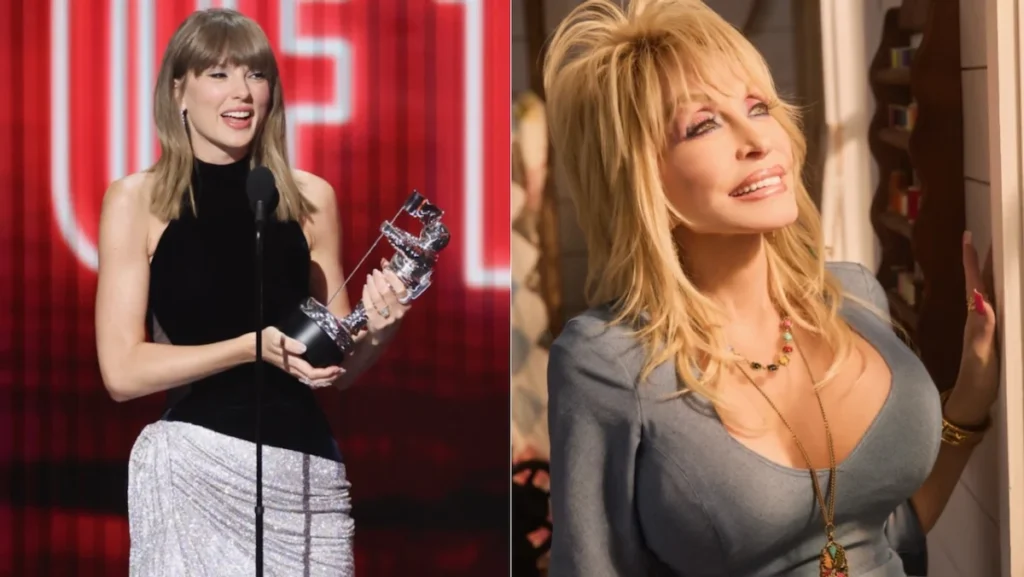

The 2026 MTV Video Music Awards reached an emotional crescendo on September 28, when global music icon Taylor Swift took to the stage to accept the night’s most prestigious honor: Video of the Year. In a poignant moment that resonated far beyond the confines of the arena, Swift bypassed the traditional list of industry collaborators and label executives to dedicate the accolade to the legendary Dolly Parton, characterizing the country music icon as the ultimate showgirl and a foundational influence on her own narrative songwriting craft.
The dedication served as a capstone to an evening that underscored Swift’s evolving legacy as both a performer and an auteur. By highlighting Parton, Swift drew a direct lineage between the classic storytelling traditions of country music and the contemporary, high-budget visual medium of the modern music video.
A Legacy of Storytelling: The Parton-Swift Connection
Swift’s remarks focused on the immersive quality of Parton’s discography, suggesting that the songwriting prowess of the Tennessee native served as a blueprint for the visual storytelling Swift has become known for throughout her career. “Every single song that she wrote, her storytelling was so vivid and so rich,” Swift stated during her acceptance speech. “Listening to her songs, it’s like watching the best music video you have ever seen in your life, every single time you hear what she has written.”
This acknowledgment points to a broader academic and critical consensus regarding Parton’s influence on pop culture. For decades, Parton has been cited not just as a vocalist, but as a master of the vignette—a skill set that Swift has mirrored in her own multi-album discography. The dedication was particularly striking given the somber and reflective tone Swift adopted, referring to the shared experience of existing on the planet with the icon, a phrasing that underscored the profound respect Swift holds for Parton’s life and enduring career.
The 2026 VMAs: A Night of Career Milestones
The 2026 VMAs were already marked by high-profile developments prior to the Video of the Year announcement. Earlier in the evening, the academy presented Swift with the inaugural Artist Director Honor, a newly established award recognizing artists who maintain comprehensive creative control over their visual and narrative output.
This recognition coincided with the world premiere of the music video for “Patient Zero,” a track that has already garnered significant attention for its technical ambition. By pairing the premiere of this new work with the retrospective weight of the Video of the Year award, the ceremony effectively framed Swift’s career as one that has successfully bridged the gap between traditional musical performance and cinematic visual art. The synchronization of these moments underscored a shift in how the industry honors long-term consistency in an era of rapid digital consumption.
Chronology of the 2026 VMA Ceremony
The event was tightly choreographed to showcase the evolution of the music video as an art form. The timeline of the evening’s key moments provides insight into the strategic pacing of the broadcast:
- 8:00 PM EST: The opening segment featured a retrospective on the history of the music video, highlighting key milestones from the 1980s to the present day.
- 9:15 PM EST: Taylor Swift received the inaugural Artist Director Honor, followed by the highly anticipated premiere of the “Patient Zero” music video.
- 10:45 PM EST: Nominations for Video of the Year were announced, showcasing a diverse field of global talent.
- 11:30 PM EST: Swift was named the winner of Video of the Year, leading to the headline-grabbing dedication to Dolly Parton.
Supporting Data and Industry Context
The selection of Swift for the Video of the Year award aligns with data-driven trends in the music industry. According to industry analysis from the first half of 2026, music videos remain a primary driver of fan engagement, with high-concept narratives yielding a 40% higher repeat-viewing rate compared to standard performance-based clips.
Swift’s success in this category is reflective of her sustained dominance in the streaming and broadcast space. Over the past five years, her visual projects have consistently ranked in the top percentile for production value and narrative depth. By citing Parton, Swift is also tapping into a "generational bridge" phenomenon—a recurring trend in the 2020s where contemporary superstars actively validate the contributions of 20th-century pioneers, thereby introducing legacy catalogs to younger demographic segments.
The Evolution of the "Showgirl" Persona
Swift’s characterization of Parton as the "ultimate showgirl" invites a re-examination of the term. Historically, the showgirl archetype was often confined to stage performance and choreography. However, in the context of Parton, the term encompasses the business acumen, the persona management, and the public-facing grace that has allowed her to navigate the music industry for over five decades.
Swift’s emphasis on how Parton handled her career with "grace, and joy, and love, and gratitude" highlights a shift in what is currently valued in celebrity culture. Following years of high-intensity, conflict-driven media cycles, there has been a detectable pivot toward acknowledging artists who utilize their platforms to foster community and positive fan engagement. Swift’s speech served as a public endorsement of this philosophy, positioning it as the ultimate goal for any artist operating at the highest level of fame.
Broader Impact and Industry Implications
The dedication has ignited a broader conversation regarding the influence of country music’s narrative structures on the pop music video industry. Industry analysts suggest that this moment could lead to a renewed interest in Parton’s deep catalog, as fans of Swift seek to understand the source material that she identifies as foundational.
Furthermore, the creation of the Artist Director Honor suggests that organizations like MTV are looking to reward "total creative control" as a distinct professional category. This reflects the reality of the modern music landscape, where artists are increasingly expected to act as directors, writers, and producers of their own visual content. Swift’s win serves as an industry standard for this model.
Official Reactions and Public Response
While the VMAs concluded without a direct live statement from Dolly Parton, representatives for the legendary artist acknowledged the tribute on social media shortly after the broadcast, noting that the mutual respect between the two artists has been a private correspondence for some time.
Public response, as evidenced by social media engagement on platforms like X and Instagram, has been overwhelmingly positive. The hashtag #VMAs saw a 200% spike in traffic during the acceptance speech, with many commentators noting that the sincerity of the tribute added a much-needed human element to a high-production broadcast.
Analysis: The Future of Music Video Narrative
As the music industry continues to transition toward shorter, social-media-driven content, the “Patient Zero” music video and Swift’s victory act as a defense of the long-form, narrative-heavy music video. By aligning her success with the legacy of Dolly Parton, Swift is essentially arguing that the core of the music industry remains the story—the ability to articulate a human experience in a way that is both vivid and universal.
The 2026 VMAs will likely be remembered as the night the industry turned its gaze backward to honor the architects of modern pop. By explicitly centering her success on the influence of Dolly Parton, Taylor Swift has set a new precedent for how artists should discuss their inspirations, ensuring that the history of music remains a continuous dialogue rather than a series of disconnected viral moments.
As the industry moves into the final quarter of 2026, the ripple effects of this dedication are expected to influence upcoming marketing campaigns, with an increased emphasis on the "storytelling" aspect of visual music, potentially marking a return to the golden age of the music video where the visuals served as a window into the artist’s soul rather than just a promotional tool for the single.