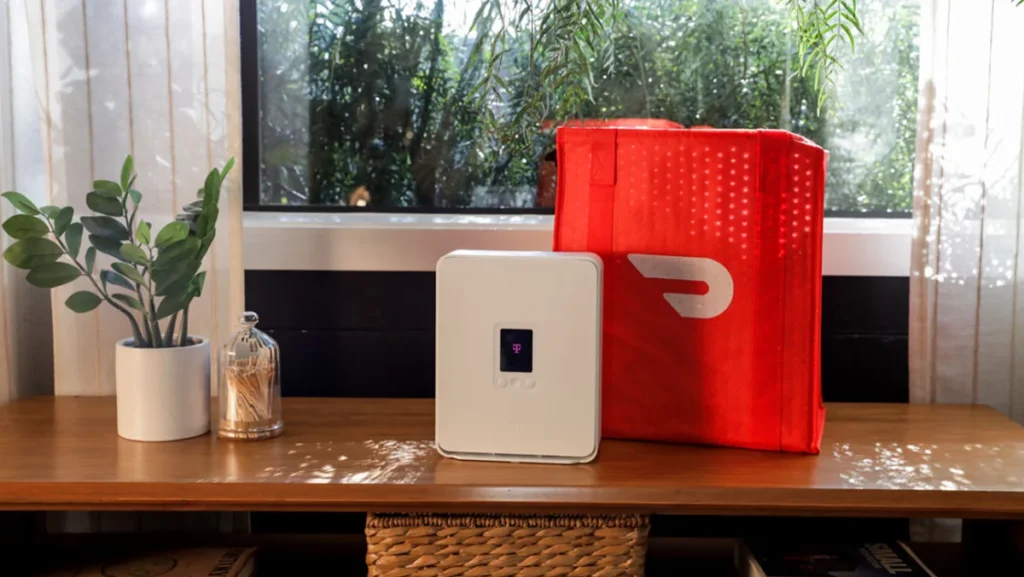

T-Mobile, a prominent disruptor in the telecommunications sector, has further cemented its commitment to customer convenience and speed by expanding its strategic partnership with DoorDash to offer same-day delivery of its 5G Home Internet Gateway. This development, which officially launched on April 9, marks a significant step in the mobile provider’s ongoing "15-Minutes to Better" initiative, designed to streamline and simplify the process of switching and accessing its services. Building on the success of its same-day phone delivery service, which commenced in December 2025, T-Mobile is now applying the same rapid fulfillment model to its burgeoning 5G home internet offering, positioning itself as a formidable challenger to traditional cable internet providers.
The "15-Minutes to Better" program was initially conceived by T-Mobile as a bold response to widespread consumer frustrations associated with carrier switching, including lengthy activation processes, complex equipment setups, and inconvenient delivery schedules. Its debut in December 2025 with same-day phone delivery, facilitated by DoorDash’s extensive logistics network, aimed to dramatically reduce the time it takes for a new customer to get a functional device in hand. This initial rollout demonstrated T-Mobile’s capability to leverage third-party delivery services to enhance customer experience, a strategy now being extended to the home internet sector. The underlying principle is clear: minimize friction, maximize speed, and empower customers with immediate access to essential services.
The Evolution of a Strategic Partnership: From Phones to Home Internet
The partnership with DoorDash is a cornerstone of T-Mobile’s strategy to differentiate itself in increasingly competitive markets. DoorDash, primarily known for food delivery, has aggressively expanded its "last-mile" logistics capabilities to include a diverse array of retail products, making it an ideal partner for T-Mobile’s ambitious delivery goals. For phone delivery, customers could order a new device online and, in many metropolitan areas, receive it within hours, bypassing the need to visit a physical store or wait for traditional mail delivery. This not only enhanced convenience but also aligned with the immediate gratification expected by modern consumers.
The extension of this partnership to T-Mobile Home Internet signifies a crucial pivot. While mobile phone delivery addresses individual device needs, home internet delivery tackles a broader household utility. The 5G Gateway, a compact wireless device that integrates the functionalities of both a modem and a router, is central to T-Mobile’s home internet ecosystem. Its same-day delivery means that customers can now transition from their existing internet provider to T-Mobile’s 5G service with unprecedented speed. This move not only capitalizes on the established logistics infrastructure but also reinforces T-Mobile’s brand image as an innovator focused on customer-centric solutions. The ability to order a 5G Gateway and have it delivered on the same day, then self-install it within approximately 15 minutes, directly addresses common pain points associated with traditional internet setup, such as scheduling technician appointments and managing complex wiring.
Understanding T-Mobile 5G Home Internet: A Disruptive Technology
T-Mobile 5G Home Internet leverages the same advanced 5G cellular network that powers its mobile phones to deliver high-speed broadband connectivity directly to homes. Unlike traditional cable internet, which relies on extensive wired infrastructure, 5G home internet uses wireless signals, offering a potentially more flexible and rapidly deployable solution. The 5G Gateway device acts as the central hub, receiving the 5G signal and broadcasting a Wi-Fi network throughout the home. This "plug-and-play" simplicity is a significant draw, eliminating the need for professional installation in most cases and providing users with greater autonomy over their internet service.
The technological shift from wired to wireless home internet represents a substantial market disruption. For years, cable and fiber optic providers have dominated the broadband landscape, often operating as regional monopolies or duopolies. 5G home internet introduces a viable third option, particularly in areas underserved by traditional broadband or where consumers seek alternatives to long-term contracts and complex billing structures. T-Mobile’s investment in its 5G network, which now covers a vast geographical area, enables it to offer competitive speeds and reliability without the overhead of laying new physical lines to individual homes. This approach not only expands internet access but also fosters greater competition, which can ultimately benefit consumers through improved service and more attractive pricing.
A Seamless Customer Experience: From Order to Online
The new same-day delivery program for T-Mobile 5G Home Internet is designed for maximum ease. Customers initiate the process by selecting one of T-Mobile’s 5G Home Internet plans, which start as low as $35 per month with qualifying bundles. Following the online order placement, customers receive real-time tracking information for their 5G Gateway delivery via DoorDash, offering transparency and predictability. Upon arrival, the self-installation process is remarkably straightforward, typically taking around 15 minutes. This rapid deployment capability is a key differentiator, contrasting sharply with the often multi-day or multi-week waiting periods associated with traditional internet service activation.
This emphasis on speed and simplicity aligns with broader consumer trends favoring immediate access and minimal hassle. In an era where digital services are expected to be instant, T-Mobile is extending this expectation to physical hardware delivery and setup. The ability to go from contemplating a switch to being fully connected within hours not only enhances customer satisfaction but also reduces the perceived barrier to changing internet providers. This frictionless onboarding experience is crucial for T-Mobile’s strategy to capture market share from incumbent providers, many of whom are still bound by legacy infrastructure and service models.
Enticing the Switch: Beyond Rapid Delivery
While same-day delivery is a powerful incentive, T-Mobile has layered additional benefits to encourage customers to make the switch from traditional providers. These benefits are strategically designed to address common anxieties and financial deterrents associated with changing internet services:
-
15-Day Worry-Free Test Drive: New users are offered a risk-free trial period of 15 days to experience T-Mobile 5G Home Internet. This allows customers to assess the service’s performance, reliability, and suitability for their specific needs without commitment. If unsatisfied, they can cancel without penalty. This confidence-building measure directly tackles consumer apprehension about committing to a new provider, especially one using a different technology.
-
Early Termination Fee (ETF) Buyout: Recognizing that many potential customers are locked into long-term contracts with "Big Cable" providers, T-Mobile offers to pay off early termination fees up to $750. This substantial financial incentive removes a significant barrier to switching, making the transition financially viable for a broader range of consumers. The rebate is typically provided via a virtual prepaid card, following a submission process, with a typical turnaround of about 14 weeks. This addresses one of the most common reasons customers delay or avoid switching, even when dissatisfied with their current service.
-
Five-Year Price Guarantee: To further instill confidence and alleviate concerns about future price hikes, T-Mobile provides a five-year price guarantee for customers who sign up now. This ensures that the monthly rate for their chosen plan remains locked in for at least half a decade, excluding standard taxes and fees. In an industry notorious for escalating prices post-promotional periods, this guarantee offers unparalleled long-term financial predictability and stability, a significant advantage for budget-conscious households and small businesses.
These combined incentives, coupled with the rapid delivery and simple setup, form a compelling package designed to disrupt the stagnant home internet market. T-Mobile is not just offering an alternative technology; it’s offering a fundamentally different customer experience built on transparency, flexibility, and financial security.
Flexible Plans for Diverse Needs: Rely, Amplified, and All-In
T-Mobile 5G Home Internet offers three distinct plans tailored to varying customer requirements and budgets:
- Rely: Positioned as the most affordable option, this plan provides essential internet connectivity suitable for standard household usage, including browsing, streaming, and light gaming.
- Amplified: Offering extra value, this mid-tier plan caters to households with higher data demands, multiple connected devices, and more intensive online activities.
- All-In: As the premium offering, the All-In plan delivers the best value for users requiring the highest speeds and bandwidth, ideal for large families, remote workers, and avid gamers.
These plans start at $35, $45, and $55 per month, respectively. These prices already reflect a $15 per month discount applied when customers bundle their home internet service with a T-Mobile voice plan and enroll in AutoPay, plus applicable taxes and fees. This bundling strategy not only offers cost savings but also strengthens customer loyalty by integrating multiple services under the T-Mobile umbrella. The tiered structure ensures that customers can choose a plan that precisely matches their usage patterns and budget, avoiding overpayment for unnecessary bandwidth.
Geographic Expansion and Eligibility
A critical aspect of 5G home internet is network coverage. While 5G cellular networks are expanding rapidly, eligibility for home internet service is dependent on the specific 5G signal strength and capacity at a given address. T-Mobile encourages prospective customers to check their address’s 5G eligibility directly on their website. This ensures that only customers who can receive a reliable and high-quality 5G signal are offered the service, maintaining service quality expectations.
T-Mobile’s aggressive rollout of its 5G network, particularly its mid-band "Ultra Capacity" 5G, has been instrumental in expanding the reach and performance of its home internet offering. This ongoing infrastructure investment is crucial for supporting the growing demand for wireless home broadband and for challenging the established dominance of wired internet providers in both urban and rural areas.
Broader Implications and Market Outlook
The expansion of T-Mobile’s DoorDash partnership for same-day 5G Home Internet delivery carries significant implications for both the telecommunications industry and consumers.
For Consumers: The immediate beneficiaries are consumers who gain access to faster, more convenient, and potentially more affordable internet options. The ease of switching, coupled with attractive incentives like ETF buyouts and price guarantees, empowers consumers to demand better service from all providers. This increased competition is likely to drive innovation, improve customer service, and potentially lead to more competitive pricing across the entire broadband market. The flexibility of 5G home internet, particularly its rapid self-installation, caters to modern lifestyles and transient living arrangements.
For T-Mobile: This move solidifies T-Mobile’s position as a serious contender in the home internet market. By leveraging its robust 5G network and innovative partnerships, T-Mobile can expand its subscriber base beyond mobile customers and tap into a new revenue stream. The focus on customer experience through rapid delivery and simplified setup could become a significant competitive advantage, attracting users disillusioned with traditional ISPs. This strategy aligns with T-Mobile’s "Un-carrier" philosophy, which has historically aimed to disrupt industry norms and put customer needs first. Analysts predict that T-Mobile’s aggressive push into home internet could significantly grow its market share in the coming years, particularly as 5G network coverage and capacity continue to improve.
For the Industry: Traditional cable and fiber internet providers are likely to face increased pressure to innovate, simplify their services, and improve their customer experience. The rise of 5G home internet challenges their long-held advantages in speed and reliability, especially as 5G technology matures. Competitors may respond by accelerating their own service improvements, offering new bundles, or exploring similar rapid delivery partnerships. The overall effect is a more dynamic and competitive broadband market, moving away from localized monopolies and towards a more diverse ecosystem of internet access options. The 2H 2025 Ookla Speedtest Intelligence® data, referenced by T-Mobile, suggests their network is already delivering competitive speeds, further validating their market entry.
In conclusion, T-Mobile’s strategic expansion of its DoorDash partnership to include same-day delivery of its 5G Home Internet Gateway represents a pivotal moment in the evolution of broadband services. It underscores a broader industry trend towards greater convenience, flexibility, and customer empowerment. By combining cutting-edge 5G technology with innovative logistics and compelling customer incentives, T-Mobile is not merely offering an alternative; it is redefining expectations for home internet service in the digital age. The launch on April 9 marks not just the availability of a new delivery option, but a further acceleration of T-Mobile’s ambition to disrupt and reshape the competitive landscape of home connectivity.