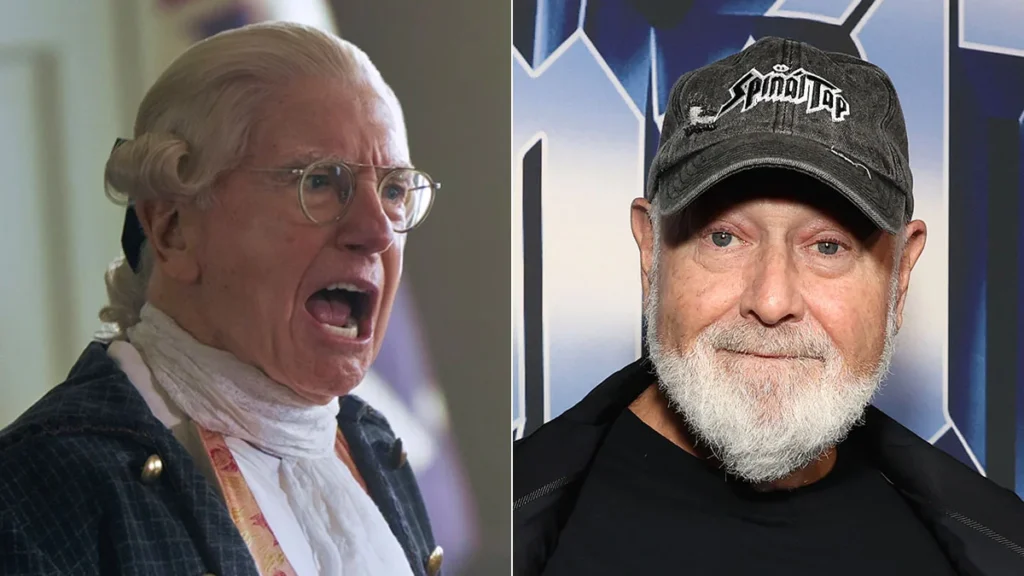

The second episode of HBO’s historical comedy series, Life, Larry, and the Pursuit of Unhappiness, titled "Farewell," featured a notable posthumous performance by the late Rob Reiner as George Washington. This appearance, one of Reiner’s final filmed roles before his passing in December 2025, served as a potent vehicle for direct political commentary, targeting a perceived "narcissistic prick" of a future president and implicitly critiquing contemporary political challenges. The sketch, which aired in July 2026, quickly garnered attention for its pointed references to events such as the January 6th insurrection, alleged censorship efforts, and other societal divisions, cementing Reiner’s legacy as both an iconic entertainer and an outspoken political activist.
The Fictional Canvas: "Life, Larry, and the Pursuit of Unhappiness"
Life, Larry, and the Pursuit of Unhappiness, an HBO historical comedy, is helmed by the inimitable Larry David, known for his unique blend of observational humor and social awkwardness that defined Curb Your Enthusiasm. The series distinguishes itself by placing David’s character, presumably an anachronistic observer or a modern-day individual transported through time, into pivotal moments of history, interacting with historical figures. This format allows for a distinctive brand of humor that often dissects the absurdities of human nature and societal conventions across different eras. The show has already gained recognition for its impressive roster of guest stars, who often portray historical figures with a comedic or satirical twist, adding layers of contemporary relevance to historical narratives. Episode 2, "Farewell," was specifically designed to tackle themes of leadership, political decay, and the fragility of democratic institutions, utilizing the historical backdrop of George Washington’s departure from office to reflect on modern anxieties.
Washington’s Warning: A Historical Precedent Reimagined
The central sketch of "Farewell" transports viewers to the conclusion of George Washington’s second term as President, as he prepares to deliver his renowned farewell address. Historically, Washington’s Farewell Address, published in September 1796, was not an oral speech but a written message to the people of the United States. In it, he offered crucial advice on preserving the Union, warning against the dangers of sectionalism, geographical distinctions, and most notably, the formation of political parties. He presciently cautioned that such factions could "become potent engines by which cunning, ambitious, and unprincipled men will be enabled to subvert the power of the people and to usurp for themselves the reins of government." This foundational document has been studied for centuries as a cornerstone of American political thought, emphasizing national unity and republican virtues over partisan division.
In the Life, Larry, and the Pursuit of Unhappiness sketch, Reiner’s portrayal of Washington brings this historical warning to vivid, almost alarming, life. The narrator, voiced by the distinctive Samuel L. Jackson, introduces Washington’s address with an unmistakable emphasis on the phrase "cunning, ambitious, and unprincipled men," immediately signaling the sketch’s contemporary relevance. Jackson’s delivery, known for its gravitas and dramatic flair, underscored the gravity of Washington’s historical admonitions, setting a tone that was both satirical and deeply serious. The choice to highlight this particular passage from Washington’s address was a deliberate narrative decision, serving to bridge the historical context with the show’s modern-day critique, implying that the dangers Washington foresaw remain alarmingly pertinent.
A Modern-Day Debate: Directing the Commentary
As Reiner’s Washington explains his decision to step down from the presidency, adhering to the then-unwritten precedent of a two-term limit, the sketch swiftly pivots into a thinly veiled critique of contemporary political figures and events. Larry David, playing a skeptical crowd member, initiates a debate with Washington about the potential for a "narcissistic prick" to one day assume the presidency. This characterization, delivered with David’s signature incredulity, serves as the primary conduit for the sketch’s pointed satire, clearly drawing parallels to former President Donald Trump without explicitly naming him. The discussion quickly escalates, touching upon the hypothetical future president’s potential to "violate the Constitution and enrich his own interests thanks to a broken system of checks and balances."
The dialogue within the sketch becomes increasingly direct in its allusions to recent American political history. The January 6th insurrection, a pivotal event in modern American democracy where a mob of Trump supporters stormed the U.S. Capitol, is referenced as a stark example of political instability and disregard for democratic processes. The sketch also alludes to "the killings of Renée Good and Alex Pretti," and "the many efforts by this current administration to censor dissent." While Renée Good and Alex Pretti are fictional characters within the show’s narrative, their inclusion is clearly symbolic, representing broader concerns about political violence, the suppression of opposition, or attacks on democratic norms that have been prevalent in contemporary political discourse. These references are not presented as literal historical events, but rather as illustrative points within the show’s fictionalized historical debate, designed to evoke real-world anxieties about political extremism and the erosion of free speech.
The satirical critique is further amplified by the appearance of Jimmy Kimmel, another prominent late-night host known for his vocal political commentary, who portrays another crowd member in a tricorner hat. Kimmel’s character, feigning disbelief, delivers a line that drips with irony: "Are you suggesting that the president would taketh the time to challenge anyone who dare make fun of him, as if he were a big baby? I don’t see it." This remark directly references Trump’s well-documented sensitivity to criticism and his frequent public attacks on perceived detractors, including comedians and media figures. The cumulative effect of these direct and indirect allusions is to construct a powerful and unmistakable indictment of specific political behaviors and the broader political climate, all framed within a historical comedic setting.
As the debate intensifies and the crowd begins to descend into chaotic infighting, mirroring the polarized divisions of modern society, Reiner’s George Washington makes a futile attempt to restore peace. His ultimate, unvarnished pronouncement, delivered directly into the camera – "We’re fucked" – serves as the sketch’s stark, un-subtle punchline. This final, resigned statement encapsulates the profound sense of despair and alarm that the show’s creators aim to convey regarding the state of contemporary American politics, presenting it as a direct outcome of the very dangers Washington had warned against centuries prior.
Rob Reiner’s Enduring Political Legacy
Rob Reiner’s posthumous appearance on Life, Larry, and the Pursuit of Unhappiness is particularly poignant given his lifelong and unwavering commitment to political activism. Throughout his illustrious career, which spanned groundbreaking television (Meathead in All in the Family), iconic films (When Harry Met Sally, The Princess Bride, Stand By Me), and successful producing ventures, Reiner was equally recognized as a formidable political voice. A staunch liberal, he was consistently outspoken on a wide array of social and political issues, utilizing his platform to advocate for causes he deeply believed in.
Reiner’s activism wasn’t merely confined to celebrity endorsements; he was actively involved in various campaigns and organizations. He co-founded the American Foundation for Equal Rights (AFER), which successfully challenged California’s Proposition 8, ultimately leading to the legalization of same-sex marriage nationwide. He was also a passionate advocate for early childhood development, serving as a prominent figure in California’s "First 5" initiative. His presence on social media, particularly Twitter, was characterized by frequent and often fiery critiques of conservative politics and, notably, former President Donald Trump. Reiner became one of Hollywood’s most vocal and consistent critics of Trump’s administration, regularly denouncing his policies, rhetoric, and conduct.
His death in December 2025, following a battle with a serious illness, marked the end of an era for many. However, the immediate aftermath of his passing brought a controversial political moment. Former President Donald Trump, in a move widely condemned across the political spectrum, chose to mock Reiner after his death. Trump’s remarks, characterized by many as disrespectful and tasteless, further inflamed political tensions. The backlash was significant, with even some of Trump’s usual allies expressing discomfort. Notably, conservative actor James Woods, typically a vocal supporter of Trump, publicly condemned the former president’s comments, stating that "the president went too far." This unusual bipartisan agreement on the inappropriateness of Trump’s remarks underscored the depth of the offense, highlighting how Reiner’s political identity remained potent even in death.
In this context, Reiner’s posthumous performance as George Washington takes on added significance. It represents not just a final acting credit but a final, powerful political statement, allowing his voice to echo one last time against the very political forces he so vehemently opposed throughout his life. The sketch provides a cathartic opportunity for Reiner, even in absentia, to deliver a message that is entirely consistent with his long-held convictions, ensuring that his advocacy for "justice and sanity," as the original article implies, continued beyond his lifetime.
The Power of Posthumous Performance and Political Satire
The utilization of posthumous performances in media, whether through pre-recorded content or advanced digital techniques, raises fascinating questions about artistic legacy and the enduring impact of a performer’s work. In Reiner’s case, the fact that he recorded this role prior to his death imbues it with an almost prophetic quality, as if he foresaw the continued relevance of his political critique. This final performance serves as a testament to his dedication, not only to his craft but also to his political beliefs.
Political satire, as employed in Life, Larry, and the Pursuit of Unhappiness, holds a unique and often powerful place in public discourse. By using humor, irony, and exaggeration, satire can effectively challenge authority, expose hypocrisy, and provoke critical thought in ways that direct commentary sometimes cannot. The show’s premise of inserting modern sensibilities into historical settings provides a clever framework for this. By having George Washington, a revered founding father, express profound concern over a future leader characterized as a "narcissistic prick" and lament the state of the nation with a blunt "We’re fucked," the show leverages historical authority to lend weight to its contemporary criticisms. This method allows the series to comment on deeply divisive issues while maintaining a comedic veneer, making the critique potentially more palatable and resonant for a broader audience.
The sketch’s directness, particularly Washington’s final line, signifies a departure from subtle political messaging. It reflects a growing trend in entertainment to engage more explicitly with pressing political and social issues, blurring the lines between pure entertainment and activism. This approach often sparks debate about the role of artists and media in shaping public opinion, but it undeniably ensures that the content is impactful and unforgettable.
Anticipated Reception and Broader Implications
The airing of "Farewell" and Reiner’s posthumous appearance is anticipated to generate significant discussion among viewers, critics, and political commentators alike. For those who shared Reiner’s political views, the sketch will likely be seen as a fitting and defiant final statement from a cherished public figure. It provides a sense of validation for their own concerns about the direction of the country and the challenges to democratic norms. Conversely, those who align with the political figures being implicitly criticized may view the sketch as partisan, biased, and an inappropriate use of a historical figure for contemporary political messaging. The show’s provocative nature is likely to fuel debates across social media, news outlets, and political talk shows, underscoring the deep ideological divides present in American society.
Life, Larry, and the Pursuit of Unhappiness, by tackling such sensitive and current political themes through the lens of historical comedy, positions itself as more than just an entertainment program. It becomes a cultural artifact reflecting the anxieties and frustrations of its time. The series contributes to the ongoing conversation about the intersection of celebrity, entertainment, and political advocacy, reminding audiences that public figures often use their platforms to champion causes important to them, even beyond their lifetime.
The broader implications of this sketch extend to the enduring relevance of the themes it explores: the fragility of democratic institutions, the dangers of unchecked power, the erosion of political norms, and the responsibility of leadership. George Washington’s original warnings about factions and unprincipled men continue to resonate centuries later, suggesting that the fundamental challenges to self-governance are cyclical. Reiner’s final performance, delivered with the weight of both history and personal conviction, serves as a powerful artistic call for vigilance and a poignant reminder of the continuous struggle to uphold the principles upon which the nation was founded. New episodes of Life, Larry, and the Pursuit of Unhappiness debut Fridays at 9:00 p.m. ET on HBO and HBO Max, ensuring that this provocative commentary continues to unfold.