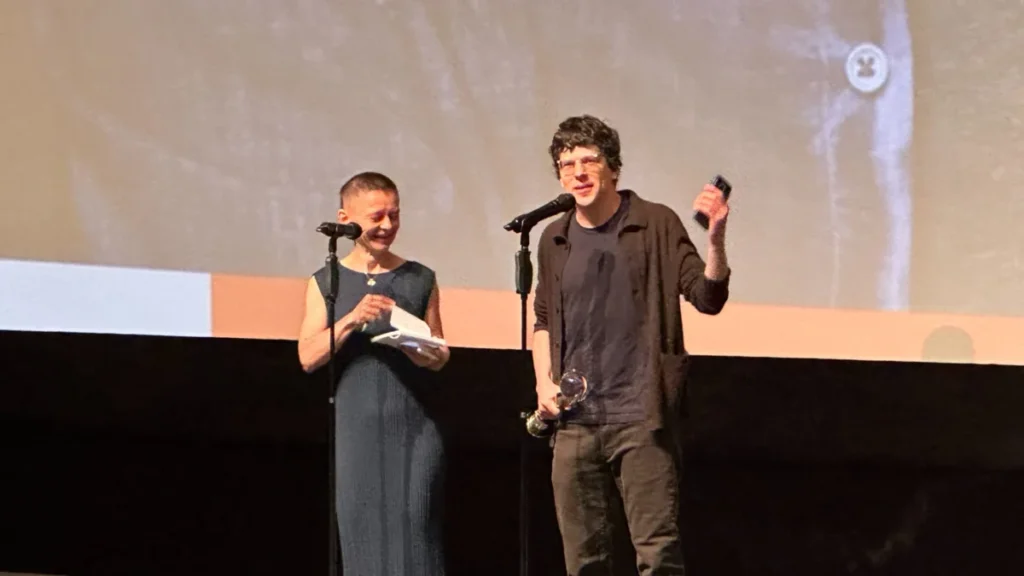

The announcement was made on Saturday at the prestigious Karlovy Vary International Film Festival in the Czech Republic, where Eisenberg was honored with the festival’s President’s Award. His remarks, delivered to a standing ovation in the Grand Hall of the Hotel Thermal, underscored a deeply personal and professional decision, linking his family’s Polish heritage with a strategic pivot in his filmmaking career. He expressed a desire to dedicate more of his time and artistic endeavors to working within Europe, particularly its central region, where he perceives a more robust environment for the kind of cinematic storytelling he champions.
The Karlovy Vary Platform: A Nexus for European Cinema
Eisenberg’s declaration unfolded against the backdrop of the 60th edition of the Karlovy Vary International Film Festival, an event celebrating its 80th year of existence. As one of the oldest and most respected film festivals globally, holding an A-list accreditation, KVIFF serves as a significant platform for showcasing both established and emerging talents, with a particular emphasis on Central and Eastern European cinema, as well as independent and art-house productions from around the world. The festival, which runs from July 3-11, attracts a constellation of international stars and industry professionals, making it an ideal setting for such a pivotal announcement.
The President’s Award, bestowed upon Eisenberg, recognized his significant contributions to contemporary cinema as an actor, writer, and director. Following the award ceremony, attendees were treated to a screening of Richard Ayoade’s 2013 film The Double, in which Eisenberg plays the lead role, a film he himself described as owing "so much to Central European cinema," making its introduction at KVIFF particularly resonant.
Eisenberg was not the only luminary celebrated at this year’s landmark KVIFF. The festival’s opening night ceremony saw cinematic icon Dustin Hoffman, known for legendary performances in The Graduate and Rain Man, receive the Crystal Globe for Outstanding Artistic Contributions to World Cinema. Actress and filmmaker Maggie Gyllenhaal, celebrated for her work in The Lost Daughter and Secretary, was also presented with a President’s Award. Veteran actor Harvey Keitel, whose career spans classics like Mean Streets and Taxi Driver, was among the other famous names gracing the festival’s expanded red carpet, highlighting KVIFF’s enduring allure as a major cultural event.
A Shift in Artistic Focus: Hollywood vs. Europe
Eisenberg’s rationale for pursuing Polish citizenship and subsequently prioritizing European filmmaking illuminates a broader trend within the global film industry, particularly the perceived divergence between Hollywood’s commercial imperatives and the artistic inclinations of many filmmakers. He articulated this clearly, stating, "In America, many of the kind of films that I love so much — human scale, strange mid-budget films — have become increasingly difficult to make, but in Europe, those movies are thriving and celebrated."
The category of "human-scale, strange mid-budget films" refers to a distinct type of cinema: character-driven dramas, quirky comedies, and independent features that do not command blockbuster budgets but require more resources than micro-budget indies. These films often prioritize nuanced storytelling, complex characters, and unique artistic visions over broad commercial appeal or special effects spectacle. Historically, Hollywood studios had a robust pipeline for such projects, often through their "specialty" or "indie" divisions. However, over the last two decades, the landscape has drastically shifted.
Hollywood’s studio system has increasingly consolidated its focus on tentpole franchises, superhero sagas, and major intellectual property adaptations, which promise global box office returns and ancillary revenue streams. The rise of streaming services, while initially offering new avenues for diverse content, has also contributed to a "feast or famine" model, where productions are either massive, high-budget endeavors or very low-budget independent features, often leaving the mid-budget range underserved. The economic model for these mid-tier films has become precarious in the U.S., facing challenges in securing financing, distribution, and audience engagement against the backdrop of blockbuster dominance.
In contrast, European cinema often benefits from different funding models and a distinct cultural appreciation for diverse cinematic forms. Many European countries have robust public funding mechanisms, including national film boards, cultural ministries, and co-production treaties (suchs as Eurimages), which actively support artistic and independent filmmaking. These systems are often designed to foster cultural expression and industry development rather than solely maximizing profit. This institutional support, coupled with a strong network of film festivals like KVIFF, Cannes, Berlin, and Venice, creates a vibrant ecosystem where films prioritizing narrative depth and artistic originality can find financing, production partners, and appreciative audiences. Eisenberg’s observations thus reflect a widely recognized reality among independent filmmakers seeking creative freedom and sustainable production environments.
The Polish Connection: Heritage and Opportunity
Eisenberg’s pursuit of Polish citizenship is deeply rooted in his family’s heritage, adding a poignant personal dimension to his professional aspirations. While he did not elaborate extensively on his specific family history during his KVIFF speech, it is widely known that his family, like many Ashkenazi Jewish families in the United States, has roots in Eastern Europe. The process of acquiring Polish citizenship, especially for descendants of former Polish citizens, often involves a "restoration of citizenship" based on ancestral ties, a pathway made possible for those whose families may have lost citizenship due to historical events such as the Holocaust or post-war political changes.

For Eisenberg, this connection to Poland is more than symbolic; it offers tangible benefits for his stated career shift. As a Polish citizen, he will also become a citizen of the European Union. This grants him the right to live and work freely across all 27 EU member states without requiring visas or work permits, significantly easing the logistical complexities of filmmaking in Europe. This freedom of movement and establishment will enable him to collaborate more readily with European filmmakers, access European funding schemes, and engage with the continent’s diverse film industries without bureaucratic hurdles that non-EU citizens often face. This move positions him to seamlessly integrate into the European cinematic landscape, fostering greater opportunities for the "human-scale" projects he aims to create.
Eisenberg’s Multifaceted Career: A Retrospective
Karlovy Vary International Film Festival’s decision to honor Jesse Eisenberg underscored his extraordinary versatility and impact on contemporary cinema. When KVIFF unveiled its plans to honor him, it lauded him as "one of the most multifaceted figures in contemporary cinema," a descriptor that aptly captures his trajectory from a critically acclaimed actor to an accomplished writer and director.
Eisenberg’s career began garnering attention with his first significant role in the 2002 film Roger Dodger, which earned him an award for most promising young actor at the San Diego Film Festival. His talent for portraying intelligent, often anxious, and deeply complex characters quickly became his hallmark. This was further solidified by his performance in Noah Baumbach’s insightful family drama The Squid and the Whale (2005), which earned him nominations for the Independent Spirit Award and the Critics’ Choice Award, establishing him as a compelling presence in independent cinema.
His commercial breakthrough arrived with the apocalyptic horror-comedy Zombieland (2009), a box office hit that showcased his comedic timing. However, it was his transformative portrayal of Facebook founder Mark Zuckerberg in David Fincher’s The Social Network (2010) that catapulted him to global recognition. This role earned him his first nominations for an Oscar, a Golden Globe, and a BAFTA Award, cementing his status as a leading actor capable of delivering performances of profound depth and nuance.
Beyond acting, Eisenberg has increasingly distinguished himself as a filmmaker in his own right. His screenwriting and directing debut came with When You Finish Saving the World, starring Julianne Moore and Finn Wolfhard. The film, a poignant exploration of a mother-son relationship, premiered at both the Sundance and Cannes Film Festivals, signaling his arrival as an auteur. He subsequently garnered significant attention with his second feature, A Real Pain (2024), in which he co-starred with Kieran Culkin as cousins navigating their heritage in Poland. This film was a critical success, earning Eisenberg an Oscar nomination and a Golden Globe nomination for best screenplay, and winning him a BAFTA Award, the Waldo Salt Award at the Sundance Film Festival, an Independent Spirit Award, and numerous other accolades. His performance in A Real Pain also earned him a Golden Globe nomination for best actor, while Kieran Culkin’s portrayal garnered an Oscar for best supporting actor, further solidifying Eisenberg’s artistic vision and his ability to elicit exceptional performances.
Looking Ahead: Projects and Prospects
With his Polish citizenship imminent and a clear vision for his future work, Jesse Eisenberg’s upcoming projects are poised to reflect this new artistic direction. His next film as a writer and director, The Debut, stars acclaimed actors Julianne Moore and Paul Giamatti. Eisenberg also contributed significantly to the film’s musical elements, having written the music and lyrics for a musical-within-the-movie. Set for release in the fall by A24, The Debut is anticipated to further showcase his unique storytelling voice and directorial prowess.
The decision to focus on Central Europe for future endeavors suggests a potential for new collaborations with European talent, access to diverse historical and cultural narratives, and participation in the continent’s vibrant co-production landscape. This could see Eisenberg exploring themes and styles that might be less commercially viable in the current Hollywood climate but resonate deeply with European audiences and funding bodies. His established reputation and critical success will undoubtedly make him a sought-after collaborator in the European film industry.
Broader Industry Implications
Jesse Eisenberg’s public declaration at KVIFF carries broader implications for the global film industry. It highlights an ongoing debate about the sustainability of independent and artist-driven cinema within the American studio system and underscores Europe’s growing role as a sanctuary for such projects. His move could inspire other filmmakers who feel creatively constrained by Hollywood’s commercial pressures to consider similar transatlantic shifts.
The "brain drain" of talent from Hollywood to more creatively supportive environments, while not a mass exodus, is a consistent undercurrent in the industry. Directors, writers, and actors seeking greater artistic control and a focus on character-driven narratives often find more receptive homes in European and international co-productions. Eisenberg’s articulate reasoning provides a high-profile example of this phenomenon, potentially drawing more attention to the structural differences between film financing and production in the U.S. versus Europe.
Ultimately, Eisenberg’s embrace of his Polish heritage and his strategic pivot towards Central European cinema represents a significant personal and professional evolution. It is a testament to his commitment to a particular kind of filmmaking, one that values human stories, artistic integrity, and nuanced expression. As he embarks on this new chapter, his journey will be watched closely, not just by fans of his work, but by an industry grappling with its future and the diverse paths artists are choosing to forge within it.