
Two decades after its initial theatrical debut captivated audiences worldwide, the revolutionary cinematic classic V for Vendetta is officially heading back to the big screen. Fathom Events has released the final promotional trailer for a special nationwide theatrical re-release, giving fans an opportunity to experience the dystopian thriller the way it was meant to be seen. Screenings are officially scheduled for November 1 and November 5, 2026, with the latter date holding immense symbolic weight within the film’s narrative universe.
Directed by James McTeigue in his feature-film directorial debut and scripted by the Wachowski sisters—Lilly and Lana—the film remains one of the most striking political action dramas of the 21st century. Originally adapted from the acclaimed 1982 graphic novel written by Alan Moore and illustrated by David Lloyd, the cinematic adaptation has endured as a cultural touchstone. As modern sociopolitical landscapes increasingly mirror the film’s chilling themes of authoritarian overreach, surveillance, and civil resistance, this 20th-anniversary engagement arrives at a uniquely resonant moment for contemporary audiences.
Chronology of a Revolution: From Page to Screen and Beyond
To understand the enduring cultural footprint of V for Vendetta, one must trace its journey from a serialized comic strip to a major Hollywood blockbuster. Created by Alan Moore and David Lloyd in the early 1980s, the original graphic novel was conceived as a direct response to the conservative political climate of Margaret Thatcher’s United Kingdom. Published initially between 1982 and 1989, the source material quickly gained a cult following for its uncompromising critique of fascism, anarchy, and government surveillance.

Fast-forward to the early 2000s, when filmmakers Lilly and Lana Wachowski—fresh off their monumental global phenomenon The Matrix—adapted Moore’s text into a screenplay. Warner Bros. greenlit the project, bringing in first-time director James McTeigue to helm the production. Filming took place primarily in Berlin, Germany, throughout 2004.
Though the film was originally scheduled for a late 2005 release, Warner Bros. delayed the premiere into the spring of 2006. V for Vendetta officially opened in theaters across the United States on March 17, 2006. Despite mixed initial reviews from traditional critics who debated its political messaging, the film struck a powerful chord with moviegoers, eventually grossing roughly $70 million at the domestic box office and building a passionate, enduring legacy. Now, twenty years later, Fathom Events is bringing the film back to commercial cinemas nationwide for a limited two-night run, anchored strategically around the famous fifth of November.
Supporting Data and Production Background
V for Vendetta boasts a legendary production pedigree and an ensemble cast that continues to define the era’s prestige genre filmmaking. At the center of the narrative is Natalie Portman, who delivered a career-defining physical and emotional performance as Evey Hammond, an ordinary British citizen transformed into an instrument of revolution. To prepare for the demanding role, Portman famously shaved her head entirely on camera during a pivotal torture sequence and worked extensively with a dialect coach to perfect an authentic British accent.
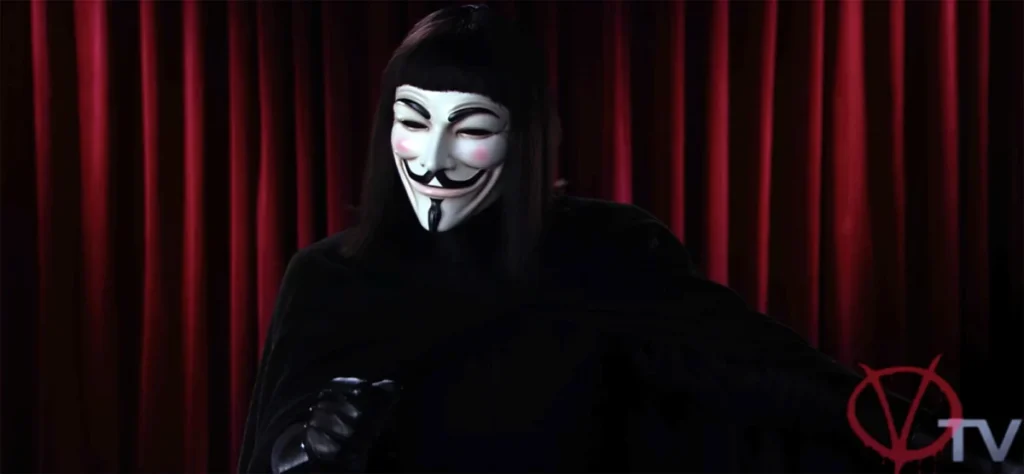
Co-starring alongside Portman is Hugo Weaving in the enigmatic role of "V," a masked freedom fighter seeking retribution against the tyrannical Norsefire Party. In a masterclass of acting economy, Weaving delivered his entire performance behind a stylized Guy Fawkes mask, relying solely on vocal cadence, physical posture, and body language to convey deep vulnerability and fierce conviction. (Notably, James Purefoy was originally cast as V and filmed several weeks before departing the project due to creative differences, after which Weaving was brought in to re-record and re-film the role).

The supporting cast reads as a who’s who of acclaimed British and international talent. It features veteran actor John Hurt as High Chancellor Adam Sutler, the ruthless dictator heading the fascist regime. Stephen Rea stars as Chief Inspector Eric Finch, the weary police detective tasked with hunting down V whose investigation slowly dismantles his own blind faith in the state. The film also features standout performances by Stephen Fry as television host Gordon Deitrich, Tim Pigott-Smith, Rupert Graves, and Roger Allam.
Financially, the film proved to be a solid commercial venture for Warner Bros. Produced on an estimated budget of $54 million, V for Vendetta went on to gross approximately $132.5 million worldwide, cementing its status as a profitable mid-budget sci-fi/action venture during an era before franchise tentpoles completely dominated the box office landscape.
Official Responses and Creative Legacy
While the film achieved commercial success and adoration from fans, its path to the screen was not without friction. Most notably, original comic book creator Alan Moore famously distanced himself from the cinematic adaptation. Dissatisfied with Hollywood’s traditional approach to adapting complex source material and reportedly having ongoing disagreements with DC Comics (a subsidiary of Warner Bros.) over rights and royalties, Moore demanded that his name be entirely removed from the film’s credits. He also declined to accept any financial royalties from the production, assigning his share to illustrator David Lloyd instead.
Despite Moore’s public disavowal, David Lloyd embraced the cinematic adaptation, noting that the film successfully captured the rebellious spirit of the original work. Furthermore, the visual iconography introduced by the film—specifically the smiling, mustachioed Guy Fawkes mask—achieved a level of real-world cultural penetration that few fictional properties ever attain. In the years following the film’s release, the mask design popularized by V for Vendetta became the universal visual symbol for online hacktivist collectives like Anonymous, as well as global grassroots protest movements advocating for privacy, anti-corruption, and political transparency during events such as the Occupy movement and the Arab Spring.

Director James McTeigue reflected on the film’s legacy in retrospective interviews, expressing astonishment at how the movie’s fictional authoritarian regime frequently intersects with real-world political developments. "When we were making the movie, it was a commentary on the political climate of the early 2000s, surveillance culture, and the erosion of civil liberties," McTeigue noted. "The fact that people are still talking about it twenty years later—and that it somehow feels even more relevant today—is a testament to the strength of the original graphic novel and the timelessness of the themes."
Broader Impact and Implications of the 20th Anniversary Re-Release
The decision by Fathom Events to bring V for Vendetta back to theaters for its twentieth anniversary is far more than a nostalgic exercise for cinephiles; it reflects a growing commercial and cultural appetite for curated theatrical repertory screenings. As modern cinema experiences face increased competition from at-home streaming platforms, special anniversary theatrical re-releases have emerged as a vital tool for driving audiences back into traditional auditoriums.
From an analytical perspective, the return of V for Vendetta to the big screen highlights the ongoing relevance of dystopian cinema in contemporary culture. In an era defined by debates over mass digital surveillance, corporate media consolidation, state-sanctioned disinformation, and the fragility of democratic institutions, the core questions posed by the Wachowskis’ screenplay retain their sharp edge. Evey Hammond’s journey from a compliant, fearful bystander to an active participant in systemic resistance offers a narrative arc that continues to resonate across generations.
The theatrical screenings on November 1 and November 5, 2026, will give younger audiences who missed the film’s initial theatrical run a rare chance to experience its striking cinematography, stirring orchestral score by Dario Marianelli, and memorable dialogue on the big screen. As the house lights dim and audiences once again hear the timeless query, "Are you ready to give your life for freedom?", V for Vendetta proves that while regimes may fall and rise, ideas truly remain bulletproof.