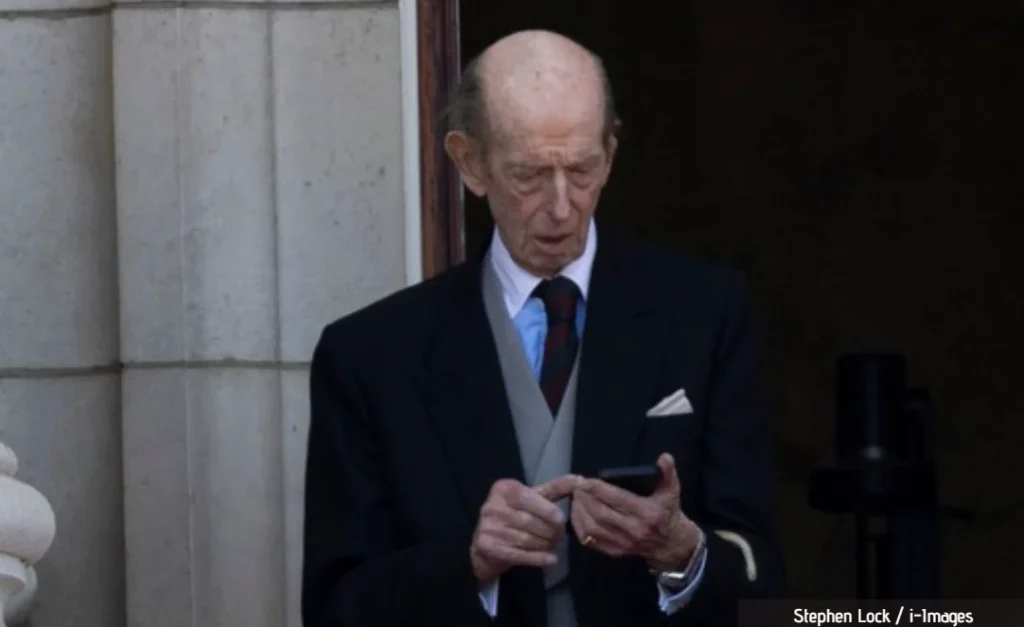

The King’s official birthday celebrations at Trooping the Colour were marked by a moment of unexpected warmth and relatability when the Duke of Kent, a rarely seen yet deeply respected figure within the British monarchy, was observed using his mobile phone to film the spectacular Royal Air Force flypast from the iconic Buckingham Palace balcony. This seemingly simple act resonated deeply with royal enthusiasts, transforming a traditional ceremonial event into a scene imbued with personal connection and generational bridging. The 90-year-old royal’s decision to capture the grandeur of the occasion through the lens of his personal device quickly became a focal point of discussion, offering a glimpse into the human side of a family often perceived as distant.
A Touch of Modernity Amidst Tradition
As King Charles III, Queen Camilla, and other senior members of the Royal Family assembled on the historic balcony to witness the aerial display, the Duke of Kent, Prince Edward, was distinctly seen raising his smartphone to record the impressive procession of aircraft. This candid gesture, captured by television cameras and widely shared across social media platforms, struck a chord with viewers. Social media was abuzz with comments, reflecting a collective sentiment of amusement and affection. One observer remarked, "Love the Duke of Kent with what I think is his mobile," encapsulating the sentiment of many who were charmed by the unexpected technological engagement. Another question posed by a viewer, "Was the Duke of Kent on his cell phone?" highlighted the surprise and intrigue surrounding the moment. A lighthearted comment, "I have to ask… is the Duke of Kent playing on his phone?" further underscored the relatable nature of the scene, drawing a parallel between the Duke’s action and everyday behaviour.
The Duke’s deliberate action, captured in video footage that circulated online, appeared to show him meticulously filming not only the enthusiastic crowds gathered below Buckingham Palace but also the intricate formations of aircraft soaring overhead. This personal documentation of the event occurred as the festivities reached their zenith, adding a layer of individual experience to the collective national celebration.
A Reassuring Presence After Earlier Concerns
This heartwarming moment of the Duke of Kent engaging with modern technology arrived after a period where viewers had expressed concern for him earlier in the day. During the televised coverage of the event, some royal watchers noted that the Duke appeared to be standing slightly apart from other members of the Royal Family on the balcony. This visual impression led to a degree of emotional reaction, with some fans admitting to feeling a sense of melancholy, perceiving him as somewhat isolated amidst the familial gathering. These observations, while perhaps stemming from a simple staging of the group, underscored the public’s deep affection and concern for the Duke, particularly given his increasingly limited public appearances.
The Duke of Kent: A Steadfast Servant of the Crown
The Duke of Kent’s presence at Trooping the Colour, while always a welcome sight, is particularly poignant due to his advanced age and the rarity of his public engagements in recent years. These appearances are cherished by royal supporters, who recognize the Duke’s enduring commitment to public service despite his advancing years and the challenges that come with them. His continued participation in significant national events like Trooping the Colour speaks volumes about his dedication to the monarchy and his sense of duty.
Last year proved to be an especially difficult period for the Duke, marked by the profound loss of his wife, Katharine, Duchess of Kent. Their marriage, which spanned over six decades, was widely regarded as one of the most enduring and steadfast partnerships within the Royal Family. The passing of the Duchess undoubtedly left a significant void, making the Duke’s continued public service even more remarkable and a testament to his resilience.
Despite his advancing age, the Duke continues to undertake a number of public duties, a fact that solidifies his status as a highly respected and integral figure within the British monarchy. As a first cousin of the late Queen Elizabeth II, he has dedicated decades of his life to serving the Crown, a commitment that has seen him attend Trooping the Colour for the majority of his adult life. His consistent presence at this flagship event symbolizes a living link to the past and a continuous thread of royal service.
A Gathering of the Royal Family
Saturday’s Trooping the Colour saw a significant turnout of the Royal Family on the Buckingham Palace balcony. Alongside King Charles and Queen Camilla, prominent figures included the Prince and Princess of Wales, accompanied by their children Prince George, Princess Charlotte, and Prince Louis. Also present were the Duke and Duchess of Edinburgh, Princess Anne and her husband Sir Timothy Laurence, and the Duke and Duchess of Gloucester. This assembly represented a broad spectrum of the modern monarchy, showcasing both established figures and the younger generation who will carry the institution forward.
The Significance of Trooping the Colour
Trooping the Colour, a grand military ceremony, marks the official birthday of the Sovereign. It is a centuries-old tradition, with its roots tracing back to the battlefield, where flags (or "Colours") were trooped to ensure soldiers could recognize them in the chaos of conflict. Today, it is a spectacular display of military precision, horsemanship, and pageantry, culminating in a thrilling RAF flypast. The event serves as a powerful symbol of the Sovereign’s connection to the Armed Forces and is a highlight of the British summer calendar.
The parade route typically sees the Sovereign travel from Buckingham Palace down The Mall to Horse Guards Parade, where they take the salute. This year, King Charles, who has been undergoing treatment for cancer, rode in a carriage for the procession, a departure from previous years when he rode on horseback. This adaptation highlighted the ongoing health considerations for the King while maintaining the continuity of the tradition.
The King’s Message of Gratitude
Following the successful execution of the parade and the impressive flypast, King Charles III issued a heartfelt message of thanks to the Armed Forces personnel who participated in the ceremony. This official acknowledgement underscores the crucial role of the military in the life of the nation and the importance of recognizing their dedication. The King’s statement read: "With thanks to the 1,400 members of the Armed Forces who took part in today’s Trooping the Colour, and with special mention to the Grenadier Guards who trooped their new Colour. We salute you." This sentiment of appreciation extends beyond the immediate event, reflecting a broader recognition of the sacrifices and commitment of those serving in His Majesty’s Armed Forces.
Broader Implications and Analysis
The Duke of Kent’s use of his mobile phone, while a personal act, carries broader implications for how the monarchy engages with the public in the 21st century. In an era where personal technology is ubiquitous, such a moment can humanize even the most formal of occasions. It suggests a willingness, even from elder royals, to embrace aspects of modern life, making them appear more accessible and relatable to a wider audience. This aligns with the ongoing efforts by the Royal Family to connect with the public in authentic and meaningful ways.
Furthermore, the contrast between the formal ceremony and the Duke’s personal act of documentation highlights the evolving nature of how significant events are experienced and remembered. While official photographs and broadcasts capture the grandeur, personal devices allow individuals to create their own unique perspectives and memories. For a figure like the Duke of Kent, who has witnessed so much history unfold, this modern method of preservation adds a personal layer to his lifelong service.
The public’s positive reaction also indicates a desire for genuine moments over carefully curated appearances. The charm of seeing a distinguished royal, a man who has dedicated his life to tradition, engaging with a common piece of technology speaks to a public appreciation for authenticity. It allows people to see the Duke not just as a royal figure, but as an individual who, like many others, wishes to capture and hold onto special memories. This subtle integration of the personal and the public can foster a stronger sense of connection between the monarchy and the people it serves. The Duke of Kent’s simple act of filming the flypast has, in its own way, become a memorable moment of Trooping the Colour, one that is likely to be recalled for its unexpected and heartwarming humanity.