
The series finale of the critically acclaimed HBO comedy Hacks has brought the narrative journey of legendary stand-up comedian Deborah Vance and her protégé Ava Daniels to a close after five seasons of sharp-witted evolution. Central to this conclusion was the grand unveiling of The Diva, a boutique casino and entertainment complex that serves as the culmination of Deborah’s professional resurgence and her business partnership with her steadfast CEO, Marcus. The design of the establishment, meticulously crafted by the show’s production team, functions not merely as a backdrop but as a physical manifestation of Deborah’s enduring legacy, blending the grit of Nevada’s gambling history with the sophisticated glamour of mid-century Art Deco.
The Aesthetic Foundation: Why Art Deco Defined The Diva
As the project moved from a derelict concept to a functional reality, the production team faced the challenge of defining what a "Deborah Vance property" would look like in the modern era. While Marcus, a Las Vegas native with a penchant for sleek, contemporary design, initially scouted the property with an eye toward modernism, the eventual involvement of Deborah steered the aesthetic toward a more classical, high-glamour direction.
Production designer Rob Tokarz and set decorator Jennifer Lukehart selected Art Deco as the primary visual language for The Diva. This choice was a deliberate callback to the design motifs established throughout the series, including the set of Late Night with Deborah Vance, her opulent season two tour bus, and her long-term residency dressing room at the Palmetto. Art Deco, characterized by its bold geometric shapes, lavish ornamentation, and symmetry, mirrors the persona of Deborah Vance herself: formidable, loud, and unapologetically classic.

Lukehart noted that the style offers a specific type of "femininity without softness." In a professional landscape where Deborah has had to be harder than her male counterparts to survive, the sharp lines and gilded surfaces of Art Deco provide a visual metaphor for her resilience. Furthermore, the resurgence of Art Deco motifs in contemporary interior design allowed the show to present the casino as both a vintage tribute and a trendy, high-end boutique destination.
From Ghost Towns to The Strip: The Chronology of Location Scouting
The path to creating The Diva involved a complex logistical journey across several real-world locations, each representing a different facet of the Nevada gambling experience. The narrative arc of the casino began earlier in the final season when Marcus scouted a derelict property located in Primm, Nevada.
The scenes featuring the initial, dilapidated state of the casino were filmed at Whiskey Pete’s Hotel & Casino. Located on the California-Nevada border, Primm was once a thriving gateway for travelers entering the state, but it has faced significant economic decline in recent years, with several properties closing or falling into disrepair. This choice of location grounded the story in the reality of the "lost" Nevada—the forgotten casinos that exist outside the glow of the modern Las Vegas Strip.
However, as the project evolved into a high-stakes venture, the production moved to the Plaza Hotel & Casino in Downtown Las Vegas to film the exterior and the theater. The Plaza, which opened in 1971, provided the perfect blend of vintage Vegas soul and refurbished luxury. The transition from the "ghost town" aesthetic of Primm to the neon-lit vibrance of Downtown Vegas mirrored Deborah’s own return to the pinnacle of show business.

Artisanal Branding and the Neon Legacy
One of the most striking elements of The Diva’s reveal is its exterior signage. In an era where digital fonts and standardized branding dominate the hospitality industry, Tokarz and his team opted for a "handmade" look that pays homage to the legendary casinos of the 1950s, such as the Stardust and the Sahara.
The logo for The Diva was not a pre-existing typeface but a custom, hand-drawn design. This artisanal approach reflects the era when casino signs were massive works of neon art, designed to be unique landmarks rather than corporate logos. By pushing the boundaries of the font’s "wildness," the designers created a visual identity for the casino that felt both expensive and deeply personal to Deborah’s brand.
A significant narrative point involved a proposed giant statue of Deborah Vance intended for the front of the building. While the statue—created using a sophisticated 3D scan of actress Jean Smart—was ultimately scrapped in the story to show Deborah’s growth and willingness to share the spotlight, the "Deborah Vance Comedy Club" remained as the heart of the property. This space was filmed inside the Plaza’s actual theater, which the production team enhanced with gold wallpaper and a gold lamé Austrian curtain. Tokarz noted that the Austrian curtain, with its heavy, scalloped draping, was a design element he had hoped to incorporate since the show’s inception, finally finding its home in the series finale.
The Cicada Club and the Bob Mackie Influence
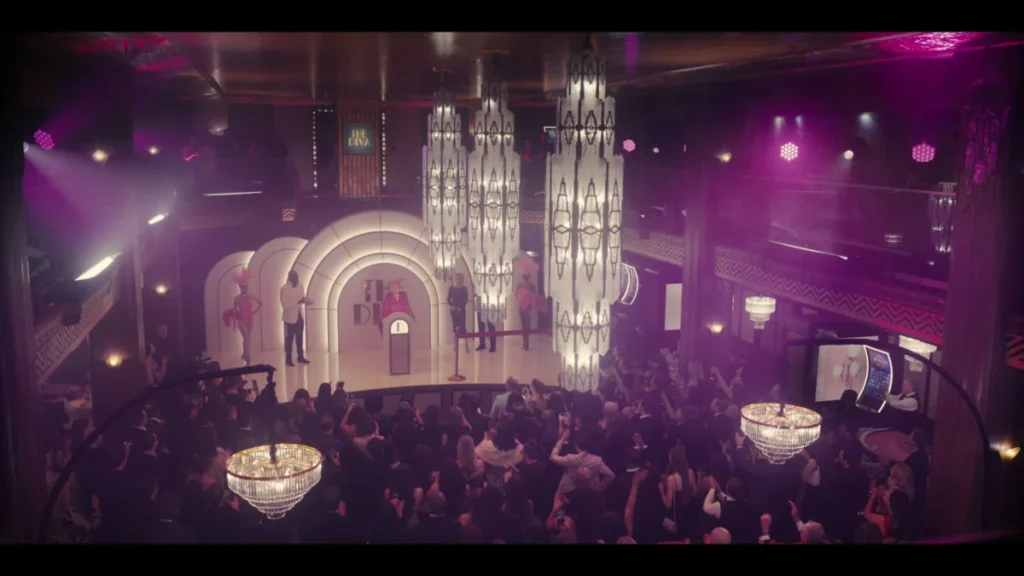
For the grand opening sequence, where the "ribbon-cutting" ceremony takes place, the production moved to the Cicada Restaurant and Lounge in Downtown Los Angeles. The Cicada Club is housed in the historic Oviatt Building, an Art Deco masterpiece that opened in 1928. Its ornate ceilings, geometric chandeliers, and mezzanine borders provided a level of architectural detail that would have been nearly impossible to replicate on a soundstage.

To transform this historic lounge into a functional casino floor, the team commissioned custom-made gaming tables with pink felt tops, bridging the gap between old-world luxury and Deborah’s signature color palette. The room was further adorned with neon showgirl props borrowed from "Heaven or Las Vegas," a specialized neon rental house in Los Angeles known for preserving the city’s glowing history.
Perhaps the most significant "Easter egg" for fans of fashion and entertainment history was the inclusion of original showgirl sketches by Bob Mackie. Mackie, the legendary costume designer who previously made a cameo in the season, provided the production with original, never-before-seen designs he had created decades ago for a casino project that was never realized. These sketches were scanned, enlarged, and placed into lightboxes throughout the venue. This collaboration added a layer of authenticity to the set, linking Deborah Vance to the real-world legends of variety television and stage spectaculars.
Broader Implications: The Legacy of Hacks
The conclusion of Hacks marks the end of one of the most successful comedy series of the streaming era. Over its five-season run, the show has been a critical darling, earning numerous Emmy Awards, including multiple wins for Jean Smart. Beyond the humor, the show has been praised for its nuanced exploration of intergenerational mentorship, the work ethic required to maintain stardom, and the evolving nature of the entertainment industry.
The creation of The Diva serves as a symbolic "win" for both Deborah and Marcus. For Deborah, it represents the ultimate ownership of her image and her career, moving from a hired performer at the Palmetto to a proprietor of her own empire. For Marcus, it represents his transition from a manager to a partner and visionary.

The design of the casino also serves as a tribute to the craftsmanship of television production. By utilizing real locations like the Plaza and the Cicada Club, and incorporating the work of icons like Bob Mackie, the production team ensured that the final image of Deborah’s world was as textured and storied as the character herself.
Analysis of the Production Design’s Impact
The decision to end the series with the opening of The Diva provides a sense of narrative closure while leaving the door open for the audience’s imagination. While some viewers may have hoped for a more extensive tour of the casino floor, the glimpses provided—the pink tables, the gold curtains, and the Mackie sketches—offer enough detail to establish the "vibe" of the establishment.
The use of a green screen at the back of the Cicada Club set allowed the designers to suggest a vast, sprawling casino floor that extended beyond the physical limits of the location. This blend of practical sets and digital extension is a hallmark of modern high-budget television, allowing for a sense of scale that matches the "larger-than-life" themes of the show.
As the credits roll on the fifth and final season, the legacy of Hacks will likely be remembered not just for its sharp dialogue, but for its visual commitment to the world of Las Vegas. The Diva stands as a monument to a specific type of showmanship—one that is rooted in history, polished with gold, and always ready for the next act. While fans may already be clamoring for a spinoff centered on the daily operations of the casino, the finale provides a definitive statement on the journey of Deborah Vance: she didn’t just survive the industry; she built a temple to it.