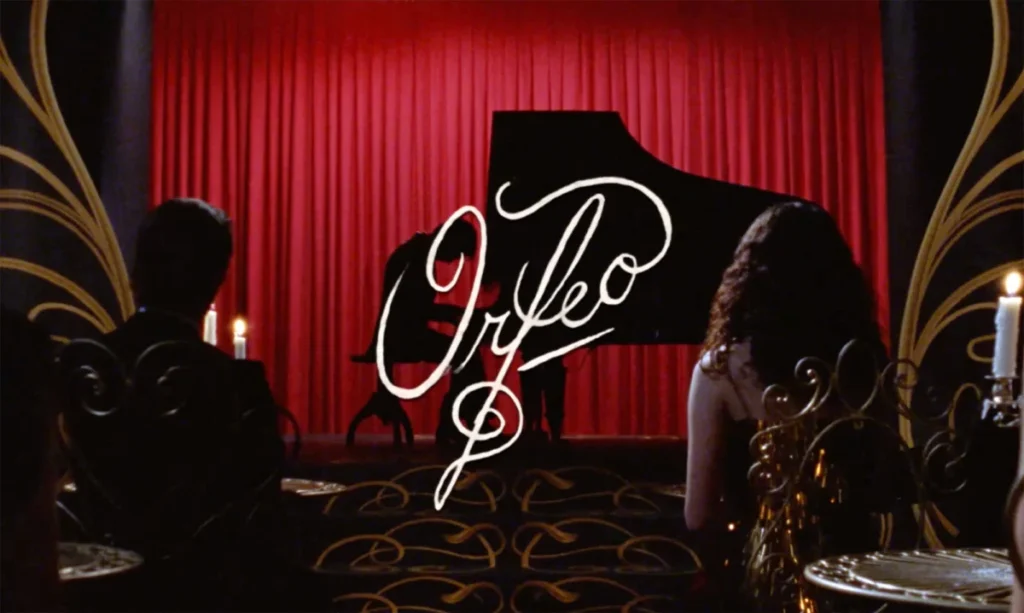

Oscilloscope Labs has officially released the domestic trailer and promotional materials for Orfeo, a visually striking, avant-garde cinematic adaptation directed by Italian filmmaker Virgilio Villoresi. Following its international premiere at the prestigious 2025 Venice Film Festival, the film is poised to make its way to select arthouse theaters across the United States this fall. Distributed by Oscilloscope Labs, a studio renowned for championing distinct, boundary-pushing independent cinema, Orfeo represents a bold reimagining of the classic Orpheus and Eurydice myth. The film draws deeply from surrealist aesthetics, early graphic novel history, and operatic traditions, positioning itself as a major event for cinephiles and enthusiasts of experimental visual storytelling.
The narrative of Orfeo centers on a contemporary concert pianist who becomes infatuated with an enigmatic, elusive woman. When she abruptly vanishes into a surreal, supernatural realm, the protagonist steps through a mysterious threshold to pursue her. Straddling the boundary between the living world and a dreamlike afterlife, he must navigate bizarre landscapes and fantastical entities. In this hallucinatory odyssey, he is guided solely by fragments of memory and the power of music.
This modern interpretation is far removed from the traditional staging of Claudio Monteverdi’s foundational 1607 opera L’Orfeo, which is widely regarded as one of the first masterpieces of the lyric stage. Instead, Villoresi’s cinematic vision is built upon a different cultural touchstone: Dino Buzzati’s landmark 1969 illustrated book Poema a fumetti (Poem Strip). Widely recognized as Italy’s very first graphic novel, Buzzati’s work modernized the ancient Greek tragedy by transposing the Underworld into a contemporary, surreal urban Milan, infusing the myth with pop-art sensibilities, psychological melancholy, and potent eroticism. Villoresi’s feature-length adaptation honors this lineage by creating a cinematic texture that is deliberately untethered from objective reality, utilizing kaleidoscopic shifts in time and place to explore universal themes of mortality, artistic creation, romantic obsession, and grief.
Production Background and the Creative Team
Orfeo marks the feature-length directorial debut of Virgilio Villoresi, an acclaimed Italian filmmaker, animator, and visual artist who has previously built a robust reputation within the international short film circuit. Known for his meticulous practical effects, mixed-media animation, and handmade optical illusions, Villoresi brings a distinctly tactile, artisanal quality to his first feature.

The screenplay was collaboratively crafted by Virgilio Villoresi, Alberto Fornari, and acclaimed Italian novelist and screenwriter Marco Missiroli, working from the foundation laid by Dino Buzzati’s pioneering graphic novel. The production was a collective endeavor backed by a team of prominent Italian producers, including Virgilio Villoresi, Enrico Maria Vernaglione, Greta Rossi, Giulio Sangiorgio, and Alessandra Breviario.
The film’s cast features a dynamic ensemble of contemporary Italian talent, anchored by Luca Vergoni as the grieving pianist, Giulia Maenza, Aomi Muyock, and Vinicio Marchioni. Each performer operates within an environment dominated by stylized set design, optical trickery, and expressionistic lighting, treating the actors as vital components of a larger, living painting rather than traditional psychological drivers of a linear plot.
Festival Circuit and Chronology of Release
The journey of Orfeo from concept to domestic distribution highlights the deliberate, measured rollout typical of high-end international arthouse cinema.
- 1969: Author and artist Dino Buzzati publishes Poema a fumetti, redefining Italian sequential art and laying the literary groundwork for future surrealist adaptations of classic myths.
- Pre-2025: Virgilio Villoresi develops the project over several years, transitioning from his established career in short-form experimental animation and commercial art to narrative feature filmmaking.
- September 2025: Orfeo celebrates its world premiere at the 82nd Venice International Film Festival, drawing critical attention for its distinct visual identity, tactile special effects, and bold stylistic departure from conventional narrative structures.
- September 18, 2026: Independent US distributor Oscilloscope Labs releases the official domestic trailer, theatrical poster, and press kit, confirming a planned theatrical rollout for the fall.
- Fall 2026: Orfeo is scheduled to open in select theaters across the United States, supported by the film’s official web portal managed by Oscilloscope Labs.
Industry Implications and the Oscilloscope Labs Distribution Model
The acquisition and distribution of Orfeo by Oscilloscope Labs underscores a continuing industry trend wherein specialized independent distributors carve out profitable niches by acquiring visually audacious foreign titles that defy mainstream Hollywood conventions. Founded by the late Adam Yauch of the Beastie Boys, Oscilloscope has historically championed films that prioritize formal experimentation and artistic risk over traditional narrative formulas—ranging from international festival darlings to innovative documentaries.
Industry analysts note that films like Orfeo face a distinct landscape in the contemporary theatrical market. While wide theatrical releases remain dominated by major franchise intellectual property, specialty distributors have increasingly relied on targeted platform releases, leveraging festival buzz to cultivate dedicated audiences in major metropolitan markets and arthouse hubs. By positioning Orfeo as an essential viewing experience for "cinema nerds" and connoisseurs of visual art, Oscilloscope aims to capture a passionate demographic of filmgoers who prioritize cinematic style, auteur-driven experimentation, and classical mythological subversion.

Furthermore, the film’s reliance on Buzzati’s graphic novel taps into a growing appreciation for cross-medium adaptations. As comic book and graphic novel adaptations continue to dominate global entertainment, highlighting historical milestones like Poema a fumetti provides cultural context to younger audiences while demonstrating the medium’s capacity for high-art literary translation.
Analysis of Villoresi’s Visual Methodology
At the core of Orfeo’s critical reception is Virgilio Villoresi’s commitment to physical, tactile filmmaking techniques in an era dominated by digital computer-generated imagery. Villoresi has long been celebrated for his mastery of stop-motion animation, optical printing, paper engineering, and in-camera illusions. In Orfeo, these techniques are scaled up to support a feature-length narrative environment.
By refusing to rely on seamless digital green-screen environments, the production creates a deliberately artificial, dreamlike atmosphere that echoes the hand-drawn panels of Buzzati’s 1969 text. Sets often appear flat, layered, or intentionally disjointed, mimicking the theatricality of early cinema and opera set design. This aesthetic choice directly mirrors the psychological state of the protagonist: a man whose grief has distorted his perception of reality, reducing the world to fragmented memories, shadows, and musical motifs.
The integration of music is another vital structural element of the film. Just as Orpheus in the original myth uses his lyre to charm the guardians of the Underworld and melt the heart of Hades, the pianist protagonist of Villoresi’s film uses sound to navigate the metaphysical architecture of the afterlife. The sound design functions not merely as an accompaniment to the narrative, but as an active agent in the character’s survival and quest for closure.
Broader Cultural Resonance of the Orpheus Myth
The enduring appeal of the Orpheus myth lies in its exploration of human grief, the finality of death, and the dangerous allure of looking backward. From Monteverdi’s seventeenth-century opera to Jean Cocteau’s cinematic masterpieces Orphée (1950) and Testament of Orpheus (1960), artists across centuries have continually repurposed the tale to reflect the anxieties and aesthetic paradigms of their respective eras.

Villoresi’s Orfeo updates this tradition for the twenty-first century by filtering the myth through the lens of mid-century Italian pop-surrealism and contemporary avant-garde cinema. In doing so, it offers a meditation on the permanence of art versus the transience of human life. As audiences prepare for the film’s domestic release this fall, Orfeo stands as a testament to the vitality of independent European cinema and the boundless capacity of classical myths to find new expressions through innovative visual artistry.
Exact theatrical release dates and ticketing information for select US cities will be announced in the coming weeks via the official Oscilloscope Labs and Orfeo film websites.