
The debut of AMC+’s new eight-part series Kill Jackie sets up a protagonist grappling with profound existential ennui, though critics note the underlying malaise appears to stem less from the character’s high-stakes lifestyle and more from the uninspired execution of the production itself. Adapted by creators Tom Butterworth and Conor Keane from Nick Harkaway’s espionage novel The Price You Pay, the series centers on an elite art dealer with a dangerous past in the global cocaine trade. Following an industry-standard premiere rollout on Friday, October 1, the thriller has drawn scrutiny for failing to convert its rich literary ingredients into compelling television.
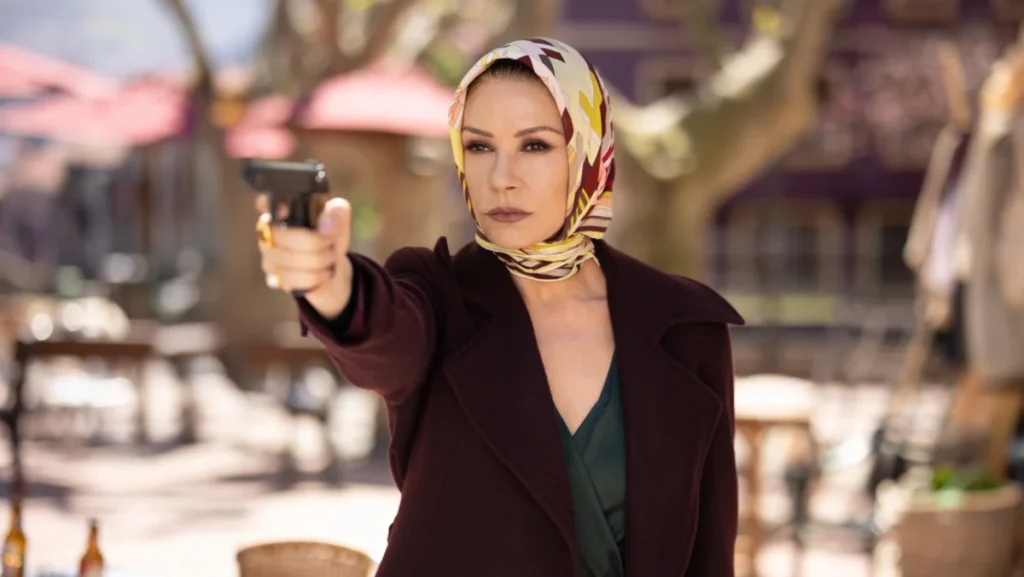
At the center of the narrative is Jackie, portrayed by Catherine Zeta-Jones, whose background as a master of high-end illicit smuggling has left her unimpressed by modern luxury, eight-figure corporate transactions, and private-jet travel. The inciting incident of the series occurs when an anonymous party retains the services of the Seven Demons—a specialized syndicate of international assassins—to target Jackie. Anticipating retaliation from shadows of her former life, Jackie initiates a pre-emptive manhunt across northern Spain, navigating terrain from the coastal region of Bilbao to the interior peaks of the Pyrenees.
Chronology and Narrative Arc
The progression of the eight-hour-long season tracks Jackie’s flight and counter-offensive against various idiosyncratic operatives dispatched by the Seven Demons. Among these adversaries are figures such as The Cuban, a gun-wielding operative played by Sebastian Armesto, and Li Dong, a parkour-practicing hipster portrayed by Tadashi Ito. The narrative incorporates typical genre tropes including shootouts, vehicular pursuits, and close-quarters combat, interwoven with stylized threats of extreme violence.
However, reviewers have pointed out a distinct disparity between the visceral threats discussed in the dialogue—such as targeted flaying, cannibalism, and specialized assassinations—and the relatively tame, perfunctory action sequences that actually appear on screen. Rather than driving the narrative momentum forward, the encounters with the Seven Demons are frequently criticized as lacking in tactical depth or psychological weight.
Cast Performances and Character Dynamics
Despite the overarching criticism directed toward the pacing and superficial design of the series, several performances within the ensemble cast have received individual examination. Catherine Zeta-Jones steps into the lead role, utilizing her natural Welsh accent for the character’s dialogue, yet her portrayal has been described by industry analysts as overly muted. Operating within a restricted emotional range that spans mild surprise, disappointment, and amusement, Zeta-Jones navigates a script featuring standard-issue genre conventions and stylized dialogue.
Supporting cast members introduce varying elements to the production. Óscar Jaenada portrays Zigor, an ex-Demon seeking vengeance who forms an alliance with Jackie, injecting a measure of gravitas into the narrative. Christine Adams assumes the role of The Doc, another operative within the syndicate, whose styling and wry delivery offer a distinct screen presence. Meanwhile, Daniel Ings emerges as a central comedic component of the ensemble as Sam, an ordinary tax attorney unexpectedly pulled into the espionage apparatus. Ings’ portrayal of a character spiraling into panic provides an alternative energy to the otherwise stoic proceedings.
Production Design and Industry Context
The technical and aesthetic choices of Kill Jackie reflect broader economic realities within contemporary streaming television. The series attempts to evoke an atmosphere of jet-setting glamour through backdrops in Spain, distinct wardrobe choices, and high-end set pieces. Nevertheless, trade publications and reviewers have observed that the cinematography and production design frequently exhibit the flat, utilitarian visual style common to mid-tier streaming content, diminishing the impact of its supposed upscale settings.
A recurring structural critique involves the narrative reliance on a shadowy Iceland-based organization known as Poltergeist. Throughout the series, Poltergeist serves as the logistical backbone for Jackie, supplying specialized weapons, conducting financial transactions, and tracking targets. Because these critical capabilities are routinely outsourced to an unseen support team rather than executed through the protagonist’s direct agency, the dramatic tension surrounding Jackie’s survival is frequently undermined.
Broader Implications for the Streaming Landscape
The launch of Kill Jackie arrives amid a fiercely competitive television market populated by numerous international espionage thrillers and stylized action series. Major streaming platforms have increasingly invested in female-led action dramas, ranging from Amazon’s Ride or Die to Netflix’s Black Doves, while the cinematic and television expansions of the John Wick universe continue to define the market for costumed, gimmicky assassin tropes.
Within this crowded ecosystem, the reception of Kill Jackie highlights the challenges faced by literary adaptations attempting to translate complex source material into episodic formats. The difficulty of balancing atmospheric world-building with sustained narrative urgency remains a central hurdle for production companies seeking to establish enduring intellectual property in the premium streaming sector. As audiences are presented with an array of alternative programming—including high-profile fantasy and comedic crime series featuring overlapping talent—the threshold for engaging thriller content continues to rise.
Ultimately, while the series offers moments of dynamic performance from its supporting players and a rare opportunity to hear Zeta-Jones perform in her native accent, the production as a whole underscores the critical demand for rigorous narrative construction and distinctive visual styling in modern television development.