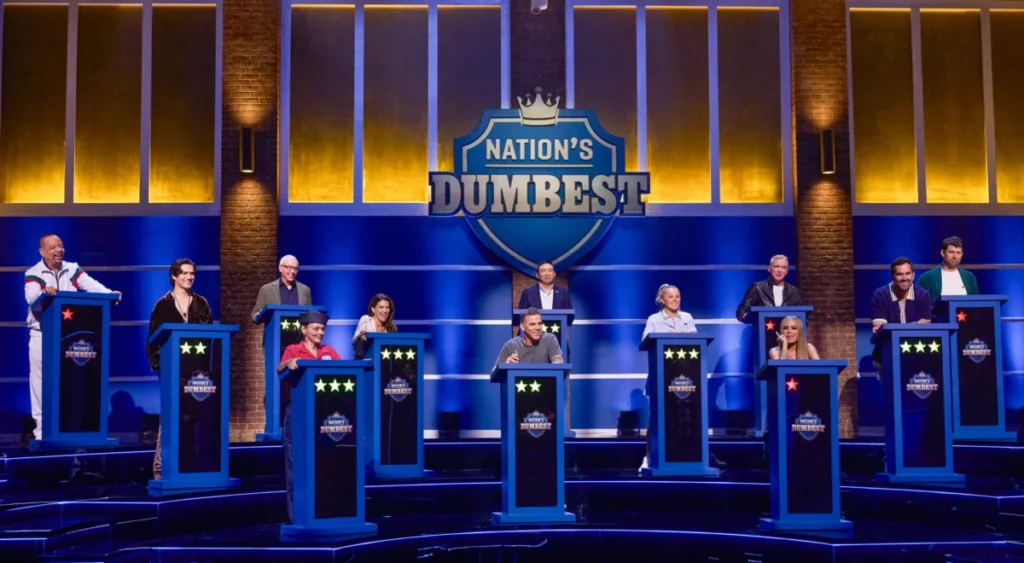

The highly anticipated Fox series, Nation’s Dumbest, premiered on July 15, introducing a novel concept to the celebrity competition genre. Unlike typical reality shows where the ultimate goal is to be the last contestant standing, Nation’s Dumbest flips the script entirely. In this unique format, the last person remaining in the competition is ultimately crowned "Nation’s Dumbest." This provocative premise sets the stage for a series designed to test the wit and problem-solving abilities of twelve well-known personalities in a series of academic and logic-based challenges.
The premiere episode immediately plunged the twelve celebrity contestants into a high-stakes logic test. The objective was to bridge a significant gap by simultaneously grasping both ends of a rope that was intentionally positioned too far apart for any single individual to reach. Armed with a variety of props, the contestants were given a strict three-minute time limit to devise a strategy and execute the task. This initial challenge was designed to gauge their immediate problem-solving skills and ability to think creatively under pressure.
Among the twelve, Jon Heder, widely recognized for his iconic role in Napoleon Dynamite, demonstrated exceptional quick thinking and strategic prowess, completing the logic test in the shortest amount of time. He was joined by a select group of other stars who successfully navigated the challenge: JoJo Siwa, a vibrant entertainer known for her energetic persona; Matt Leinart, a former Heisman Trophy winner and NFL quarterback; and Elle King, a multi-talented singer-songwriter. These four contestants not only proved their mettle in the first task but also earned a strategic advantage moving forward.
Conversely, a significant portion of the celebrity cast struggled with the initial logic puzzle. Eight contestants were unable to complete the challenge within the allotted time. This group included veteran actor Anthony Michael Hall, known for his roles in John Hughes classics; Ice-T, a pioneering rapper and actor; Hilaria Baldwin, a prominent media personality; social media influencer Chase Hudson; entrepreneur Anthony Yang; comedian and daredevil Steve-O; actress Carmen Electra; and Dr. Drew Pinsky, a well-known addiction medicine specialist and television host. Their failure to solve the puzzle immediately placed them at a disadvantage in the competition’s scoring system.
The show’s scoring mechanism was introduced with the concept of "gold stars." Each of the twelve contestants began the competition with two gold stars. The four celebrities who successfully completed the logic test were rewarded with an additional star, bringing their total to three. In contrast, the eight contestants who did not finish the challenge faced a penalty, losing one star and being left with a single gold star. This system immediately created a tiered playing field, emphasizing the importance of early success and the risk associated with failure.
Academic Challenges and Shifting Tides
Following the initial logic test, the competition moved to a more academic setting, with contestants entering a "classroom" environment. Here, they were tasked with answering a series of questions designed to assess their knowledge at an elementary school level. The format remained consistent: a correct answer earned a star, while an incorrect answer resulted in the loss of one. This round was crucial in further stratifying the contestants based on their recall and general knowledge.
At the conclusion of this academic segment, a clearer picture of the contestants’ performance began to emerge. Only two celebrities, Elle King and Matt Leinart, managed to retain their three stars, demonstrating a consistent ability to perform well under academic pressure. A larger group, consisting of Carmen Electra, Dr. Drew Pinsky, Hilaria Baldwin, Ice-T, Jon Heder, JoJo Siwa, and Steve-O, finished with two stars. Meanwhile, Anthony Michael Hall, Anthony Yang, and Chase Hudson found themselves at the bottom of the pack with just one star.
The competition then shifted its focus to zoological knowledge, with contestants answering questions specifically about the animal kingdom. This particular round saw a resurgence for some, with JoJo Siwa, Anthony Yang, Hilaria Baldwin, and Elle King all earning stars. This successful performance allowed King, Baldwin, and Siwa to solidify their positions with three stars each. Anthony Yang and Matt Leinart moved into the two-star category, while the remaining contestants were left with a single star, underscoring the unpredictable nature of the challenges and the varying strengths and weaknesses of the participants.
Team Dynamics and Strategic Maneuvering
The next phase of the competition introduced a significant shift in dynamics: team challenges. The contestants were divided into two teams, each captained by a celebrity who had performed well in previous rounds. Elle King and Hilaria Baldwin were designated as team captains. Team Baldwin was comprised of Chase Hudson, Steve-O, Matt Leinart, Dr. Drew Pinsky, and Anthony Yang. Team King consisted of Carmen Electra, Ice-T, JoJo Siwa, Anthony Michael Hall, and Jon Heder.

The team challenge was designed to foster collaboration and strategic thinking within smaller groups. The outcome of this challenge saw Team Baldwin emerge victorious. This win would likely have provided a boost in morale and potentially offered some strategic advantage or reward, although the exact benefits were not detailed in the initial episode summary. The team format highlighted how different personalities and skill sets could either complement or clash when working towards a common goal.
The Final Exam and the Unconventional Victory
As the competition progressed towards its climax, the contestants faced a "final exam." The stakes were significantly raised, as the number of stars each contestant possessed directly translated into the number of "lives" they had available for this ultimate test of trivia. This crucial mechanic meant that contestants with more stars had a greater margin for error, while those with fewer were under immense pressure to answer correctly from the outset.
The final exam whittled down the field, setting the stage for a dramatic conclusion. The competition ultimately came down to a head-to-head showdown between Anthony Yang, a former presidential candidate known for his political ambitions, and Elle King, the dynamic singer. This final pairing represented a stark contrast in their public personas and backgrounds, adding an extra layer of intrigue to the decisive moments of the episode.
In a surprising turn of events, it was Elle King who ultimately triumphed in the final exam. However, in a testament to the show’s unique premise, her victory did not result in her being crowned the winner in the traditional sense. Instead, her success meant that Anthony Yang was sent back to the "classroom" with the other eliminated contestants, while King herself was sent "home." On Nation’s Dumbest, being sent home signifies a successful avoidance of the ultimate title. Therefore, Elle King officially avoided the ignominious distinction of being crowned "Nation’s Dumbest."
Broader Implications and Future of the Series
The premiere of Nation’s Dumbest has certainly made a splash in the reality television landscape. The show’s unconventional premise—celebrating a lack of intelligence rather than rewarding it—is a bold statement that challenges viewers’ expectations. This format could attract a specific audience drawn to its darkly humorous and self-aware approach to celebrity culture.
The success of the initial episode suggests that the show has tapped into a vein of public fascination with watching celebrities navigate challenges that expose their vulnerabilities. The "reverse competition" aspect ensures that every elimination brings the remaining contestants closer to the undesirable title, creating a constant undercurrent of tension and dark comedy.
The long-term implications for the series will depend on its ability to sustain this novelty and continue to present engaging challenges. The show’s success hinges on the contestants’ willingness to embrace the premise and deliver entertaining performances, whether through genuine struggle or humorous attempts at problem-solving. The integration of various academic and logic-based tests, combined with team dynamics, provides a flexible framework for future episodes.
Furthermore, the show’s title itself is provocative and likely to generate discussion and debate. It could be interpreted as a commentary on the perceived intelligence of public figures or as a lighthearted exploration of human fallibility. The impact of such a series on public perception of celebrity intelligence remains to be seen, but it undoubtedly offers a fresh perspective in a crowded television market.
Nation’s Dumbest airs Wednesdays at 9/8c on Fox, promising more unconventional challenges and surprising outcomes as the season unfolds. The series’ unique approach guarantees that viewers will be tuning in to see who might be on the fast track to being crowned "Nation’s Dumbest."