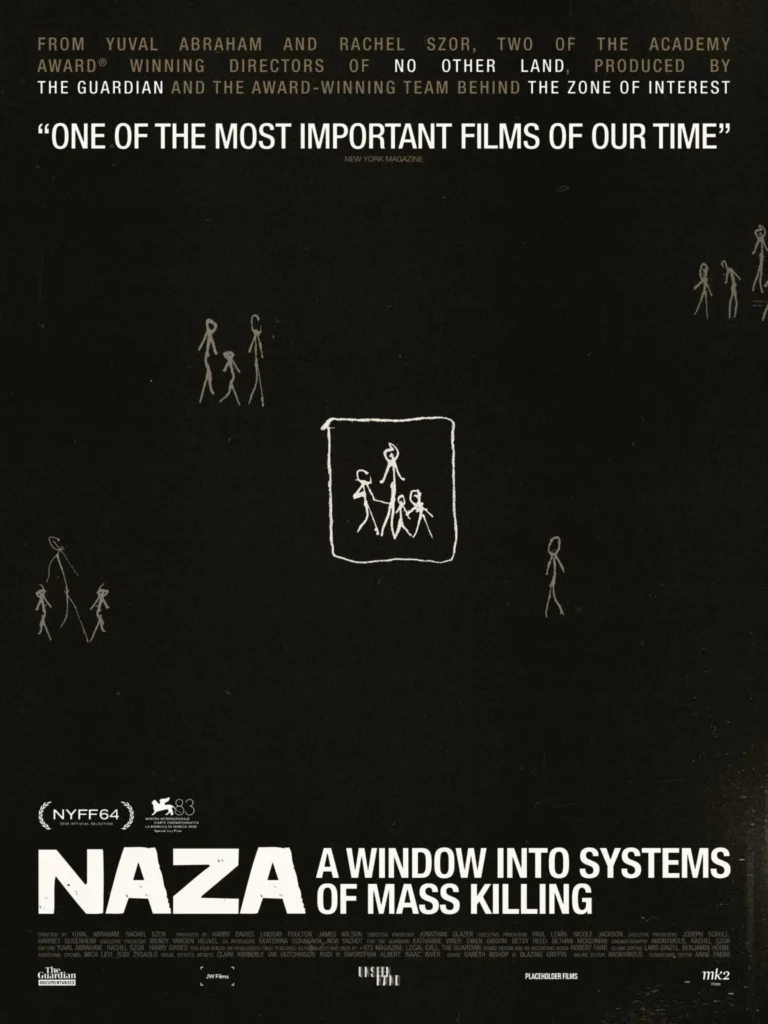

The official trailer for NAZA, an investigative documentary examining the integration of artificial intelligence in military targeting systems and civilian casualties in Gaza, has been released by Mk2 Films. Directed by Israeli filmmakers and journalists Yuval Abraham and Rachel Szor—best known for their work on No Other Land—the film made its world premiere earlier this month at the 2026 Venice Film Festival, where it drew significant critical attention.
Produced collaboratively by The Guardian, JW Films, Placeholder Films, and Unseen Hand, with Academy Award-winning filmmaker Jonathan Glazer serving as executive producer, NAZA draws heavily on investigative reporting conducted in the wake of the October 7, 2023, attacks. The documentary explores the mechanics of automated target-generation systems and surveillance architectures employed in modern warfare, relying on insights derived from secret conversations and analyses captured over a three-year production period. Following its festival run, NAZA is scheduled for a select theatrical release in the United States on September 30, 2026, ahead of a free global digital release hosted by The Guardian in November 2026.
Background Context and Journalistic Origins
The foundation of NAZA lies in investigative journalism published shortly after the outbreak of the Israel-Hamas war in October 2023. Major findings incorporated into the documentary were initially developed through reporting partnerships between The Guardian, +972 Magazine, and Local Call. These investigative pieces detailed how military agencies increasingly utilize machine learning and advanced database systems to accelerate the identification and approval of targets in densely populated urban environments.
Co-directors Yuval Abraham and Rachel Szor structured the documentary to extend beyond the scope of traditional print journalism. By embedding the project within the subjective and tense atmosphere of Tel Aviv rooftops at night, the filmmakers sought to capture not only the technical explanations provided by the individuals who designed and operated these systems, but also the broader institutional and psychological frameworks that facilitate mass casualty events.
In a joint statement accompanying the trailer’s release, the directors explained the impetus behind the project: “We made this film out of a sense of obligation to use our position as Israeli filmmakers and journalists to examine the systems behind the mass killing of Palestinian civilians for which our country is responsible. While filming members of Israel’s military on rooftops at night in Tel Aviv over the past three years, we found ourselves asking the very questions that were asked by our grandparents’ generation and throughout the 20th century: how does one group of people allow the total dehumanization of another? What do the inner workings of such a system look like?”

Chronology of Production and Distribution
The trajectory of NAZA spans three years of clandestine production, journalistic collaboration, and festival screening. The chronology of the project highlights its swift transition from investigative reporting to a globally distributed cinematic feature:
- October – December 2023: Initial investigative reports detailing military AI usage and targeted killing infrastructure are published by The Guardian in collaboration with +972 Magazine and Local Call.
- 2023 – 2026: Production continues in secret, incorporating late-night observations, expert interviews, and whistle-blower accounts regarding automated military surveillance systems.
- September 2026: NAZA holds its world premiere at the 2026 Venice Film Festival, receiving widespread critical notice for its uncompromising subject matter.
- September 25, 2026: Mk2 Films releases the official theatrical trailer and promotional poster to the public.
- September 30, 2026: The film is slated for a theatrical release in select theaters across the United States.
- November 2026: The Guardian plans to release the documentary for free streaming globally on its platform.
Technological Focus and Operational Mechanics
A central element of NAZA is its granular examination of artificial intelligence deployed in contemporary conflict zones. Unlike historical models of warfare where targets were predominantly selected through individual human intelligence assessments, modern systems highlighted in the documentary integrate massive datasets to generate automated target lists at unprecedented speeds.
The film examines how algorithmic surveillance systems aggregate communications data, movement patterns, biometric inputs, and digital footprints to assign risk profiles to individuals. According to the disclosures examined in the film and associated journalistic investigations, these computational tools are designed to bypass traditional bureaucratic bottlenecks, enabling military commanders to process high volumes of targets daily. NAZA scrutinizes the implications of delegating life-and-death decisions to automated infrastructure, raising critical questions regarding accountability, error rates, and the erosion of human judgment in military engagements.
Production Team and Industry Support
The production of NAZA represents a convergence of investigative journalism and independent cinema. The project was produced by Harry Davies, Lindsay Poulton, and James Wilson, alongside production entities including The Guardian, JW Films, Placeholder Films, and Unseen Hand.

The involvement of Jonathan Glazer as executive producer aligns with his prior artistic explorations of systemic detachment and institutionalized violence, most notably demonstrated in his Holocaust-set feature The Zone of Interest. Glazer’s support has provided the documentary with heightened visibility within the international film community, bridging the gap between high-stakes investigative journalism and cinematic art.
Implications and Broader Impact
The release of NAZA arrives at a time of intense global debate regarding the regulation, ethics, and military applications of artificial intelligence. As governments and defense contractors worldwide increasingly invest in autonomous systems, algorithmic decision-making, and predictive policing technologies, documentaries like NAZA provide a rare window into the operational realities of these tools.
From a policy perspective, the film challenges international legal frameworks that govern armed conflict, particularly regarding proportionality, distinction, and command responsibility when AI-generated intelligence is utilized. Legal scholars and human rights advocates have frequently noted that existing humanitarian laws were drafted without accounting for the velocity and opacity of machine-learning systems in combat.
Furthermore, NAZA forces a reckoning within the technology sector itself. By documenting how commercial and specialized data-processing architectures can be repurposed for military targeting, the film raises pressing questions for software engineers, data scientists, and institutional leaders regarding the dual-use nature of advanced technology and the ethical boundaries of surveillance capitalism.
By combining rigorous investigative reporting with visceral visual storytelling, NAZA seeks to transcend standard political discourse, urging audiences to confront the structural mechanisms of modern warfare and the human costs associated with the unchecked expansion of automated surveillance systems.