
In the competitive world of high-end residential architecture, clients typically arrive at consultations armed with Pinterest boards, color swatches, and specific fabric samples. However, for the renovation of her family cabin on a Minnesota lake, Gina Henkemeyer presented designer Julia Miller with a directive that was as abstract as it was evocative. Eschewing traditional aesthetic categories, Henkemeyer described a sensory experience: she envisioned a space that captured the essence of "Sophia Loren meeting Walden Pond," a home defined by the olfactory memory of cedar wood and pasta water. This project, recently completed by Miller’s firm, Yond Interiors, stands as a masterclass in how heritage, memory, and functional modernism can be synthesized into a cohesive architectural narrative.

The cabin, situated in the rugged landscape of Minnesota’s Iron Range near Lake Superior, serves as a physical bridge between Henkemeyer’s dual ancestral roots. Inspired by childhood summers spent in the region, the renovation sought to honor her Italian and Finnish grandparents. This cultural intersection—the warmth and culinary richness of Italy paired with the stoic, nature-focused minimalism of Finland—provided the foundational "Venn diagram" for the design process. For Julia Miller, a member of the prestigious AD PRO Directory, the challenge was to translate these esoteric concepts into a tangible, liveable environment that could withstand the rigors of a young family’s daily life.
Architectural Synthesis and Cultural Context
The Iron Range of Minnesota is a region historically defined by its mining industry and a unique cultural melting pot resulting from European immigration in the late 19th and early 20th centuries. Finnish and Italian immigrants were among the primary groups that settled the area, bringing with them distinct traditions that have merged over generations. Henkemeyer’s cabin renovation is a reflection of this regional history. By requesting a "heritage feel," the client was not looking for a museum-like preservation of the past, but rather a space that felt as though it had been curated over 50 years, with each piece of furniture and every architectural detail telling a story of migration and adaptation.

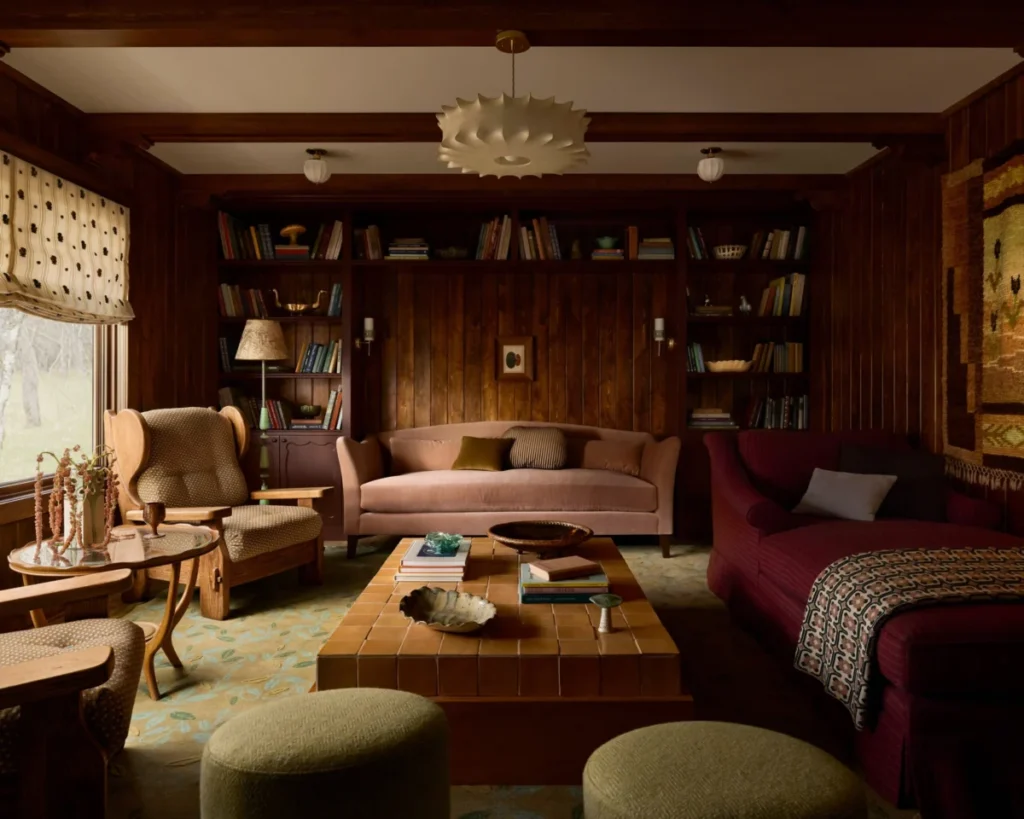
To achieve this, Miller had to navigate the complexities of an existing structure while adding a significant second-floor expansion. The primary architectural objective was to create seamless cohesion between the original lower level and the new addition. Miller achieved this by continuing the use of dark-stained pine paneling, a hallmark of traditional Midwestern cabin design. This choice provided a moody, grounded atmosphere that balanced the lighter, more eclectic elements introduced in the upper-level living spaces.
The Design Chronology: From Brief to Execution
The renovation began with the lower level, specifically focusing on a previously updated kitchen. This room served as the "anchor" for the entire project’s color palette. The kitchen’s deep olive cabinetry and rust-toned stone counters provided a naturalistic foundation. Miller expanded upon this, layering in a sophisticated spectrum of blues, yellows, and browns. According to Miller, working with green and red tones—while seemingly bold—offered a classic versatility that allowed for the introduction of more daring pigments elsewhere in the home.

The transition from the old to the new is most evident in the entryway. Here, Miller doubled down on pattern and texture, retaining the original terracotta and white checkerboard tile floors while introducing a 1920s-style leafy wallpaper from Bradbury & Bradbury. The centerpiece of the stairwell is an alpine handrail featuring a hand-carved motif of Lily of the valley. As the national flower of Finland, the Lily of the valley symbolizes purity and a "return to happiness," a subtle but profound nod to the family’s Nordic heritage.
At the top of the stairs, the second-floor addition opens into a long living room tailored for Henkemeyer’s husband, Jim, and their young son. The furniture in this space was selected for its ability to tell both an aesthetic and a functional story. A custom-designed chaise, upholstered in a Pierre Frey burgundy wool check, was lengthened specifically to accommodate Jim’s height. Simultaneously, the Jura Coffee Table from Ah Um, topped with dandelion-patterned tiles, was chosen for its durability. Miller noted that the table was intended to survive the inevitable wear and tear of Matchbox cars and spills, reinforcing the philosophy that high design should not be precious or fragile.

Supporting Data: Materiality and Sourcing
The project’s success relies heavily on Miller’s commitment to vintage sourcing and custom craftsmanship. By integrating items that do not strictly "match," the designer avoided the sterile feel of a showroom, instead creating a home that feels "collected."
Key material and sourcing data points include:

- Vintage Sourcing: Miller sourced Scandinavian wall hangings and mid-century Italian nightstands to represent the client’s dual heritage.
- Textiles: Extensive use of Pierre Frey fabrics, including chartreuse tweed for ottomans and burgundy wool for the living room chaise.
- Wall Coverings: A combination of nickel gap shiplap and "Jagged Stripe" wallpaper from The Pattern Collective in the children’s quarters.
- Flooring and Tile: Sea blue-glazed terracotta squares from Zia Tile in the bathroom, and geometric mosaic tiles from Mosaic House on the vanity floors.
- Custom Woodwork: A blue-pigmented oak console and a double-arched walnut headboard in the primary bedroom.
The primary bedroom serves as a focal point for the "Sophia Loren" aspect of the brief. The space is anchored by a vibrant citron "Petal Rug" by Eny Lee Parker, which provides a pop of Mediterranean warmth against the more traditional, moody walnut furniture. The inclusion of a wine-and-moss botanical tapestry inset into the headboard further blends the themes of European elegance and woodland rusticism.
The Finnish Sauna: A Non-Negotiable Cultural Anchor
In any Finnish-inspired home, the sauna is more than a luxury; it is a spiritual and social necessity. For Henkemeyer, the inclusion of a wood-clad sauna was a non-negotiable element of the project. Miller positioned the sauna at the front of the house, a strategic decision that allows for a tranquil view over the lake from within the heated chamber.

This placement underscores the project’s commitment to the "Walden Pond" side of the directive—prioritizing a direct, reflective connection with nature. The sauna’s design incorporates the same sea-blue terracotta tiles found in the main bathroom, ensuring that the transition from the large standing shower to the sauna feels intentional and integrated. The scent of the heated wood, combined with the view of the water, fulfills the olfactory portion of the original brief, providing a sensory anchor that connects the owner to her Finnish roots.
Broader Impact and Design Implications
The Henkemeyer cabin renovation reflects a broader shift in the interior design industry toward "sensory-led" and "heritage-focused" architecture. In an era where digital fatigue is common, homeowners are increasingly seeking spaces that engage the senses beyond the visual. The "olfactory memory" requested by Henkemeyer—cedar and pasta water—represents a desire for homes that evoke emotional responses and nostalgia.

Furthermore, the project challenges the prevailing "modern farmhouse" trend that has dominated Midwestern residential design for the last decade. Instead of white-washed walls and mass-produced rustic accents, Miller’s work suggests a move toward "maximalist-minimalism." This approach uses high-quality, durable materials and vintage pieces to create a space that is visually rich but structurally simple.
From a sustainability perspective, Miller’s emphasis on vintage sourcing and "pass-down" quality furniture aligns with growing consumer interest in reducing the environmental impact of home renovations. By selecting pieces that are intended to last for 50 years rather than five, the project advocates for a more conscious and enduring form of luxury.

Conclusion
The completion of the Henkemeyer cabin demonstrates that even the most abstract architectural briefs can result in highly functional and sophisticated outcomes when handled with a deep respect for cultural context. By synthesizing the glamour of mid-century Italy with the transcendentalist simplicity of the American Northwoods, Julia Miller and Yond Interiors have created a residence that is both a personal sanctuary and a tribute to regional history.
The project stands as a reminder that the most successful homes are those that do not merely follow a trend but instead capture a spirit. In the case of this Minnesota lake cabin, that spirit is found in the scent of cedar, the durability of a tiled table, and the quiet view of Lake Superior from a Finnish sauna—a perfect intersection of Sophia Loren’s elegance and the rustic solitude of Walden Pond.