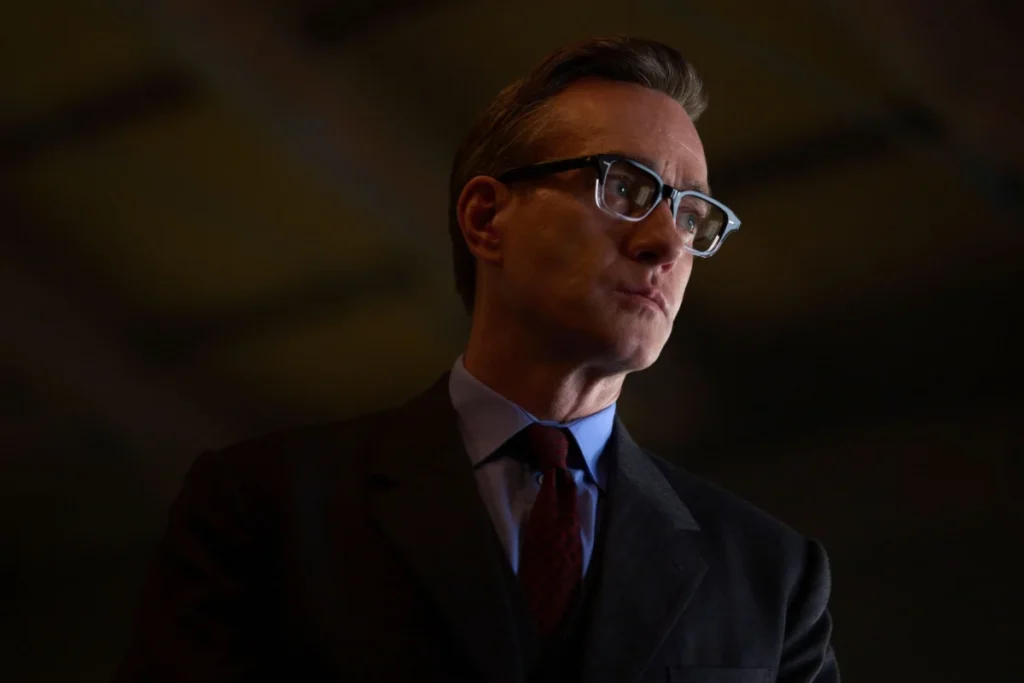

The television landscape is bracing for a return to the shadowed, tension-filled corridors of the Cold War as the BBC confirms the production of its upcoming eight-part series, Legacy of Spies. At the heart of this high-stakes adaptation is Matthew Macfadyen, who has been captured in the first official imagery sporting the quintessential aesthetic of John le Carré’s most famous creation, George Smiley. Dressed in a sharp, understated black suit and framed by the character’s signature thick-rimmed spectacles, Macfadyen’s portrayal promises to capture the quiet, intellectual intensity that defines the brilliant yet unassuming intelligence officer.
The production represents a significant investment by the BBC into high-end drama, blending two of le Carré’s most revered works: the 1963 landmark bestseller The Spy Who Came In From The Cold and its 2017 successor, A Legacy of Spies. By bridging these two narratives, the series aims to offer both a foundational look at the early days of Cold War operations and a retrospective examination of the moral costs associated with espionage.
A Legacy Reimagined: From Literature to the Screen
John le Carré’s George Smiley stands as the antithesis of the flamboyant, gadget-wielding spy archetype popularized by Ian Fleming’s James Bond. Throughout the literary canon, Smiley is presented as a man of modest physical presence—often described as a toad-like figure—who commands authority through unparalleled analytical prowess and a profound, often weary, understanding of human nature.

Macfadyen, whose resume includes a notable turn in the espionage thriller Spooks and the critically acclaimed war drama Operation Mincemeat, appears uniquely suited to embody this restraint. The role of Smiley has historically been occupied by titans of the screen. Sir Alec Guinness famously defined the character in the 1979 and 1982 television adaptations of Tinker Tailor Soldier Spy and Smiley’s People, setting a gold standard for the role. More recently, Gary Oldman’s 2011 film performance brought a modernized, visceral vulnerability to the character. Macfadyen now faces the challenge of navigating these legacies while grounding the character in the specific historical reality of the 1960s.
Plot and Setting: The Shadow of the Berlin Wall
The series is set against the backdrop of the early 1960s, a period defined by the erection of the Berlin Wall and the height of paranoia between the Western intelligence services and the East German Stasi. The narrative centers on Alec Leamas, played by Charlie Hunnam. Leamas is a weary, cynical operative whose exhaustion with the "great game" of spying makes him an ideal candidate for a final, high-risk mission.
In the source material, Leamas is tasked with a deceptive operation intended to trap the deputy director of the East German Intelligence Service. While Leamas acts as the boots on the ground, the series explores how Smiley operates from the safety—and the isolation—of his London office, orchestrating the complex psychological maneuvers that define the plot. Hunnam, known for his roles in The Gentlemen and Sons of Anarchy, brings a gritty, noir-inflected energy to the role, visually echoed in the first-look photos where he appears draped in a dark, high-collared coat, staring solemnly into the distance beneath the glow of a neon sign.
Chronology of Production and Development
The development of Legacy of Spies has been a multi-year effort to secure the rights and assemble a production team capable of honoring the complexity of le Carré’s writing.

- 2017: John le Carré publishes A Legacy of Spies, which serves as a coda to his previous novels, prompting immediate industry speculation regarding a potential screen adaptation.
- 2023: The BBC officially announces the project, confirming a partnership with production houses The Ink Factory and Amusement Park Film.
- 2025 (Early): Principal photography commences in various European locations designed to replicate the stark, austere environment of 1960s Berlin and London.
- 2026 (September): Production officially wraps. The BBC releases the first batch of promotional stills, confirming the casting of the ensemble and the aesthetic direction of the series.
- Future: A formal release date for the eight-part series on BBC iPlayer and BBC One is expected to be announced in the coming months.
A Stellar Ensemble Cast
The series distinguishes itself not only through its lead actors but through a supporting cast that underscores the BBC’s commitment to prestige television. Joining Macfadyen and Hunnam are several high-profile names, including Hugh Laurie, whose previous work on the adaptation of The Night Manager established him as a key voice in the le Carré television universe.
Charlotte Ritchie, known for her versatility across comedy and drama, is confirmed to play a pivotal role, alongside an international cast that includes Daniel Brühl, Dan Stevens, Agnes O’Casey, Devrim Lingnau Islamoglu, Jake Dunn, Anjana Vasan, and Felix Kammerer. This diverse assembly suggests that the series will delve into the lives of the various bureaucrats, informants, and handlers who operated within the fringes of the Cold War, rather than focusing solely on the protagonists.
Analysis: The Cultural Significance of Le Carré
The enduring appeal of John le Carré’s work lies in its rejection of the "black and white" morality of traditional spy fiction. Instead, his stories occupy a "grey zone," where the actions of intelligence officers often result in personal destruction, moral compromise, and the erosion of the very principles they claim to defend.
The decision to adapt both The Spy Who Came In From The Cold and A Legacy of Spies simultaneously is an ambitious narrative choice. It allows the showrunners to explore the "consequences of history." By presenting the mission of the 1960s alongside the reflective viewpoint of a later era, the series creates a dialogue between the past and the present.

For the BBC, this project is a strategic pillar in their ongoing effort to dominate the premium drama market. With the rise of global streaming platforms, the demand for high-quality, culturally significant British storytelling has never been higher. By anchoring the series in the recognizable intellectual property of the le Carré brand—and pairing it with a cast of proven, globally recognized talent—the BBC is positioning Legacy of Spies as a potential awards-season contender.
Implications and Audience Expectations
As filming concludes and the show moves into post-production, anticipation among literary enthusiasts and television critics remains high. The challenge for the creative team will be balancing the glacial, psychological pace of le Carré’s prose with the requirements of a modern, fast-paced television audience.
Furthermore, the portrayal of the 1960s in the series will be scrutinized for historical accuracy. The production design—from the spectacles worn by Macfadyen to the specific architecture of the Berlin sets—must evoke a sense of authenticity that satisfies both historians and long-term fans of the source material.
With the project currently in the final stages of editing, the industry is waiting to see if Legacy of Spies will redefine the spy genre for the next decade. If the initial glimpses are any indication, the series intends to trade in the high-octane explosions of the Bond franchise for the quiet, devastating power of the "ordinary" man in the extraordinary world of espionage. The arrival of Matthew Macfadyen’s Smiley may well mark a return to the golden age of the thinking person’s thriller.