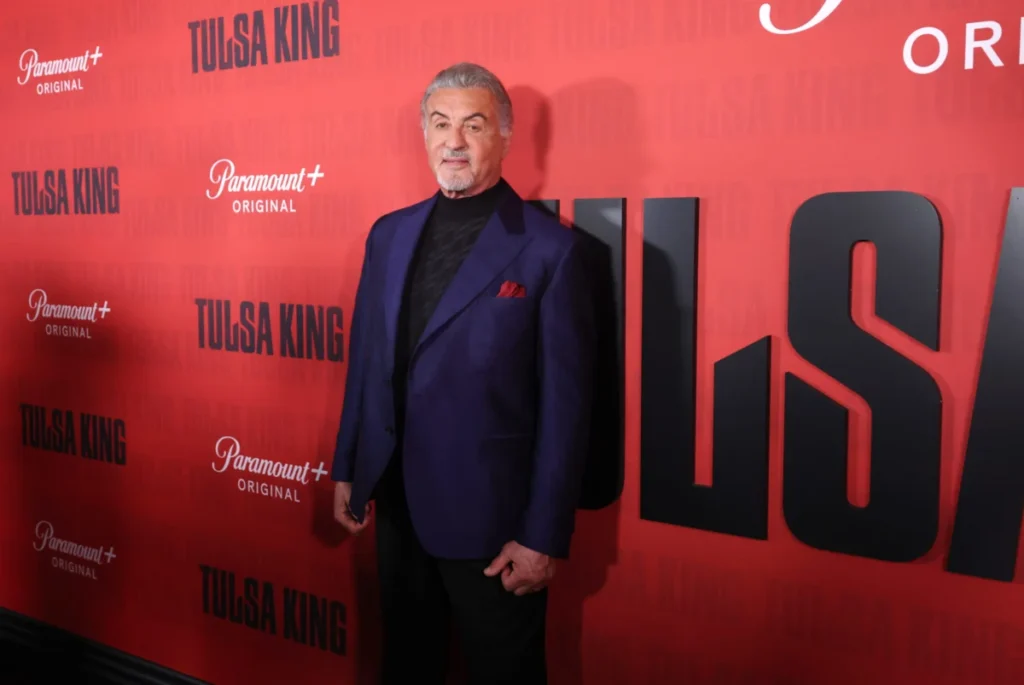

Hollywood icon Sylvester Stallone is addressing the cinematic retelling of his own storied rise to fame, speaking candidly about the new biographical film I Play Rocky. During a promotional appearance at New York City’s prestigious 92NY on Monday evening, the celebrated actor, writer, and director shared his initial reservations, his astonishment at the uncanny physical resemblance of the film’s lead star, and his strictly hands-off approach to the project. The event, moderated by CBS Sunday Morning journalist Tracy Smith, also served as a platform for Stallone to promote his newly released memoir, The Steps, while touching upon broader reflections regarding the modern film industry, the evolution of action cinema, and his ongoing ambition to rectify what he considers a major misstep in his legendary cinematic franchise.
The film at the center of the discussion, I Play Rocky, generated substantial critical and audience fanfare when it premiered earlier this month at the Toronto International Film Festival. Directed by acclaimed filmmaker Peter Farrelly, the biographical drama chronicles the arduous, high-stakes journey behind the making of the seminal 1976 classic Rocky. The original sports drama went on to transcend its modest budget, capturing multiple Academy Awards, including Best Picture, and cementing Stallone’s status as a global superstar. In the new retrospective feature, rising actor Anthony Ippolito steps into the heavy boots of a young Stallone, capturing his tireless crusade to bring his screenplay to the silver screen despite countless studio rejections and formidable industry barriers.
Initial Hesitation Turned to Astonishment
When Stallone first learned that a major motion picture was being developed about the genesis of his career-defining masterpiece, his reaction was not one of immediate celebration. Speaking to the packed 92NY audience, the actor admitted that his initial feelings were mixed. He recalled thinking that the project might be premature, questioning the decision to chronicle a living person’s life story before their journey has concluded.
"I’m not dead yet. Aren’t we jumping the gun a little bit?" Stallone recalled thinking when the project was first brought to his attention.
However, those early doubts quickly dissolved the moment he laid eyes on footage of the film’s lead actor. Stallone described a moment of genuine disorientation upon viewing test footage and scenes featuring Anthony Ippolito. The similarity was so striking that it briefly tricked even the man who lived the experience.
"And then I saw this video of this kid. I actually thought it was me the first moment; there were a couple of angles," Stallone told the crowd. "I go to my daughter and say, ‘That’s unbelievable.’"
Despite the uncanny accuracy of the portrayal, Stallone was quick to clarify that he had no creative input, financial stake, or administrative control over the production. Emphasizing that he maintained a completely hands-off policy, the actor revealed that he deliberately chose to step back and observe the filmmaking process from a distance rather than attempt to steer the narrative of his own biography.
"I said, ‘I’ll just sit back and watch.’ I talked to the kid. I said, ‘If you want any questions, here I am,’ and that was it. But they did it all on their own," Stallone explained, adding with characteristic self-deprecation after watching Ippolito’s performance: "I go, ‘Do I talk like that?’ Now I get it. Now I get it."
Reflecting on a Legacy and the Rocky V Regret
While looking back at the cultural footprint of the Rocky franchise, Stallone offered a candid assessment of what it feels like to revisit the films that defined his career. Rather than basking entirely in nostalgia, the viewing experience often brings a critical eye to the forefront. He likened watching his past cinematic triumphs to looking at an old photograph where everyone else sees a flattering image, but the subject himself focuses exclusively on the flaws.
The conversation naturally pivoted toward the broader history of the franchise, leading Stallone to reveal a persistent professional grievance. He openly admitted that the 1990 installment, Rocky V, remains a painful sore spot in his filmography. Directed by John G. Avildsen—who helmed the original 1976 film—Rocky V saw the aging boxer return to his gritty roots after losing his fortune, mentoring a young up-and-coming fighter played by real-life boxer Tommy Morrison. Despite its commercial performance, the film was widely panned by critics and fans alike, frequently ranking as the lowest point in the storied saga.
Stallone did not mince words when analyzing why the fifth installment failed to connect with audiences in the manner of its predecessors, placing the blame squarely on his own shoulders.
"It bothers me to death because I know I took my foot off the gas," Stallone stated. He acknowledged that he should have taken the directorial reins himself instead of handing them over to Avildsen, and admitted that he fell into the trap of trying to cater too directly to shifting audience expectations rather than trusting the authentic emotional core of the character.
Revealing that he is actively attempting to rectify the past, Stallone shared that he is currently in discussions with Amazon to secure permission to recut Rocky V. Whether the studio will grant the veteran filmmaker the opportunity to re-edit the 35-year-old motion picture remains to be seen, but Stallone tempered expectations regarding what a revised version might achieve. Characteristically pragmatic about the prospect, he joked that any potential recut would not transform the movie into a masterpiece, noting simply, "It’s not going to be great. It’ll be acceptable."
The Modern Hollywood Landscape and Casting Challenges
Later in the evening, moderator Tracy Smith steered the conversation toward the contemporary film industry, posing a hypothetical question to the veteran actor: Could a young Sylvester Stallone, starting out today with the same grit, determination, and raw background, climb to the very top of Hollywood under current industry standards?
Stallone’s response was a definitive and reflective negative. He pointed to a fundamental shift in cultural ideology, industry mindset, and audience expectations that separates the mid-1970s filmmaking boom from the current entertainment ecosystem.
"It’s a whole different ideology out there… I don’t think so. It’s a whole different mindset," Stallone replied. "The actors look different. They act different — not the mentality, but the subject matter isn’t something that I could relate to. Like action right now is kind of anachronistic."
Expanding on his critique of modern cinematic production, Stallone used Francis Ford Coppola’s 1972 cinematic benchmark, The Godfather, to illustrate how deeply intertwined classic films are with the specific socio-cultural climates in which they are produced. He argued that the unique convergence of societal pressures, ethnic representation, and historical context during that era made such masterpieces possible in a way that modern studio structures simply cannot replicate.
"For example, if you were going to make The Godfather today, try casting it. Impossible," Stallone observed. "The whole premise — it just came at a certain time, and that’s why it makes it so unique. So quite often when they do remakes, they’re fundamentally forgetting that that film was based on the social climate, the thing, the look, the ethnicity, everything that there was going on at that time. Today, you couldn’t cast the film."
Broader Context and Memoir Release
Stallone’s remarks at 92NY arrive at a pivotal moment in his multimedia career. As the entertainment landscape continues to embrace biographical dramas and nostalgic IP revivals, the release of I Play Rocky highlights the enduring cultural fascination with the underdog narrative that first catapulted Stallone to international fame nearly five decades ago. Peter Farrelly’s film is expected to seek major distribution and awards consideration following its warm reception in Toronto, ensuring that the origins of the Italian Stallion will be introduced to an entirely new generation of moviegoers.
Simultaneously, the debut of Stallone’s new memoir, The Steps, which hit bookshelves on Tuesday, offers fans a deeper, unfiltered look into the personal trials, professional setbacks, and defining triumphs that shaped his extraordinary life both on and off the screen. Through a combination of literary reflection, candid public appearances, and ongoing creative endeavors, Stallone continues to actively manage and contextualize a legacy that has profoundly shaped American cinema for nearly half a century.