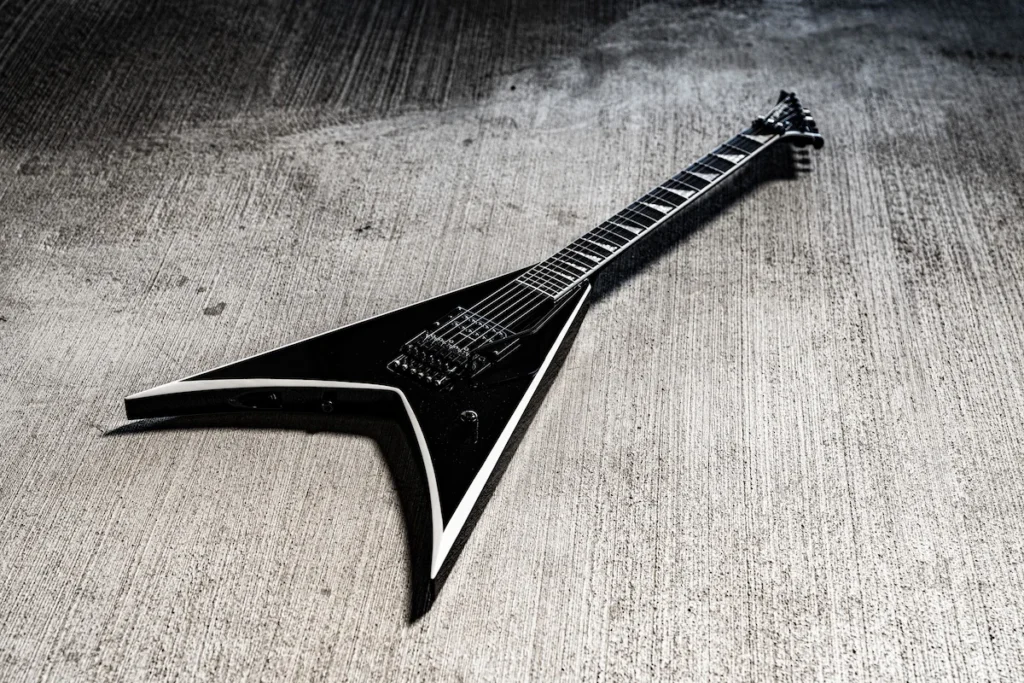

Limp Bizkit guitarist Wes Borland has officially launched his first-ever signature guitar collaboration with Jackson Guitars, introducing the King V KV model. This highly anticipated release, retailing at $1,299.99, marks a significant milestone in Borland’s long-standing relationship with the iconic guitar manufacturer and reflects his refined approach to instrument design, prioritizing robustness and streamlined functionality for live performance. The announcement comes after years of Borland utilizing Jackson instruments on stage and in the studio, cementing his place within the brand’s esteemed artist roster.
The new signature King V KV is engineered to meet the rigorous demands of Borland’s distinctive playing style and intense stage presence. Key specifications include a powerful Seymour Duncan Invader bridge pickup, a 1-piece maple neck-through construction fortified with graphite reinforcement for enhanced stability and sustain, and a compound radius ebony fingerboard featuring 24 jumbo frets for effortless playability across the neck. Further enhancing its performance capabilities, the guitar incorporates a recessed Floyd Rose 1500 series bridge, providing reliable tuning stability and expressive vibrato manipulation crucial for Borland’s aggressive riffing and dynamic soundscapes. The guitar’s design ethos, as articulated by Borland himself, centers on pragmatic reliability, ensuring it stands up to the rigors of touring.
A Philosophy of Performance and Durability
Borland’s philosophy on guitar design, as revealed in a recent interview with Heavy Consequence, emphasizes utility and resilience above all else. "It’s taking me a long time to figure out what I need as a guitar player," Borland stated. "For me, you just need volume, pickups, locking tremolo system and 24 frets, that’s it. Live, it just needs to be as bulletproof as possible. You know, I’ve been very rough with guitars over the years." This candid assessment underscores a shift from complex features to essential, high-performance components that can withstand the physical demands of Limp Bizkit’s energetic performances. His stage persona, often characterized by elaborate costumes and dynamic movement, necessitates an instrument that is not only sonically versatile but also physically robust.
He further elaborated on this streamlined approach, noting, "I’ve come to realize that the more streamlined our guitars are, the less problems we have on stage… You know Jackson is fun, the over the top, shred-a-copter shapes and my outrageous stage costumes pushing the boundaries, this fits in more with that. The way people dress, it affects how you behave, and I think it also changes how I play guitar." This insight provides a fascinating look into the symbiotic relationship between Borland’s visual artistry and his musical output, suggesting that the instrument itself must complement his overall artistic expression, even if that means stripping away non-essential elements for maximum reliability. The King V, with its aggressive, angular silhouette, naturally aligns with the aesthetic exuberance Borland brings to the stage, making it a fitting choice for his signature model.
A Journey to Jackson: Influences and Fateful Encounters
The path to Borland’s signature Jackson King V has been a long and winding one, rooted in childhood admiration and professional relationships. His connection to Jackson Guitars stretches back decades, predating his tenure with Limp Bizkit. "It’s kind of been a long time coming," Borland admitted, highlighting a deep, personal history with the brand. This history began with formative influences, particularly his fascination with heavy metal titans Megadeth. "I was a huge Megadeth fan as a kid, so seeing Dave Mustaine playing King Vs just put something in my head that I can’t ignore or get away from." The iconic imagery of Mustaine, Marty Friedman, and Dave Ellefson in Megadeth’s music videos, especially the "Go to Hell" video with its distinctive shark fin inlays, solidified Jackson’s appeal in young Borland’s mind. "Little kid me just went, ‘Jacksons are amazing,’ after seeing all those videos… I just thought they were such cool guitars. I just loved them so much."
Borland’s professional association with Jackson was significantly influenced by Mike Tempesta, Jackson’s American artist relations representative. Borland had previously collaborated with Tempesta at Yamaha Guitars, where he also had a signature model. When Tempesta transitioned to Jackson, Borland naturally followed, cementing a professional relationship built on trust and mutual understanding. This continuity in partnership allowed for years of collaboration and discussions leading up to the eventual development of the King V KV.
Adding another layer to his enduring connection with Jackson, Borland recounted a significant gift from Ross Robinson, the acclaimed producer of Limp Bizkit’s debut album, Three Dollar Bill, Y’all. Robinson gifted Borland his first Jackson guitar years ago—an ’81 Randy Rhoads model, which Borland still cherishes in his guitar vault. This serendipitous acquisition further reinforced the brand’s presence in his musical life, leading him to conclude, "For some reason, the Jackson just kept coming to me over and over again in different ways in my life. So, I’m really just surrendering to fate, I guess, and going, ‘Well, I guess I’m a Jackson player now.’" This narrative paints a picture of a destiny intertwined with the distinctive V-shaped guitars.
The Genesis of the King V KV: A Custom Shop Anomaly
The direct inspiration for the signature King V KV stems from a unique and somewhat humorous anecdote involving a custom shop Jackson King V Borland acquired around 2012 or 2013. The story began when Mike Tempesta informed Borland about a reverse headstock King V that had been returned by a customer who found the ebony fretboard insufficiently dark. Borland’s reaction was one of disbelief: "I was like, ‘What an asshole.’ I was just like, ‘That’s such a little thing to be that picky about.’" While acknowledging that custom shop clients might have exacting standards, Borland saw an opportunity.
Upon inspecting the guitar, a crucial detail emerged: "He opened the case, and he goes, ‘Oh, it’s a lefty. It’s not a reverse headstock.’" Borland, unfazed by the left-handed configuration, responded, "That’s not a problem." This unexpected turn led to a collaborative project with his guitar technician, who expertly converted the left-handed instrument into a right-handed playing guitar. This particular guitar became a beloved instrument for Borland, its unique journey and the hands-on modification imbuing it with a special significance. "For some reason, I just loved that guitar so much, and that’s what we based the signature model on," he explained. The signature King V KV proudly features a reverse headstock with the Jackson logo inverted, a subtle yet meaningful "tip of the hat" to the converted left-handed King V that inspired its creation. This detail not only adds a unique aesthetic flourish but also encapsulates the personal history behind the instrument.

Technical Deep Dive: Engineering for the Modern Metalist
The choice of components for the Wes Borland King V KV reflects a meticulous selection process aimed at delivering optimal performance for heavy music.
-
Seymour Duncan Invader Bridge Pickup: The Seymour Duncan Invader is renowned for its aggressive output and thick, crushing tone. Featuring three large ceramic magnets, oversized metal pole pieces, and a hot coil wind, it delivers a massive, powerful sound with exceptional clarity for high-gain applications. This pickup is ideal for Borland’s chunky, drop-tuned riffs and percussive playing style, providing the necessary punch and sustain while maintaining articulate note separation, even under heavy distortion. Its ability to handle low frequencies with authority makes it a perfect match for Limp Bizkit’s nu-metal sound.
-
1-Piece Maple Neck-Through Construction with Graphite Reinforcement: Neck-through design, a hallmark of high-performance guitars, means the neck extends through the entire length of the body, providing superior sustain, resonance, and structural integrity compared to bolt-on or set-neck constructions. The use of maple, a dense and bright-sounding wood, contributes to the guitar’s clarity and attack. Graphite reinforcement rods within the neck further enhance its stability, preventing warping and twisting due to temperature and humidity changes or the stresses of heavy string gauges and aggressive playing. This "bulletproof" construction aligns perfectly with Borland’s demand for reliability.
-
Compound Radius Ebony Fingerboard: A compound radius fingerboard (typically 12"-16" or 10"-14") transitions from a rounder radius at the nut to a flatter radius at the higher frets. This design offers the best of both worlds: the rounder radius near the nut facilitates comfortable chord playing, while the flatter radius higher up the neck makes string bending easier and reduces fretting out during fast solos and wide vibrato. Ebony, a dense and smooth tonewood, provides a slick playing surface and contributes to a bright, articulate tone.
-
24 Jumbo Frets: The inclusion of 24 jumbo frets provides an extended two-octave range per string, crucial for modern guitarists who utilize higher registers for solos and melodic lines. Jumbo frets offer a larger surface area, making them easier to fret and facilitating bending and vibrato techniques with less effort.
-
Recessed Floyd Rose 1500 Series Bridge: The Floyd Rose locking tremolo system is synonymous with heavy metal guitar, offering unparalleled tuning stability even under extreme dive-bombing and vibrato use. The 1500 series represents a high-quality iteration of this iconic bridge, providing precise intonation and smooth operation. Its recessed mounting allows for both upward and downward pitch manipulation, expanding the guitar’s expressive capabilities without affecting tuning. Borland’s reliance on a locking tremolo underscores its necessity for his dynamic stage performance and tonal explorations.
Broader Impact and Market Positioning
The release of Wes Borland’s signature King V KV holds significant implications for both Jackson Guitars and the wider guitar community. For Jackson, it solidifies their position as a premier brand for high-performance instruments favored by metal and hard rock artists. Borland’s distinctive style and widespread recognition within Limp Bizkit’s fanbase ensure that this model will attract considerable attention, potentially introducing a new generation of players to the Jackson brand. Signature models are crucial for guitar manufacturers as they not only celebrate an artist’s legacy but also offer fans a direct connection to their idols’ sound and aesthetic.
Priced at $1,299.99, the King V KV positions itself in the competitive upper-midrange market, offering premium features typically found in more expensive custom shop instruments. This accessible price point makes Borland’s preferred specifications attainable for a broader audience, from aspiring musicians to seasoned players seeking a reliable, high-performance instrument. The emphasis on durability and essential features aligns with a growing trend among professional musicians who value reliability and straightforward functionality over superfluous complexity, especially in the demanding environment of live touring.
For Wes Borland, this signature model is a culmination of his journey as a guitarist, reflecting his evolution in both playing style and gear philosophy. It represents a tangible embodiment of his artistic vision, combining aggressive aesthetics with practical, performance-driven design. The unique backstory of the left-handed King V, converted and cherished, adds a personal touch that resonates with fans and collectors alike, making this more than just another production model. It’s a piece of Borland’s history, distilled into a powerful, stage-ready instrument.
The Wes Borland King V KV is available for purchase via authorized retailers such as Reverb, and comprehensive specifications can be reviewed on the official Jackson Guitars website. This collaboration is poised to leave a lasting mark, offering fans a direct link to the distinctive sound and uncompromising stage presence of one of modern rock’s most enigmatic and influential guitarists.