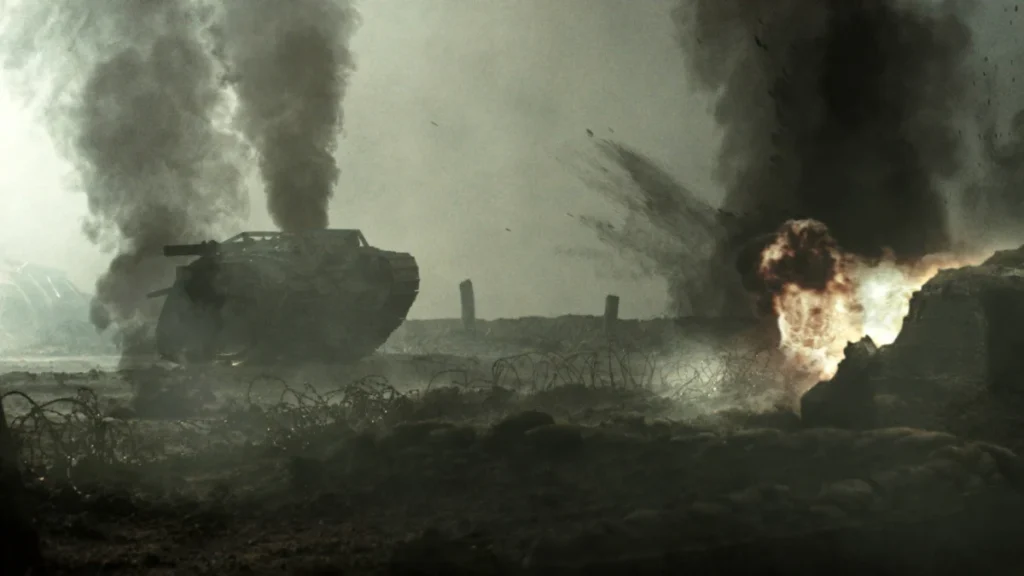

Kaleidoscope Entertainment has released the first full trailer for Landship, a British World War I action film that delves into the brutal realities of early mechanized warfare. Directed by Callum Burn, known for his previous war dramas Lancaster Skies, Spitfire Over Berlin, and Battle Over Britain, the film promises a gritty portrayal of a pivotal moment on the Western Front. The trailer offers a glimpse into the claustrophobic and perilous existence of a nine-man British MKIV tank crew as they undertake a perilous mission during the Battle of Passchendaele in 1917. The film is slated for a UK cinema release on June 26th, 2026, with no U.S. release date announced as of yet.
The narrative centers on the intense ordeal of a British MKIV tank crew facing overwhelming odds. Their objective is to breach heavily fortified German positions, a task fraught with danger from artillery, machine-gun fire, and the unforgiving terrain of No Man’s Land. The trailer depicts a critical moment where their formidable tank becomes immobilized, trapped in a shell crater mere yards from enemy lines. This precarious situation escalates the internal conflict, forcing the crew to confront not only the external threat of the enemy but also the internal battles of starvation, shellshock, and the psychological toll of prolonged trench warfare.
The Brutality of the Somme and Passchendaele
The setting of the film, the Battle of Passchendaele, also known as the Third Battle of Ypres, was one of the most horrific and costly campaigns of World War I. Fought from July to November 1917, the battle was characterized by relentless rain, which turned the battlefield into a quagmire of mud, making movement for men and machines incredibly difficult. This environmental devastation compounded the already immense casualties inflicted by artillery bombardments and machine-gun fire.

The introduction of tanks, like the British MKIV featured in Landship, was a significant, albeit still developing, aspect of warfare during this period. These early armored vehicles were designed to overcome the stalemate of trench warfare by breaking through barbed wire defenses and suppressing enemy strongholds. However, they were far from invincible. Their mechanical reliability was often questionable, and they were vulnerable to direct artillery hits, anti-tank rifles, and even the treacherous mud, which could immobilize them. The MKIV, a successor to earlier models, was an improvement but still suffered from significant limitations, including poor visibility, cramped conditions, and a reliance on its crew to operate its various functions under extreme duress.
The MKIV Tank: A Symbol of Evolving Warfare
The British MKIV tank, a key element in Landship, represented a significant advancement in military technology at the time. Introduced in 1917, it was a direct response to the battlefield challenges faced in the early years of the Great War. The MKIV came in two main variants: the "Male" armed with six-pounder guns and Maxim machine guns, and the "Female" armed with only machine guns. Both were designed to provide mobile firepower and protection for infantry assaults.
Key features of the MKIV included its distinctive rhomboidal hull shape, which allowed it to traverse trenches and rough terrain more effectively. It was powered by a 105-horsepower engine, capable of speeds of around 3.7 mph on level ground. Despite its imposing appearance and relative protection, the interior of a MKIV tank was an inferno of noise, heat, and fumes. The crew, typically numbering eight to ten men, had to contend with deafening engine noise, the acrid smell of oil and exhaust, and extreme temperatures, especially during combat. Communication within the tank was difficult, and coordination with infantry outside was a constant challenge. The psychological impact of being inside such a metal behemoth, hurtling towards the enemy under fire, cannot be overstated. The vulnerability of these machines, especially when bogged down or disabled, would have been a constant source of anxiety for their crews.
A Glimpse into the Film’s Narrative
The trailer for Landship emphasizes the human element within the mechanical war machine. The crew, comprised of Vin Hawke, David Dobson, Matthew Canny, Jack Sherlock, Micky David, Ricky Oakley, Daniel Cornish, and Sam Dowdy, are portrayed as seasoned soldiers facing an existential threat. The line, "You’re looking at the finest tank crew in the entire British army," delivered with a mix of pride and defiance, sets the tone for their resolve.

The film’s synopsis highlights the arduous journey of these nine men. Their mission to destroy German bunkers, a crucial objective in breaking enemy lines, becomes a desperate fight for survival when their tank, the "Landship," becomes mired. The description of their predicament – "trapped in a shell crater just yards from enemy lines" – paints a vivid picture of their isolation and vulnerability. The ensuing struggle against starvation, shellshock, and relentless enemy fire underscores the film’s commitment to depicting the harsh realities of WWI combat.
Director Callum Burn’s previous work on films like Lancaster Skies suggests a focus on historical accuracy and the personal stories of soldiers in wartime. His recurring collaboration with screenwriter Andrew Burn also indicates a consistent thematic approach to war cinema, often highlighting themes of courage, camaraderie, and the human cost of conflict. The choice to focus on a tank crew offers a unique perspective on the Great War, moving beyond the traditional infantry-centric narratives to explore the nascent but increasingly vital role of armored warfare.
Historical Context and Implications of Early Tank Warfare
The deployment of tanks in World War I marked a turning point in military history, fundamentally altering the landscape of land combat. The initial introduction of tanks by the British at the Battle of the Somme in 1916 was met with a mixture of awe and skepticism. While their potential was evident, early models were plagued by mechanical failures and limited effectiveness. However, by 1917, with advancements like the MKIV, tanks were becoming a more reliable and impactful weapon.
The strategic implications of successful tank operations were significant. They offered the potential to break through entrenched enemy lines, overcome machine-gun nests and artillery positions, and provide mobile support for advancing infantry. The psychological impact on enemy troops, who had never before faced such formidable armored vehicles, was also considerable. For the crews themselves, however, the experience was one of extreme peril. Confined within a metal shell, subjected to deafening noise, intense heat, and the constant threat of enemy fire, their bravery and resilience were tested to the absolute limit.

The scenario depicted in Landship – a disabled tank trapped behind enemy lines – was a very real danger. Such situations often resulted in the heroic but often futile last stands of tank crews, who would fight to the bitter end against overwhelming odds. The film’s focus on the internal struggles of the crew, including shellshock, speaks to the profound psychological impact of prolonged exposure to combat, a phenomenon increasingly recognized and studied during and after World War I.
Kaleidoscope Entertainment’s War Film Portfolio
Kaleidoscope Entertainment has established itself as a key player in the production and distribution of British war films. Their consistent output of historical dramas, often focusing on specific campaigns or iconic aircraft and vehicles, suggests a dedication to bringing these narratives to a wider audience. Films like Lancaster Skies, which chronicled the bravery of bomber crews during World War II, and Spitfire Over Berlin, detailing aerial combat, have resonated with audiences interested in military history.
Landship fits squarely within this established niche. By focusing on the operational deployment of the MKIV tank during a pivotal, yet often overshadowed, campaign like Passchendaele, the film aims to provide a fresh perspective on the Great War. The choice to center the narrative on a specific crew and their struggle for survival within the confines of their tank allows for a more intimate and intense exploration of the human experience of war.
The film’s release date in June 2026 places it in a competitive summer movie season, but its niche appeal and historical subject matter may attract a dedicated audience. The absence of a confirmed U.S. release date suggests that distribution strategies are still being finalized, a common practice for independent productions. However, the trailer’s quality and the film’s thematic resonance indicate potential for international appeal.

The Future of Historical War Dramas
The continued interest in World War I films, despite the proliferation of World War II narratives, speaks to the enduring fascination with the "war to end all wars." The unique nature of trench warfare, the advent of new technologies like tanks and aircraft, and the sheer scale of the human tragedy continue to provide fertile ground for storytelling. Films like Landship contribute to this growing body of work by shedding light on specific, often overlooked, aspects of the conflict.
The success of such films often hinges on their ability to balance historical accuracy with compelling human drama. By focusing on the intense, claustrophobic experience of a tank crew, Landship appears poised to deliver a visceral and emotionally resonant portrayal of warfare. The challenges faced by the crew, from mechanical failure to psychological trauma, are universal themes that transcend the specific historical context.
As Landship prepares for its UK release, audiences can anticipate a film that not only showcases the brutal realities of early armored warfare but also delves into the resilience, courage, and ultimate humanity of the soldiers who fought on the front lines of the Great War. The trailer suggests a film that honors the sacrifice of those who served, offering a powerful reminder of the profound impact of conflict on individuals and the relentless pursuit of survival against overwhelming odds.