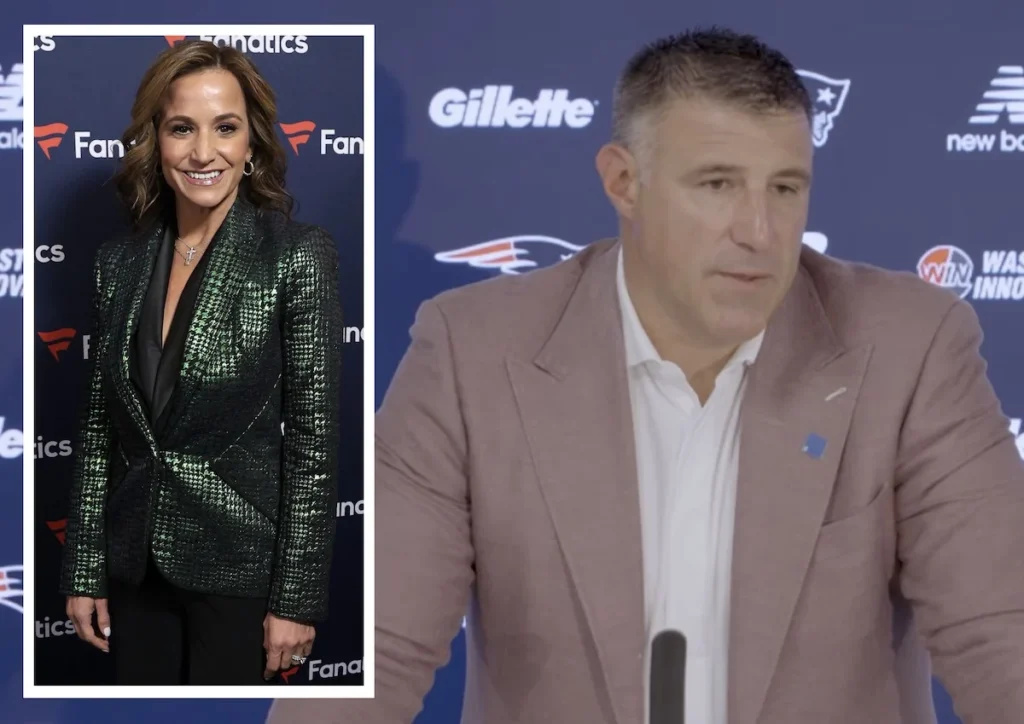

A peculiar situation, highlighted by a recent report, has brought into sharp focus the often-awkward timing inherent in media cycles, particularly when pre-planned narratives collide with unforeseen personal controversies. The scenario described involves a hypothetical Boston Magazine cover story celebrating Mike Vrabel as the New England Patriots head coach, lauded as Boston’s most influential figure following a fictional triumphant 2025 season that saw the team reach the Super Bowl, with rookie quarterback Drake Maye nearly securing MVP honors. This celebratory portrayal, as presented by the original source, starkly contrasts with real-world allegations concerning Vrabel’s personal life, specifically a rumored affair with NFL reporter Dianna Russini, which had been circulating widely just as the magazine’s hypothetical issue would have been released. The dissonance between this envisioned public acclamation and the unfolding private drama has generated significant online commentary, underscoring the complexities of public perception in the digital age.
Background Context: The Mike Vrabel Saga
To fully appreciate the layered irony of this hypothetical media portrayal, it is crucial to understand Mike Vrabel’s real-world standing and recent trajectory within the National Football League, alongside the context of the allegations against him. Mike Vrabel is a deeply respected figure in New England, having been a formidable linebacker for the Patriots during their early 2000s dynasty, winning three Super Bowls. His playing career was marked by versatility, intelligence, and a relentless competitive spirit, making him a fan favorite and a foundational piece of one of the NFL’s most successful franchises.
Following his illustrious playing career, Vrabel transitioned into coaching, steadily climbing the ranks. He served as a defensive assistant for the Kansas City Chiefs before moving to the Houston Texans, where he eventually became defensive coordinator. His success there led to his appointment as the head coach of the Tennessee Titans in 2018. During his tenure with the Titans, Vrabel transformed the team into a consistent playoff contender, known for its physical style of play and strong defensive identity. He earned NFL Coach of the Year honors in 2021, cementing his reputation as one of the league’s top strategists and motivators. However, after a challenging 2023 season, Vrabel was unexpectedly dismissed by the Titans in January 2024. His availability immediately sparked widespread speculation about his potential return to New England, particularly given the Patriots’ subsequent decision to part ways with long-time head coach Bill Belichick. While the Patriots ultimately hired Jerod Mayo, Vrabel’s connection to the franchise and the region remained strong, making him a perpetually relevant figure in Boston sports discussions.
Drake Maye, the other figure prominently featured in the hypothetical Boston Magazine cover, is a highly touted quarterback prospect from the University of North Carolina. He was selected by the New England Patriots with the third overall pick in the 2024 NFL Draft, marking a new era for the franchise. His arrival is seen as a pivotal moment for the Patriots, tasked with revitalizing an offense that has struggled since Tom Brady’s departure. The original report’s suggestion of Maye nearly achieving MVP honors in a fictional 2025 season, leading the Patriots to the Super Bowl, reflects the high expectations and hopes placed upon him by the fan base and the organization.
The contrasting element in this scenario is the emergence of significant allegations concerning Vrabel’s personal life. In late April and early May 2024, reports and social media discussions began to circulate widely regarding a rumored affair between Vrabel and NFL Network reporter Dianna Russini. The allegations, which gained traction across various online platforms and gossip sites, suggested an ongoing relationship and even claimed that spouses of the involved parties had allegedly hired private investigators to gather evidence. While these claims remain unconfirmed by Vrabel or Russini, and are subject to the inherent unreliability of internet speculation, their pervasive nature ensured they became a prominent topic of public discussion. Several sports journalists and commentators alluded to the situation, with some claiming it had been an "open secret" within NFL circles, further fueling the public’s interest and the sense of an unfolding scandal.
The Boston Magazine Scenario: A Hypothetical Public Acclaim
The core of the reported irony lies in a hypothetical Boston Magazine profile, which, according to the original source, would have crowned Mike Vrabel as its "most influential Bostonian" in an upcoming May issue. This feature would have depicted Vrabel, alongside rookie quarterback Drake Maye, grinning confidently on the magazine’s cover, celebrating a fictional, highly successful 2025 season where the New England Patriots had clawed their way back to the Super Bowl spotlight. Such a narrative—a triumphant return of a beloved figure, leading his former team to glory with a promising young star—is precisely the kind of feel-good story that regional publications often feature to resonate with their local readership.
Boston Magazine is a prominent regional publication, known for its in-depth journalism, lifestyle coverage, and influential lists, such as its annual "Most Influential Bostonians." These lists typically highlight individuals who have made significant contributions to the city’s culture, economy, and public life. The editorial process for such comprehensive features and cover stories is usually extensive, involving weeks, if not months, of planning, interviews, photo shoots, and writing. This long lead time means that content is often finalized and sent to print well in advance of its actual publication date.
In the hypothetical scenario presented by the original report, this standard editorial timeline becomes central to the perceived awkwardness. The Boston Magazine team would have conceived, produced, and finalized the celebratory Vrabel feature long before the allegations concerning his personal life became widely publicized. This pre-production timeline offers the most plausible explanation for the complete absence of any mention of the unfolding controversy within the magazine’s content. A publication of Boston Magazine‘s stature would typically adhere to journalistic integrity, and either be unaware of emerging rumors during its production phase, or, if aware, might deem them unverified and outside the scope of a pre-planned celebratory profile focused on professional achievements. The alternative, as suggested by the original source, would be a "very deliberate choice to stick to football," effectively ignoring a burgeoning public scandal, a decision that would carry its own set of journalistic implications.
Chronology of Contradiction: A Timeline of Events
The reported juxtaposition can be understood through a simplified timeline, blending the hypothetical elements of the Boston Magazine story with the real-world emergence of the allegations:
- Winter/Early Spring 2024 (Hypothetical Boston Magazine Production): Following Mike Vrabel’s real-world departure from the Titans and the Patriots’ real-world drafting of Drake Maye, Boston Magazine hypothetically conceives and executes a cover story. This feature is based on the premise of Vrabel being the Patriots’ head coach, leading them to a fictional successful 2025 season, a narrative designed to capitalize on local excitement and Vrabel’s strong ties to the region. Interviews are conducted, photos are shot, and the article is written and sent to print.
- Late April / Early May 2024 (Real-World Allegations Emerge): Reports and widespread social media discussions begin to surface regarding alleged personal conduct involving Mike Vrabel and Dianna Russini. These allegations rapidly gain public attention, fueled by online speculation and commentary from various media personalities.
- May 2024 (Hypothetical Publication): The Boston Magazine issue, with its celebratory portrayal of Vrabel as a triumphant Patriots coach, is hypothetically released to the public. The timing of this publication, coinciding with the peak of the personal controversy, creates an immediate and striking contrast.
- Immediate Public Reaction (Real, as described by source): Social media platforms, particularly Instagram where the magazine’s cover would likely be promoted, are flooded with comments from users highlighting the perceived incongruity. Fans and observers quickly point out the "wild timing" and the stark difference between the magazine’s narrative and the ongoing public discourse surrounding Vrabel’s personal life.
This chronology illustrates the inherent challenge for media outlets with long production cycles. While the magazine’s content would have been a testament to Vrabel’s professional achievements and local significance, its release during a period of intense scrutiny over his personal conduct transforms the narrative from one of pure celebration to one fraught with implicit tension.
Public Perception and Media Dissonance
The "elephant in the room" described by the original report—the complete absence of any mention of Vrabel’s alleged off-field drama in the Boston Magazine profile—became the focal point of public commentary. In an era of instant news and pervasive social media, the public is highly attuned to perceived inconsistencies and omissions in media narratives. The internet, particularly platforms like Instagram, provided an immediate forum for collective expression, with users quick to connect the dots between the celebratory magazine cover and the ongoing personal controversy.
The reactions described by the source underscore a broader trend in public consumption of news: a demand for immediacy and comprehensive context. When a major publication releases content that appears disconnected from current, widely discussed events, it often triggers a wave of skepticism and criticism. Comments on social media, as cited by the original report, ranged from simply pointing out the "jarring" contrast to more pointed observations about the "unreal" timing. This collective public response highlights the difficulty for public figures to control their narrative, especially when different facets of their lives—professional triumphs and personal challenges—unfold simultaneously but are reported on different timelines.
For traditional media outlets, this situation presents a significant dilemma. Publications with long lead times, like monthly magazines, are particularly vulnerable to such timing clashes. Once an issue is sent to print, making substantive changes to reflect breaking news or emerging controversies becomes logistically and financially prohibitive. The choices are limited: proceed with the pre-planned content and risk appearing out of touch, or, in extreme cases, attempt to pull or significantly alter an issue, incurring substantial costs and delays. The Boston Magazine scenario, even if hypothetical in its specifics, epitomizes this challenge. The choice to "stick to football," as suggested by the original source, is a common editorial strategy in such situations, aiming to maintain focus on the intended subject matter. However, as evidenced by the hypothetical public reaction, such a strategy can inadvertently amplify the very issue it seeks to avoid by creating a glaring omission that the audience cannot ignore.
Analysis of Implications
The hypothetical situation surrounding Mike Vrabel and Boston Magazine carries several implications for public figures, media organizations, and the broader landscape of information dissemination.
Impact on Vrabel’s Public Image: For Mike Vrabel, even in this hypothetical scenario, the juxtaposition of a celebratory public profile with ongoing personal allegations could complicate his public image. While the magazine article would highlight his professional achievements and local hero status, the concurrent controversy could overshadow these positive narratives. Public figures often face the challenge of managing both their professional persona and their private life under intense scrutiny. When these two spheres collide in a high-profile manner, it can lead to a perception of hypocrisy or a loss of credibility, regardless of the veracity of the allegations. The difficulty of controlling one’s narrative in the age of rapid information spread means that even pre-produced positive stories can be recontextualized by breaking news.
Media Responsibility and Timing: The scenario underscores the increasing pressure on media outlets to be current and comprehensive, even when dealing with content that has long production cycles. While Boston Magazine‘s hypothetical editorial process would be standard, the public’s expectation for immediate and contextualized information is growing. This raises questions about how publications can adapt their strategies to mitigate such timing conflicts, perhaps by implementing more flexible editorial calendars or including disclaimers when unforeseen events impact a published story. The "open secret" phenomenon, where allegations circulate within certain circles before becoming public, also poses a challenge: at what point do rumors become sufficiently credible or widespread for a publication to address them, even if only to acknowledge their existence, within a profile?
The Role of Social Media: Social media platforms are highlighted as critical amplifiers of public sentiment. They enable immediate, collective reactions to perceived media missteps or disconnections, creating a parallel narrative that can significantly influence how traditional media content is received. The speed at which Instagram comments or Twitter discussions can generate a counter-narrative means that publications must be increasingly aware of the broader information ecosystem in which their content is released.
Future of Vrabel and Maye (Real Context Reiteration): It is important to reiterate that in the real world, Mike Vrabel is not currently the head coach of the New England Patriots, and Drake Maye is a rookie quarterback yet to play an NFL snap. Vrabel is currently unemployed, having been a sought-after candidate for several NFL head coaching positions that ultimately went elsewhere. The allegations concerning his personal life represent a real-world challenge to his public standing, separate from any hypothetical professional triumphs. For Drake Maye, his actual status as a promising rookie remains untainted by these specific controversies, as he is merely a hypothetical participant in the magazine’s fictional celebration. The implications for Maye in the real world are solely tied to his performance on the field and his development as an NFL quarterback.
In conclusion, the hypothetical Boston Magazine cover story featuring Mike Vrabel, as described by the original report, provides a compelling illustration of the intricate dance between public image, media timelines, and the unpredictable nature of personal lives. While the specific details of the magazine’s content are fictional, the underlying tension—the clash between a curated narrative of professional success and the unfolding reality of personal controversy—is a very real challenge faced by public figures and media organizations alike in the contemporary information landscape. It serves as a reminder that in an interconnected world, the timing of a story can sometimes be as impactful as the story itself.