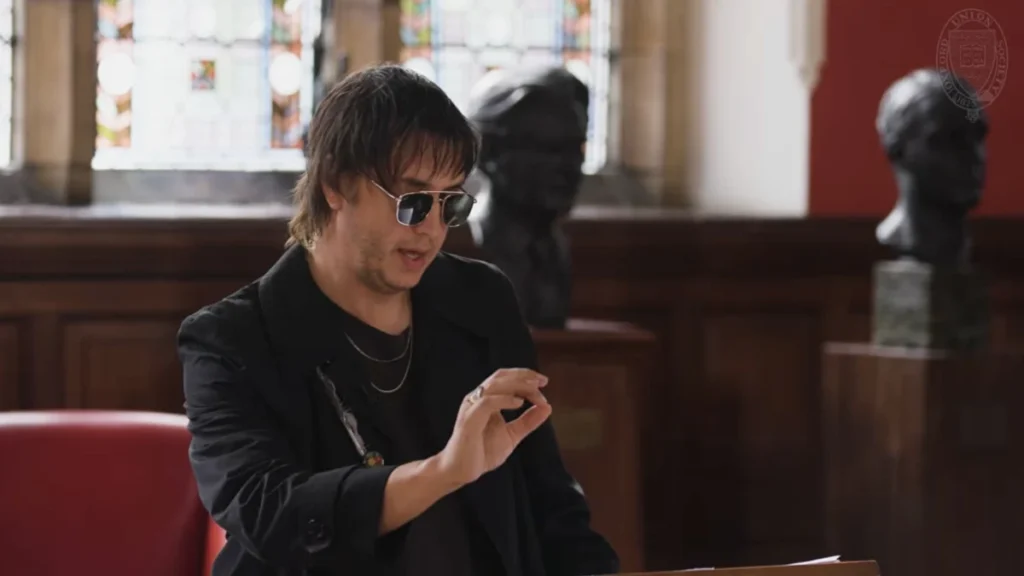

Julian Casablancas, the enigmatic frontman of The Strokes, has further elaborated on his controversial assertions regarding "white privileged American Zionists" and their perceived appropriation of victimhood narratives, in a newly released video of a speech delivered at the venerable Oxford Union debating society. The address, originally given in May 2024 but made public on YouTube on a recent Friday, provided a platform for Casablancas to refine and deepen the perspective he first articulated during an April appearance on the podcast SubwayTakes with Kareem Rahma, where he was prompted to share his most contentious opinion.
The Genesis of the Controversy: SubwayTakes Remarks
The initial spark of contention ignited during Casablancas’s segment on SubwayTakes, a series known for eliciting bold and often provocative statements from its guests. When asked for his most controversial take, Casablancas declared, "American Zionists get the benefits of white privileged people but talk like they are Black people during slavery." He subsequently addressed the Hamas attack in Israel on October 7th, 2023, acknowledging its reprehensibility but drawing historical parallels: "But Native American rebellions didn’t mean it was okay to do what we did. Slave rebellions that were violent didn’t mean that slavery is not bad." These comments swiftly garnered significant attention across social media and various news outlets, polarizing audiences and prompting accusations of insensitivity and historical distortion. The comparison of modern Zionists to historical victims of slavery and genocide immediately thrust Casablancas into a heated debate surrounding identity, historical trauma, and contemporary geopolitics.
The Oxford Union Address: Clarification and Nuance
In his Oxford Union speech, Casablancas explicitly sought to clarify and contextualize his earlier remarks, acknowledging the potential for misinterpretation inherent in concise, unedited podcast segments. He stated, "So what I should have said in the subway take thing maybe — let’s call it settler style Zionist expansionist and maybe some good hearted indoctrinated moderates — when they’re talking in this kind of victim language, (it) is weird because they get many of the perks of white privilege and in America . . . But speak like they are Black people during slavery . . . So I was not talking to my friends who say Israel has the right to exist." This clarification aimed to distinguish between a general belief in Israel’s right to exist and what he termed "settler style Zionist expansionism," emphasizing that his criticism was directed at a specific ideological stance rather than Zionism in its entirety or Jewish people broadly.
Broader Philosophical Underpinnings: The Erosion of Meaning
Casablancas prefaced his detailed explanation by outlining a broader concern about the state of modern political discourse. He posited that words have increasingly lost their precise meaning, particularly in politically charged discussions, leading to what he described as "endless rage bait circles." This erosion of linguistic integrity, he argued, hinders constructive dialogue and perpetuates cycles of anger and misunderstanding. For Casablancas, "Zionism" itself has become one such word, its multifaceted definitions often collapsed into a monolithic, frequently weaponized, term. This observation resonates with wider concerns about political polarization and the impact of social media on nuanced communication, where complex issues are often reduced to soundbites and hashtags, losing their historical and contextual depth.
Deconstructing Zionism: Expansion as the "Nerve Point"
The core of Casablancas’s Oxford address revolved around his attempt to dissect the term "Zionism." He emphasized that his critique was not an indictment of Jewish identity or the existence of Israel, but rather a specific aspect he identifies as "expansion." He unequivocally condemned antisemitism, stating, "Discrimination obviously is vile. And I think antisemitism is stupid and small-minded and vile. Many of my most dearest friends happen to be Jewish, and some are the most moral, bright, wonderful people I’ve ever known. If you’re Jewish or Muslim or anything other than a Nazi type, wonderful. You are my brother. Be proud. Devout. You should love Israel, and I want to be able to go there, and I want to know it’s going to be a safe place. And that’s all well and good at this point."
However, he immediately pivoted to what he sees as the problematic interpretation of Zionism: "Now in terms of dividing up the word Zionism, I think the true nerve point really comes down to one thing, and that is ‘expansion.’ Expansion is the key concept, I think, more than a vague nationalism or love of a country — meaning Israel settlements and greater Israel." To illustrate his point, he drew parallels with other nationalisms: "You can love England and want its inhabitants safe without wanting it to control India, for example. The greater America project is insane to me, but I don’t feel the need to be defensive ’cause I’m American. I can differentiate. I can say ‘it’s fucked.’ I can say (larger) reparations are . . . far overdue." This analogy suggests that a love for one’s nation does not inherently necessitate support for its territorial expansion or historical injustices, thereby attempting to separate national pride from colonialist or expansionist ideologies.
The "Genocide" Litmus Test and "Dog Whistles"
Casablancas further posited that in contemporary discourse, a critical "litmus test" for identifying an "ally of peace" regarding the Israeli-Palestinian conflict is the willingness to acknowledge the possibility of "genocide toward Palestinians." He asserted that for many peace activists, such an acknowledgment is a prerequisite for moving forward in unity. He elaborated on this, saying, "However, from the perspective even of Jewish peace activists, if there is a weird reciting of certain propaganda points, which includes not being able to say it’s a genocide, it’s kind of akin to not being able to say Black Lives Matter. You’re showing you maybe don’t quite get what the issue is . . . If the only thing you can bring yourself to say is ‘Netanyahu is the problem’ or ‘Well, I believe Israel has the right to exist,’ you are perhaps accidentally signaling to some that you indirectly, maybe by accident, whoopsie, are supporting Jewish supremacy and white supremacy in a sense. It is a sort of dog whistle to those who are fighting to see basic equal rights for any and all."
This particular assertion, linking a reluctance to use the term "genocide" to "Jewish supremacy and white supremacy," is perhaps the most provocative aspect of his Oxford speech. It delves into the complex and emotionally charged debate surrounding the terminology used to describe the Palestinian experience, particularly in the context of the ongoing conflict and the humanitarian crisis in Gaza. The term "genocide" itself is subject to intense legal and political dispute, with international bodies and legal scholars holding differing views on its applicability to the situation. By framing this as a "dog whistle," Casablancas implies a coded message understood by those within certain ideological frameworks, suggesting that seemingly innocuous statements can inadvertently align with broader systems of oppression.
Distinguishing "Green Liners" from "Expansionists"
To further refine his position, Casablancas introduced a distinction between "green liners" and "expansionists." He identified himself as a "green liner," advocating for Israel’s borders to be set according to internationally recognized boundaries, implicitly referencing the pre-1967 borders. In contrast, he described "expansionists" as those who seek a "Greater Israel," extending beyond these lines, and attributed much of the turmoil in the Middle East to this latter ideology. This distinction is crucial for understanding the nuances of the debate surrounding the Israeli-Palestinian conflict, which often centers on land, settlements, and the vision for the future of the region. The "green line" represents a foundational concept in the two-state solution framework, while "Greater Israel" typically aligns with more right-wing and religious Zionist movements that envision Israeli sovereignty over all historical land, including the West Bank.
The Oxford Union: A Stage for Contentious Dialogue
The Oxford Union, founded in 1823, is one of the world’s most prestigious debating societies, renowned for its tradition of hosting prominent figures from politics, academia, and the arts, often inviting them to discuss controversial topics. Its role as a forum for free speech, even on highly sensitive subjects, aligns with its mission to promote debate and critical thinking. Casablancas’s appearance fits squarely within this tradition, offering him a platform to expand on remarks that might otherwise be confined to the ephemeral nature of a podcast soundbite. The Union’s historical significance and its global reach lend a certain gravitas to the statements made within its hallowed halls, amplifying their potential impact and scrutiny.
The Broader Context of Celebrity Activism and Geopolitical Discourse
Julian Casablancas’s foray into the complexities of the Israeli-Palestinian conflict is indicative of a broader trend of celebrities engaging with geopolitical issues, often using their platforms to voice opinions that resonate with or challenge public sentiment. While such engagement can raise awareness and galvanize support for various causes, it also frequently draws criticism regarding the depth of understanding and the potential for oversimplification of intricate historical and political realities. Public figures, by virtue of their visibility, often find their statements scrutinized under a microscope, with every word analyzed for its implications and potential impact.
The terms and concepts Casablancas invoked – Zionism, white privilege, slavery, genocide, expansionism, dog whistles – are all deeply embedded in academic, political, and social justice discourse. Each carries significant historical weight and contemporary relevance, and their application to the Israeli-Palestinian conflict is a source of ongoing, fervent debate.
- Zionism: Historically, Zionism is the national movement of the Jewish people that supports the re-establishment of a Jewish homeland in the territory defined as the historic Land of Israel. While its core tenet is the right to Jewish self-determination, it has evolved into various forms, from secular political Zionism to religious Zionism. Critics often conflate certain interpretations of Zionism, particularly those associated with settlement expansion and the occupation of Palestinian territories, with colonialism or apartheid.
- White Privilege: This concept refers to the societal advantages, benefits, and courtesies that come with being a member of the dominant racial group in many Western societies. Casablancas’s application of this to "American Zionists" suggests a belief that certain individuals leverage their racial identity to dismiss or diminish the suffering of others, while simultaneously claiming victimhood status.
- Genocide: As defined by the UN Genocide Convention, genocide involves acts committed with intent to destroy, in whole or in part, a national, ethnical, racial or religious group. The debate over whether the actions in Gaza constitute genocide is highly contentious, with many international law experts and human rights organizations differing in their assessments. Casablancas’s assertion that acknowledging "genocide toward Palestinians" is a litmus test reflects a viewpoint common among pro-Palestinian activists, while many pro-Israel groups vehemently reject the term as a baseless accusation.
- Expansionism and Settlements: The issue of Israeli settlements in the West Bank and East Jerusalem is a central point of contention in the Israeli-Palestinian conflict. Most of the international community considers these settlements illegal under international law and an obstacle to peace, particularly to the viability of a two-state solution. Casablancas’s distinction between "green liners" and "expansionists" highlights this critical divide.
Analysis of Implications
Casablancas’s decision to clarify his remarks at Oxford, rather than retracting them, indicates a firm commitment to his perspective, albeit one refined for a more formal setting. His speech underscores the challenges of discussing complex geopolitical issues, particularly for public figures who may lack the academic or diplomatic background of traditional commentators. While his analogies and terminology are likely to continue to draw criticism from some quarters, particularly those who perceive his statements as anti-Israel or historically insensitive, they also resonate with segments of the public and activist communities who advocate for Palestinian rights and criticize Israeli government policies.
The episode highlights the ongoing struggle for clarity and nuance in highly polarized discussions. It also demonstrates the power of celebrity platforms to amplify specific narratives, potentially shaping public opinion and contributing to the broader discourse surrounding one of the world’s most intractable conflicts. As The Strokes continue their tour, these statements will undoubtedly remain a talking point, underscoring the intertwining of art, activism, and global politics in the modern era.
Julian Casablancas’s extended commentary at Oxford represents a significant articulation of his views on Zionism, the Israeli-Palestinian conflict, and the broader state of political discourse. By distinguishing between different forms of Zionism and emphasizing the concept of "expansion" as a central concern, he sought to refine his controversial initial statements. However, his continued use of analogies and specific terminology, particularly regarding "white privilege," "genocide," and "dog whistles" relating to "Jewish supremacy," ensures that his remarks will remain a subject of intense debate and scrutiny. The incident serves as a poignant reminder of the complexities inherent in discussing such sensitive topics, especially when filtered through the lens of celebrity and public platforms.